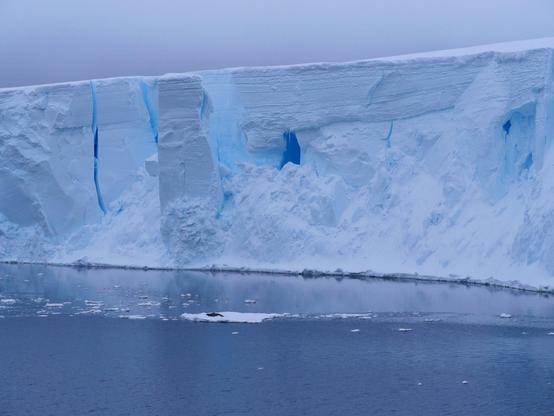
As today is UN World Day for Glaciers I'm taking the opportunity to post this reminder that the main reason nobody can confidently predict how much sea-level will rise over the rest of this century and beyond is "deep uncertainty in ice sheet processes" (IPPC AR6). The biggest uncertainty is how quickly ice will be lost from regions where the ice sheet bed is below sea level. The most immediate risk comes from the Amundsen Sea sector of the West Antarctic Ice Sheet and #ThwaitesGlacier in particular. Thwaites has been losing ice at an accelerating rate over the past three decades. It is the fastest changing large glacier in #Antarctica and, because its bed gets deeper towards the interior of the ice sheet, it is the most vulnerable.
Here is a link to a thread I posted previously summarising some key findings from research conducted by the International Thwaites Glacier Collaboration.
https://fediscience.org/@PoLaRobs/115441900033252024
#WorldDayOfGlaciers
#Glacier
#sealevel
#Algae Growth on #Greenland’s #Ice Contributes to Melting, Studies Show
New studies show how algae grows on ice and snow, creating “dark zones” that exacerbate melting in the region.
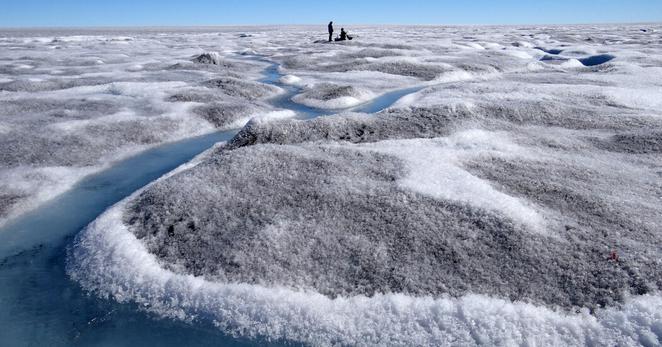
As a warming #climate eats away at the ice that covers most of the world’s largest island, algae blooms are speeding up that process, according to two new studies. Greenland is shedding hundreds of billions of tons of ice every year and raising #sealevel as it does.
https://www.nytimes.com/2026/01/30/climate/greenland-algae-melting-icesheet.html
https://archive.ph/wtlgu
Algae Growth on Greenland’s Ice Contributes to Melting, Studies Show

New studies show how algae grows on ice and snow, creating “dark zones” that exacerbate melting in the consequential region.

The New York Times

Visual poetry: Footsteps and tyretracks (at about 03:20)

https://youtu.be/40r-UyVyqFw

#sealevel #generations

Hoe lang houdt Nederland het hoofd nog boven water? | VPRO Tegenlicht

YouTube
“The fact that geoid models are developed and performing relatively well in reflecting local sea-level height in the Global North (for example, the United States and Western Europe) may perhaps explain the overconfidence placed in geoid-model performance by Global-North-based scientists when performing assessments on a global scale or in other regions of the world in which geoid models perform less well.” 1/2

#SeaLevel #Modeling #ColonialAttitudes

https://doi.org/10.1038/s41586-026-10196-1

When the Shoulders Of Giants are too high, scientists overlook observations on the ground. In this case, satellite-derived gravity models and altimeters, and the computer simulations they got fed into, mis-measure and miscalculate coastal land elevation and sea level.
https://www.nature.com/articles/s41586-026-10196-1

The 2 sea level models most commonly used for hazard evaluation underestimate MOST local sea levels by one to several metres, the rest of the coasts are experiencing less than half a meter more than the models told us, and then there are regions where sea level is lower than in the common models. These regions are in the #Arctic and #Antarctic. And in the Mediterranean, go figure! (So yay, your coasts are higher than previously thought, dear Greece and Italy, but increasing destruction during flooding in winter storms makes up for this.)

This mis-informs policy makers and engineers wrt adaptation – and its funding. Money is especially relevant because the biggest under-estimate is in SE-Asia.

Interestingly, the North American #Atlantic coast shows zero discrepancy. But I reckon, this is due to the model used ( 🙈 ) for the comparison, and how this model has a completeness-bias toward the N-Am East Coast.

#ClimateChange #SeaLevel #SeaLevelRise

Sea level much higher than assumed in most coastal hazard assessments - Nature

Meta-analyses on a global scale show that the measured coastal mean sea level is higher than assumed in most coastal hazard assessments.

Nature
"Globally, the research found ocean levels are an average of 30cm higher than previously believed, but in some areas of the global south, including south-east Asia and the Indo-Pacific, they may be 100-150cm higher than previously thought."
#climate #climatechange #sealevel #environment
https://www.theguardian.com/environment/2026/mar/04/global-sea-levels-underestimated-poor-modelling-research
Global sea levels have been underestimated due to poor modelling, research suggests

Analysis shows average levels are 30cm higher than thought, and up to 150cm in south-east Asia and Indo-Pacific

The Guardian

Whoops‼️Most sea level calculations are flawed, and our coastal population centers may be more screwed than thought…

“…more than 99% of the evaluated impact assessments handled sea-level and land elevation data inadequately, thereby misjudging sea level relative to coastal elevation. Based on our literature evaluation, 90% of the hazard assessments assume coastal sea levels based on geoid models, rather than using actual sea-level measurements. Our meta-analyses on global scale show that measured coastal sea level is higher than assumed in most hazard assessments…” #SeaLevel #Environment #ClimateChange #GlobalWarming #ClimateCrisis #ClimateEmergency #CoastalLiving #migration

https://www.nature.com/articles/s41586-026-10196-1

Sea level much higher than assumed in most coastal hazard assessments - Nature

Meta-analyses on a global scale show that the measured coastal mean sea level is higher than assumed in most coastal hazard assessments.

Nature

Committee on Earth Observation Satellites (CEOS) - Fleet - 2026 🛰️

#Atmospheric/oceanIndicators #ClimateIndicators #EarthInformationCenter #EarthScience #Oceans #Orbit #Satellite #SeaLevel

⏩ 2 new pictures and 2 new videos from NASA (SVS) https://commons.wikimedia.org/wiki/Special:ListFiles?limit=6&user=OptimusPrimeBot&ilshowall=1&offset=20260303125705

10) In a devastating climate milestone, Svalbard lost 1% of its total glacial ice during a single record-shattering heatwave in 2024. The Norwegian archipelago is warming faster than nearly anywhere on Earth. Scientists warn these extreme melt events are accelerating, with alarming consequences for global sea levels and fragile Arctic ecosystems.

#Svalbard #ClimateChange #GlacialMelt #Heatwave #ArcticWarming #SeaLevel #Norway #ClimateEmergency #Rorshok #ArcticUpdate