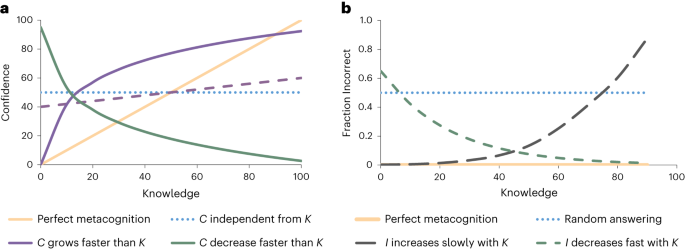
"Intermediate levels of scientific knowledge are associated with overconfidence and negative attitudes towards science", Lackner et al. 2023 https://www.nature.com/articles/s41562-023-01677-8
The Institute for Replication (#I4R) is collaborating with the publisher (Nature Human Behaviour) and has now produced a report on the above paper (https://osf.io/mg95t/files/mjs86 ) which is largely positive:
"LFMMG (2023) presents a computationally reproducible and largely robust finding. We re-implemented the full analytical pipeline and conducted thirty-one robustness checks with those results summarized in Table 8. There is much kudos to be given to the original authours* for making the process of replicating their work clear and worthwhile."
* typo in the original text of the report.

Lackner et al. show that individuals with an intermediate level of science knowledge tend to have overconfidence in their own knowledge and negative attitudes to science.
Relatedly, in the middle of the XX century the scientists that were responsible signed the paper as authors, and everyone else was listed in the Acknowledgements section.
That today we list everybody as "middle authors" is, on the one hand, a consequence of the "publish or perish" culture, and on the other, a way to bring visibility to people who did the actual work (I am thinking here of famous neuroscience papers were the actual work was done by non-PhD women technicians who were merely "acknowledged" instead of signing as first authors, which would have been the case today).
Further, in my own papers, I don't add anyone as author who hasn't read the whole paper and commented on it. As a bare minimum. Each contributor should know first hand what they are agreeing to endorse with their name, even if they couldn't do that work themselves without a lot of training.
I'm reading news of someone in academia complaining about the new no-AI policy by ArXiv that requires something as outlandish as co-authors to take responsibility for what gets published in a scientific paper and … I'm sorry, how is this unexpected?
Academic publishing has a lot of issues, but requiring people to actually read what they sign off to is not one of them.
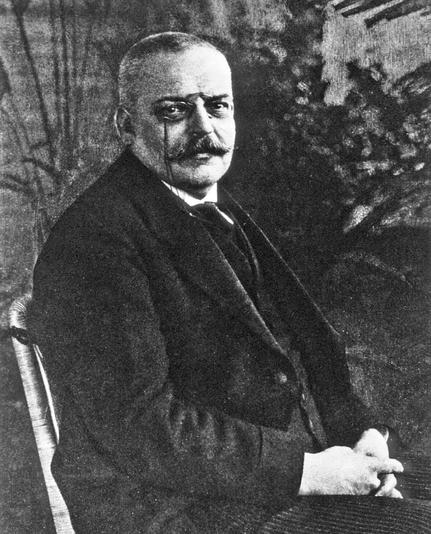
Scientific publishing has always been hard, and as always, it's about attention. Here is Dr. Alois Alzheimer trying to communicate his findings about dementia to his contemporaries 120 years ago:
"On 3 November 1906, Alzheimer discussed his findings on the brain pathology and symptoms of presenile dementia publicly, at the Tübingen meeting of the Southwest German Psychiatrists. The attendees at this lecture seemed uninterested in what he had to say. The lecturer that followed Alzheimer was to speak on the topic of "compulsive masturbation", which the audience of 88 individuals was so eagerly awaiting that they sent Alzheimer away without any questions or comments on his discovery of the pathology of a peculiar case of early-onset dementia."
https://en.wikipedia.org/wiki/Alois_Alzheimer
Thankfully, "Following his presentation, Alzheimer published a short paper summarizing his presentation; in 1907 he wrote a longer paper detailing the disease and his findings."
"... he used the newly developed Bielschowsky stain to identify amyloid plaques and neurofibrillary tangles. These brain anomalies became identifiers of what is now known as Alzheimer's disease."
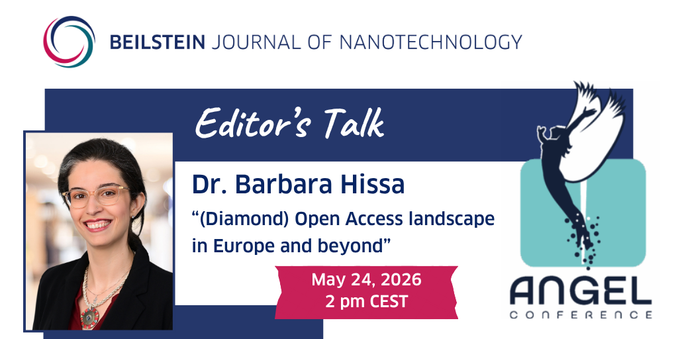
Our Managing Editor Dr. Barbara Hissa will give an online talk during the International Conference on Advanced Nanoparticle Generation and Excitation by Lasers in Liquids (ANGEL) on May 24, 2026 at 2 pm CEST. Barbara will talk about “(Diamond) Open Access landscape in Europe and beyond”.
➡️ https://angel-conference.org/program/
#EditorsTalk #EdiTours #ScientificPublishing #DiamondOpenAccess #OpenScience #BJNANO 💎🔓
You may not agree with this paper, but you should read it:
"Aging and the narrowing of scientific innovation", Cui et al. 2026 (James Evans lab)
https://www.science.org/doi/10.1126/science.ady8732
"Analyzing more than 12.5 million scientists who published between 1960 and 2020, we find that novelty—the linking of previously unconnected ideas—increases with academic age, whereas disruption—the replacement of established ideas with new ones—declines."
"The hard truth about how hard it is to publish in Development", Briscoe et al. 2026
https://journals.biologists.com/dev/article/153/1/dev205432/370214/The-hard-truth-about-how-hard-it-is-to-publish-in
"for the past 10 years, 35-45% of papers submitted to Development ultimately get published."
Find the centre Mersenne's funding data on the TSOSI platform: https://tsosi.org/entities/Q55606850
The centre Mersenne is participating in the TSOSI project and has chosen to publish its funding details. This project is still ongoing: new data will be published shortly.