other physicists, notably david albert, argued forcefully that krauss redefined “nothing” to mean something — quantum fields, laws of physics, spacetime itself. that’s not nothing.

no respectable physicist would even say -- 'the unstable nature of nothing gives rise to elementary particles. period. end of debate.' that's not how science works.

#science #qft #particles

We extended the numerical approximation scheme for modular Hamiltonian in quantum field theory and got new results for fermionic fields:

‘Numerical approach to the modular operator for fermionic systems’
http://arxiv.org/abs/2605.20001

#qft #quantumfield #modulartheory #modularHamiltonian

Numerical approach to the modular operator for fermionic systems

We numerically approximate the Tomita-Takesaki modular operator for local subalgebras of the 1+1-dimensional massive Majorana field. Our method works at the one-particle level with a discretisation of time-0 data in position space. The local subspaces we consider are associated with one double cone and with the disjoint union of two double cones. In order to avoid boundary effects, we primarily choose the overall spacetime to be a cylinder; different choices of boundary conditions (antiperiodic and periodic) are considered. We compare our numerical results to known analytic expressions in the massless case. It turns out that the modular operator has a non-trivial dependence on the mass. In the case of two double cones, the modular generator does not only have ''local'' contributions (supported on the diagonal in configuration space) but also ''bilocal'' terms (connecting the two double cone regions); we find the latter to be less prominent at higher masses, in line with expectations.

arXiv.org

There's topics and directions I wouldn't have even considered two years ago, that I'm now curious about. I do some quantum computing work, but I could see myself branching off in several directions over time.

My favorite courses so far were #QFT and statmech. I also find the emerging complex systems field fascinating. The remaining courses plus additional studies will likely add more.

That said, there does remain one thing I'd still do as a #compsci #phd, and that may actually be viable.

2/..

ITT: some personal thoughts about career and future.

I'm starting the ninth course in my #physics master's degree, plasma physics. I started this program because I have no physics undergrad, and wanted to build out my background.

At this point, I've been through the usual core curriculum, plus #QFT, nonlinear dynamics, and now finishing out with plasma, solid state, and quantum optics.

I've slowed some on the #phd front, because my interests have broadened particularly in the past year.

1/..

This is What Spin Actually Means in Quantum Physics

https://youtu.be/OmhGxljkKgI

(I have a new physicist crush.)

#Physics #QuantumPhysics #Spin #QFT

This is What Spin Actually Means in Quantum Physics

YouTube

WHAT’S REAL? “ACTION-BASED REALITY” (ABR) 


Are “virtual particles” real? What makes a real particle real? And what of Matter Waves? Are the waves real too? 

We need to define what “real” means. What is real? I propose that:

REAL = INTERACTION. If Object A changes the state of Object B, then Object A must be “real.”Actions (on another object) are real. An “ELEMENT OF REALITY” OCCURS WHEN AN ACTION OCCURS.

In the EPR paper of 1935, Einstein and Al. hypothesized that “elements of reality” were local, one could always separate observer from observed system. Now we know that this is not the case, in space, through various Bell-like experiments (and the formalism of Quantum Mechanics, which predicted it, the main point of the EPR 1935 paper was that the Quantum Mechanics formalism violated the Principle of Locality).

The definition of element of reality I propose here is vastly different from the one proposed by Einstein and Al. And the reason why it is vastly different is that the definition of “reality” proposed by Einstein and Al. does NOT work [1]. We have EXPERIMENTAL (not just theortetical) proof of it.

***

The famous COW (Colella, Overhauser, and Werner) experiment gave another more global answer: when going through an interferometer made of two channels, gravity interferes with each, and differently so, according to geometry. So gravity acts on Matter Waves. Conversely one must then consider that Matter Waves generate gravity (in the name of a generalization of the Third Law of classical mechanics: no action without equal and opposite reaction).

If the wave carries energy and momentum (which it must, to interact with gravity), then the wave itself is an “element of reality,” not just a mathematical probability. Indeed, according to my ABR definition of Reality above, the Matter Wave, in whichever channel, ACTS and therefore IS.

The action of Matter Waves on the gravitational field hence the potential divided nature of inertia (using the Principle of Equivalence) are real, because they act on other objects.

***

In general, and historically speaking, action on other objects happened at a point, what we call a particle. So a “real” particle is, or describes, action at a point. Quantum Field Theory (QFT) suggests: “Particles” are just localized excitations (ripples) in an underlying field.

The “point-like” nature we perceive is often just a result of the scale at which we measure the interaction. Particle accelerators show “real” particles as humps in a graph with a sigma (a probability) attached. 


However, as COW shows, actions do not have to be at a point, and indeed Matter Waves are not localized: waves are never localized. Quantum Entanglement is more of the same.

“Virtual” particles, or more exactly intermediate “propagator” states, act on other objects. Thus, according to the definition of reality we started with, that an element of reality occurs when there is an action on other objects, they are real. 

The usual objection is that virtual particles are confined in space, time, and momentum. But, asymptotically, the same objection could be made about any “real” particle. If the proton lived only 10^45 years, would it stop being real?

***

The objection made to virtual particles being real because they are not states in Hilbert space, and not directly observable, amounts to the same complaint, namely that they are not final states, namely particle states of the HS (so it’s a tautology). And the same could be said about waves (they are not final states in the Hilbert Space)… However COW definitively shows that the Matter Waves are real.

Similarly the relativistic mass-energy-momentum equation of relativity, E^2=p^2+m^2, is proven, ultimately, by the slowing down of time in the moving frame. But the fact that the “virtual particle”, or, more exactly, the intermediate state,  is not directly observable deprives it of the possibility of having its own proper time, thus of the necessity of satisfying the equation derived from it…that what is called “off shell”… The 2026 STAR experiment (see below) shows that, as “on shell” conditions are approached,  intermediate states can reveal themselves.

***

Reality is a Spectrum of Interaction, rather than a binary of “exists/doesn’t exist.”

  • Locality is not a requirement for reality (proven by Quantum Entanglement).
  • Permanence is not a requirement for reality (proven by Particle Decay).
  • Point-like structure is not a requirement for reality (proven by the COW experiment).
  • If we accept my premise—that an element of reality is simply an action—then Virtual Particles and Matter Waves are indeed real, as they are indispensable links in the chain of physical cause and effect. We don’t see the “things”; we only ever see the “doings.”

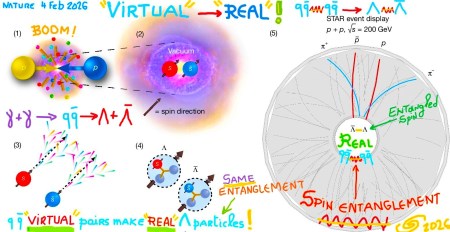
    A recent experiment of the STAR collaboration (Brookhaven, USA) shows “virtual” quark-anti-quark pairs getting transformed into “real” hyperon pairs (pic is extracted/modified from it)…

    Virtual particles are not real—but neither are, really, real particles. Only interactions are real, and more or less so. “STAR” did not really show that “virtual particles are real”. STAR shows:

    👉 correlations between field disturbances (described by the “propagator”) can be made rich enough to reconstruct the internal spin structure of the (otherwise unknowable) intermediate state (STAR uses hyperons which are parity violating and emits protons whose direction is related to the hyperons’ spins! Who dare to say that high energy physics was useless?)

    In other words, there is a structured intermediate state… And, although presently unknowable, mostly, STAR showed something about it which was not known before, namely that it can become quasi-real as partons (here quark-anti-quark pairs) approach “on shell” status.

    Reality, ladies and gentlemen, is more mysterious, ubiquitous and mystifying than ever!

    We focused above on the hard case, the Foundations of Physics. Action Based Reality, ABR has vast consequences there, as it shows that CIQ, the Copenhagen Interpretation of the Quantum, is wrong: the Matter Waves are real, not just observer dependent knowledge waves of some quirky sort (as CIQ has it). If ABR can be crucially effective for the Foundations of Physics, no doubt it will be also crucial in softer domains!

    ACTION BASED REALITY has vast consequences, including in the analysis of history and political science: don’t look at what they said, or what was said about them, look at what real real actions ensued! Reality trumps fiction through action. 

    Patrice Ayme

    ***

    [1] In the 1935 EPR paper, an “element of reality” refers to a physical property whose value can be predicted with certainty (probability 1) without disturbing the system. EPR defined it precisely as follows: “The elements of the physical reality cannot be determined by a priori philosophical considerations, but must be found by an appeal to results of experiments and measurements. A comprehensive definition of reality is, however, unnecessary for our purpose. We shall be satisfied with the following criterion, which we regard as reasonable. If, without in any way disturbing a system, we can predict with certainty (i.e., with probability equal to unity) the value of a physical quantity, then there exists an element of reality corresponding to this physical quantity.”


    The quark-anti-quark pairs are not directly observed… The claim above is not really that “virtual” is real, but that the intermediate “virtual”, “propagator” state can be somewhat known, thus has more structure than used to be expected: there are elements of reality therein, now partly revealed… There may be perhaps more…

    #ABR #ActionBasedReality #Consciousness #Einstein #ElementsOfReality #EPR #FoundationsPhysics #Philosophy #Phiosophy #Physics #QFT #QuantumFieldTheory #QuantumMechanics #Science #STARExperiment

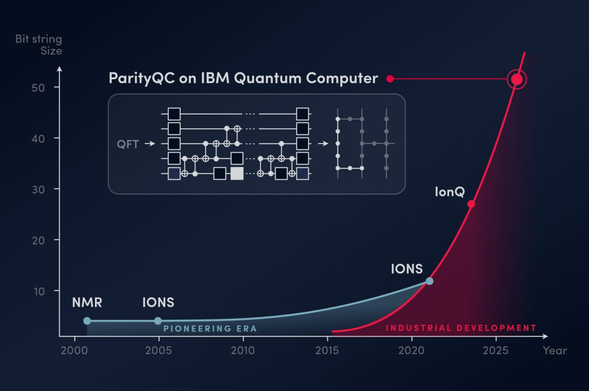
    #ParityQC just came out with the largest #QFT on an #IBM Quantum device. The QFT was basically an example of how their ParityQC architecture is able to push the limits on what we can do with our #NISQ devices today.

    → press release: https://parityqc.com/parityqc-set-new-record-benchmark-using-ibm-quantum-computer-with-the-largest-quantum-fourier-transform-ever-reported
    → pre-print: https://arxiv.org/abs/2604.12465

    #quantumcomputing #IBMQuantum

    Happy #WorldQuantumDay! 🌌
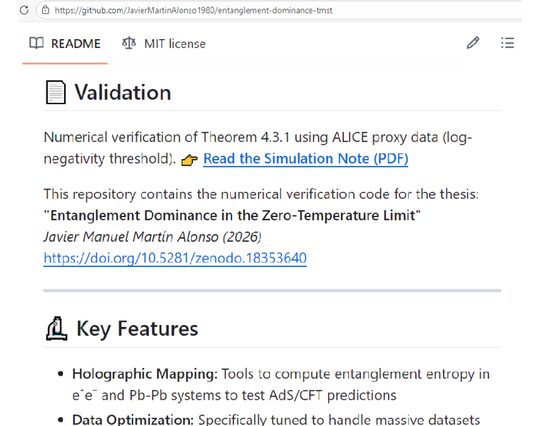
    On April 20, Quantum Observables for Collider Physics 2026 opens at CERN, bringing entanglement, magic, and collider observables closer to the center of high-energy physics. Proud to contribute to this direction through the Theorem 4.3.1 framework. Time to move beyond correlations and start mapping quantum geometry. 🚀
    🔗 doi.org https://doi.org/10.5281/zenodo.18207031
    https://doi.org/10.5281/zenodo.18353640
    https://doi.org/10.5281/zenodo.18764143
    #QuantumAlgorithms #QuantumGravity #Physics #Entanglement #CERN #QFT
    Topological Vortex Superradiance and TMST: A QCD Framework for Intrinsic Charm and Proton Structure Tests with Belle II at the Chiral Belle Polarization Upgrade

    We develop a topological QCD framework in which color confinement, intrinsic charm and the proton’s partonic structure emerge from an entanglement–driven phase transition between a three–valence–quark regime and a gluon–dominated collective condensate. The central ingredient is the Two–Mode Squeezing Threshold (TMST), an entanglement–dominance threshold T_0 at which a collective vortex mode in color space becomes superradiantly amplified and stabilizes heavy quark–antiquark components (such as intrinsic charm) as quasi–topological excitations rather than rare perturbative fluctuations. This mechanism provides a first–principles, geometric explanation of intrinsic charm signals in global PDF analyses and of the gluon–cloud picture of the proton, unifying them with a topological vortex description of confinement and ER=EPR–type geometric channels. On the phenomenological side, we show how the TMST can be probed through two–particle correlation observables in high–luminosity e+e− collisions. In particular, we formulate an operational equation (Eq. 1, implemented in an open Python module) that relates an effective “entanglement temperature” T_obs derived from the log–negativity of the TMST state, to quantities extracted from two–particle correlation functions, dT_obs = (d dv) / (dv dT), providing a concrete handle to distinguish standard gluon radiation from topological vortex stabilization in heavy–flavor final states. The Chiral Belle / SuperKEKB electron–polarization upgrade and Belle II–style e+e− correlation measurements offer an especially clean environment to test this scenario, by searching for TMST–driven changes in spin– and flavor–sensitive observables associated with charm and exotic spectroscopy. The framework is formulated in a way that is directly implementable in basf2–type analysis chains and extensible to lattice QCD, global PDF fits and cold–atom analogs. Keywords QCD confinement intrinsic charm proton structure topological vortices Two–Mode Squeezing Threshold (TMST) entanglement dominance gluon condensate Belle II Chiral Belle polarization upgrade SuperKEKB e+e− correlations spin observables exotic hadron spectroscopy dark sector searches electroweak precision

    Zenodo

    Belle II correlations: TMST proxy testing.

    DOI: https://doi.org/10.5281/zenodo.18207031

    #BelleII #QFT

    Topological Vortex Superradiance and TMST: A QCD Framework for Intrinsic Charm and Proton Structure Tests with Belle II at the Chiral Belle Polarization Upgrade

    We develop a topological QCD framework in which color confinement, intrinsic charm and the proton’s partonic structure emerge from an entanglement–driven phase transition between a three–valence–quark regime and a gluon–dominated collective condensate. The central ingredient is the Two–Mode Squeezing Threshold (TMST), an entanglement–dominance threshold T_0 at which a collective vortex mode in color space becomes superradiantly amplified and stabilizes heavy quark–antiquark components (such as intrinsic charm) as quasi–topological excitations rather than rare perturbative fluctuations. This mechanism provides a first–principles, geometric explanation of intrinsic charm signals in global PDF analyses and of the gluon–cloud picture of the proton, unifying them with a topological vortex description of confinement and ER=EPR–type geometric channels. On the phenomenological side, we show how the TMST can be probed through two–particle correlation observables in high–luminosity e+e− collisions. In particular, we formulate an operational equation (Eq. 1, implemented in an open Python module) that relates an effective “entanglement temperature” T_obs derived from the log–negativity of the TMST state, to quantities extracted from two–particle correlation functions, dT_obs = (d dv) / (dv dT), providing a concrete handle to distinguish standard gluon radiation from topological vortex stabilization in heavy–flavor final states. The Chiral Belle / SuperKEKB electron–polarization upgrade and Belle II–style e+e− correlation measurements offer an especially clean environment to test this scenario, by searching for TMST–driven changes in spin– and flavor–sensitive observables associated with charm and exotic spectroscopy. The framework is formulated in a way that is directly implementable in basf2–type analysis chains and extensible to lattice QCD, global PDF fits and cold–atom analogs. Keywords QCD confinement intrinsic charm proton structure topological vortices Two–Mode Squeezing Threshold (TMST) entanglement dominance gluon condensate Belle II Chiral Belle polarization upgrade SuperKEKB e+e− correlations spin observables exotic hadron spectroscopy dark sector searches electroweak precision

    Zenodo