What does #Openness in Research mean? Last Friday, we reflected with a group of researchers on their own backgrounds, #assumptions and research #values. We discussed how openness is a brave thing in #research and how personal backgrounds influence the research we are doing.

You can find the blogpost about the workshop on #positionality statements on our website: https://reproducibilitynetwork.nl/2025/10/02/open-by-reflection-candidness-for-more-transparent-science/

All training materials on #zenodo: https://zenodo.org/records/17174961
#OpenResearch #OpenScience #Reproducibility

Displacement and Solidarity: Reflections on African Phenomenology (Interview with Abraham Olivier)

YouTube

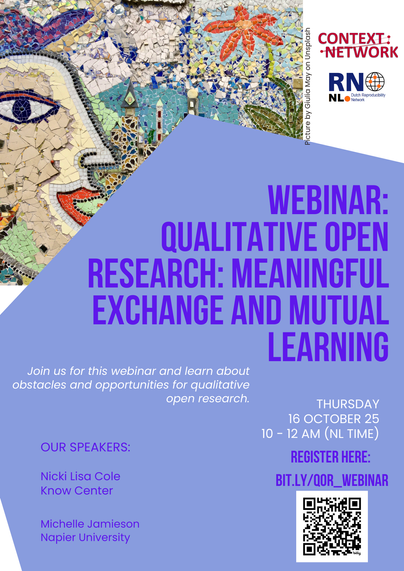
Webinar: "Qualitative Open #Research: Meaningful Exchange and Mutual Learning."

Michelle Jamieson and Nicki Lisa Coole will present on what #qualitative open research means and how #positionality statements, a technique used by many qualitative researchers, can help opening up research processes independent of research methodologies.

Date: 16 October 2025
Time: 10-12 am (Amsterdam Time)
Follow this link to register: https://reproducibilitynetwork.nl/event/qualitative-open-research-meaningful-exchange-and-mutual-learning/

#QualitativeResearch #OpenScholarship

Positionality statements can help researchers to reflect on their own research process and can be a first step towards opening and sharing this process.
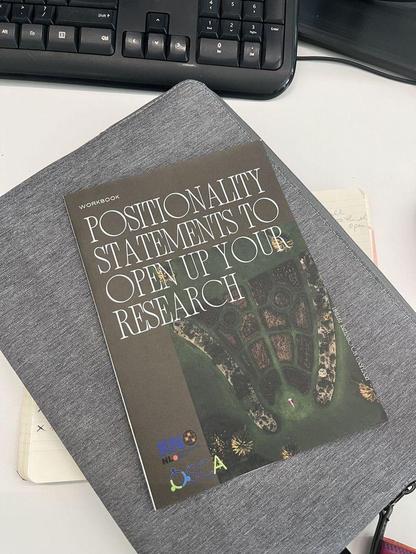
We will use writing prompts to guide attendees towards a first draft of their positionality statement. Attendees will be working with a workbook and are invited to write with pen on paper for this session.

#QualitativeResearch #OpenScience #PenAndPaper #ResearchProcess #OpenScienceNL #Positionality #QuantitativeResearch #ResearchMethods

Helpful roundup by Mirjam Glessmer of recent pieces on #positionality statements and reflexivity in research

https://mirjamglessmer.com/2024/12/17/reading-up-on-the-purpose-pros-and-cons-of-positionality-statements/

Reading up on the purpose, pros and cons of positionality statements - Adventures in Oceanography and Teaching

Reading up on more positionality statement discussions for ongoing work with Kirsty, which started from us drawing up our own positionality statements and discussing the differences [see hers and mine — and I would do mine substantially different now after a lot of thinking has gone into the topic!], and then us reading an article […]

Adventures in Oceanography and Teaching

📢 NEW BLOG POST | 'I' am here! The necessity of acknowledging the historian in scholarship.

Kicking off our new series on positionality and bias! Through personal reflections, our team explores how acknowledging our own perspectives leads to stronger, more transparent scholarship.

Team member Amber has written the first blog, reflecting on her experiences (and challenges) with positionality.

Read it here! https://combattingbias.huygens.knaw.nl/news/positionality/

#blog #bias #positionality #history #knowledgeproduction

‘I’ am here! The necessity of acknowledging the historian in scholarship. - Combatting Bias

@ChrisMayLA6 Highlighting the importance of #positionality is one of the great contributions of #feminist research. What is #Reeves ' background? - and what are the rules for punctuating hashtags?

For archives and libraries folks: Should descriptive metadata record the processes by which collections have been described? I've been arguing that it's important for finding aids to include information about who created the descriptions and how they've been revised over time.

An article I wrote came out last month: "Archival meta-metadata: revision history and positionality of finding aids"
https://doi.org/10.1007/s10502-024-09443-z

#archives #metadata #positionality

Archival meta-metadata: revision history and positionality of finding aids - Archival Science

This article starts from two observations about archival description. First, creating finding aids requires significant judgment and interpretation, and is therefore inevitably influenced by the positionalities—the perspectives, personal histories, and social identities—of the archivists. Second, finding aids occasionally call for revision, sometimes to fit a new data standard or reflect an evolving collection, but also to correct errors, reduce bias, and remove harmful language. In light of these observations, this article has two aims. First, it develops and presents a theoretical rationale for recording metadata about finding aids, including revision history and authorship, arguing for transparency about positionality as a response to recognizing the infeasibility of impartiality. Second, it presents the results of a survey of state archivists in the US, who were asked about their descriptive practices and their attitudes regarding disclosing their authorship of finding aids. Results of the survey reveal diverse practices, as well as some hesitation to embrace expressions of positionality in the context of description. The article closes with a discussion of options for conceptualizing metadata about finding aids and the professional role of archivists, concluding with two general recommendations.

SpringerLink
with ChatGPT | Canadian Food Studies / La Revue canadienne des études sur l'alimentation

Scholarly and community articles about food and food systems

with ChatGPT | Canadian Food Studies / La Revue canadienne des études sur l'alimentation

Scholarly and community articles about food and food systems