
New paper published in Insectes Sociaux 🐜
We analysed the factors associated with the determinism of social polymorphism in the trap jaw ant O. hastatus.
Read the study here: https://rdcu.be/dyPQd
#recognition #polygyny #queens #ants
Many thanks to all collaborators! The field work in FG was just great 🤩😍🐜
This research was supported by #CNRS, #AgenciaFAPESP,
#CNRS_Nouragues and #AgenceRecherche
#UnivToulouse #UT3PaulSabatier #CbiToulouse #CNRS_Toulouse
Photo: Philipp Hoenle
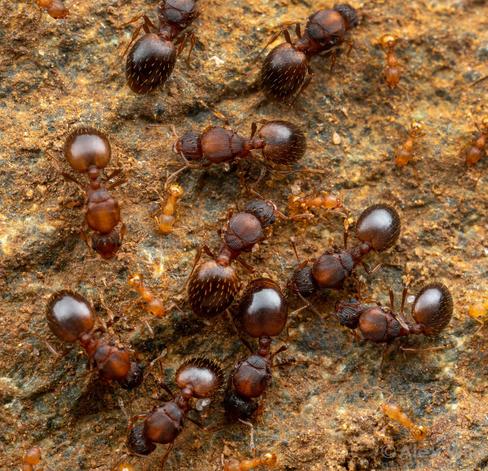
Often, ant colonies will have more than one queen.
Sometimes, colonies will have dozens, or even hundreds. This is a nest of little fire ants, Wasmannia auropunctata, in Puerto Rico.
The queens are obvious, but do you see the much smaller worker ants?
#Reproductive #inequality in #humans and other #mammals
"Data from 90 human societies & 49 mammalian species. Humans exhibit lower average sex differences in reproductive inequality than do most other mammals, while falling within the mammalian range. These small sex differences in #ReproductiveSkew are due to institutions supporting #monogamy, to a limited intensity of #polygyny and especially to heavy dependence of children on #care from both parents"