A young progenitor for the most common #PlanetarySystems in the Galaxy: https://www.nature.com/articles/s41586-025-09840-z -> We finally know how the most common types of planets are created / Cotton Candy Worlds Evolve into Rock Candy Worlds: https://newsroom.ucla.edu/releases/we-finally-know-how-the-most-common-types-of-planets-are-created / https://www.nao.ac.jp/en/news/science/2026/20260108-abc.html
A young progenitor for the most common planetary systems in the Galaxy - Nature

A nine-year transit-timing campaign has measured the extremely low masses and densities of four large planets orbiting the young star V1298 Tau, which are now predicted to contract and form a typical compact super-Earth and sub-Neptune system.

Nature

15-Jan-2025
Super-Earth vs. Sub-Neptune? The winner is Super-Venus!

New observational data from the James Webb Space Telescope and simulation models have confirmed a new type of planet unlike anything found in the Solar System. This provides another piece of the puzzle to understand how #planets and #planetarySystems form.

https://www.eurekalert.org/news-releases/1070551 #science #exoplanets #astrobiology

Super-Earth vs. Sub-Neptune? The winner is Super-Venus!

New observational data from the James Webb Space Telescope and simulation models have confirmed a new type of planet unlike anything found in the Solar System. This provides another piece of the puzzle to understand how planets and planetary systems form.

EurekAlert!

15-Jan-2025
Not all Hot Jupiters orbit solo
A UNIGE study shows that #HotJupiters do not systematically eject their planetary neighbours during migration. This discovery overturns our perception of the architecture of #planetarySystems

https://www.eurekalert.org/news-releases/1070234

#science #astrobiology #exoplanets

Not all Hot Jupiters orbit solo

Hot Jupiters are giant planets initially known to orbit alone close to their star. During their migration towards their star, these planets were thought to accrete or eject any other planets present. However, this paradigm has been overturned by recent observations, and the final blow could come from a new study led by the University of Geneva (UNIGE). A team including the National Centre of Competence in Research (NCCR) PlanetS, the Universities of Bern (UNIBE) and Zurich (UZH) and several foreign universities has just announced the existence of a planetary system, WASP-132, with an unexpected architecture. It not only contains a Hot Jupiter but also an inner Super-Earth and an icy giant planet. These results are published in Astronomy & Astrophysics.

EurekAlert!

-JAN-2024
Three iron rings in a planet-forming disk
A three-ringed structure in the planet-forming zone of a circumstellar disk where metals and minerals serve as a reservoir of planetary building blocks

https://www.eurekalert.org/news-releases/1030395 #science #astrobiology #PlanetarySystems

Three iron rings in a planet-forming disk

<p><strong>A research team, including astronomers of the Max Planck Institute for Astronomy (MPIA), detected a three-ringed structure in the nursery of planets in the inner planet-forming disk of a young star. This configuration suggests two Jupiter-mass planets are forming in the gaps between the rings. The detailed analysis is consistent with abundant solid iron grains complementing the dust composition. As a result, the disk likely harbours metals and minerals akin to those in the Solar System’s terrestrial planets. It offers a glimpse into conditions resembling the early Solar System over four billion years ago during the formation of rocky planets such as Mercury, Venus, and Earth.</strong></p>

EurekAlert!
Discovery of two planetary systems around sun-like stars

A study published today (Dec. 15) in the journal Astronomy & Astrophysics reveals the discovery of two new planetary systems orbiting stars similar to our sun, also known as solar analogs.

Phys.org

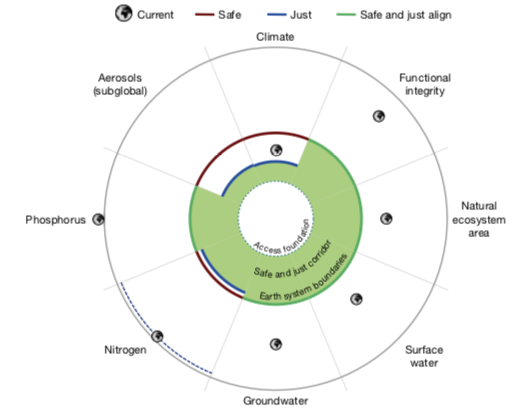
New paper in the journal Nature well worth a read. "Safe and just Earth system boundaries" (#Nature, 31. May 2023, Rockström, Gupta, Kin, Lade et al.)

7 out of 8 Earth System Boundaries (ESBs) are already in the unsafe, out-of-bounds zone, and have already crossed the "red line" (see attached figure). The #climate has not yet crossed the red line, but is getting very close, of course.

"#Humanity is well into the #Anthropocene, the proposed new geological epoch where human pressures have put the #Earth system on a trajectory moving rapidly away from the stable #Holocene state of the past 12,000 years, which is the only state of the Earth system we have evidence of being able to support the world as we know it. These rapid changes to the Earth system undermine critical life-support systems with significant societal impacts already felt, and they could lead to triggering tipping points that irreversibly destabilize the Earth system. These changes are mostly driven by social and economic systems run on unsustainable resource extraction and consumption.

Contributions to Earth system change and the consequences of its impacts vary greatly among social groups and countries. Given these interdependencies between inclusive human development and a stable and resilient Earth system an assessment of safe and just boundaries is required that accounts for Earth system resilience and human well-being in an integrated framework."

#GlobalWarming #Climate #ClimateCrisis #Klima #Klimakrise #EarthSystems #Earth #Planet #Ecosystems #Water #Groundwater #PlanetarySystems
https://www.nature.com/articles/s41586-023-06083-8

Safe and just Earth system boundaries - Nature

We find that justice considerations constrain the integrated Earth system boundaries more than safety considerations for climate and atmospheric aerosol loading, and our assessment provides a foundation for safeguarding the global commons for all people.

Nature

OK, finally set up and ready for my #Introduction to #ScienceMastodon #Astrodon #TwitterMigration.
I work at the boundary of #stellar and #planetary #astrophysics, emphasizing #Mdwarfs #youngstars and #youngplanets. In particular, I want to learn how #planetarysystems #evolve from formation to maturity, including what early conditions give rise to systems like ours. I lead two surveys searching for young #transiting planets.

I'm also a dad to one infant and one orange cat.

The Great Planet Bake Off

In today's episode, the star's have been preparing some planets. But have they all been using the same recipe to form them? We will have to "taste" their compositions to find our winner!

astrobites