St. John of the Cross Novena, Day 2: Self-giving

Reading

All for me and nothing for you. All for you and nothing for me.

Sayings of Light and Love, 110–111

Scripture 

I believe nothing can happen that will outweigh the supreme advantage of knowing Christ Jesus my Lord. For him, I have accepted the loss of everything, and I look on everything as so much rubbish if only I can have Christ and be given a place in him. I am no longer trying for perfection by my own efforts, the perfection that comes from the Law, but I want only the perfection that comes through faith in Christ, and is from God and based on faith. All I want is to know Christ and the power of his resurrection and to share his sufferings by reproducing the pattern of his death. That is the way I can hope to take my place in the resurrection of the dead. Not that I have become perfect yet: I have not yet won, but I am still running, trying to capture the prize for which Christ Jesus captured me. I can assure you my brothers, I am far from thinking that I have already won. All I can say is that I forget the past and I strain ahead for what is still to come; I am racing for the finish, for the prize to which God calls us upward to receive in Christ Jesus. We who are called “perfect” must all think in this way. If there is some point on which you see things differently, God will make it clear to you; meanwhile, let us go forward on the road that has brought us to where we are.

Philippians 3:8-16

Meditation

“Nothing for me.” The nada—that absolute, naked, utter nothing—of Saint John of the Cross can seem so stark, even off-putting to a novice reader of the Church’s Mystical Doctor. Nothing for me? How can this be?

In order to unpack these absolutes, it helps to have a reference point. Saint Paul can help us to understand the purpose of striving for such nakedness, such emptiness, the possession of nothing to the point of being nothing.

In the verses preceding our Scripture reading, St. Paul lists all the reasons that he had to boast of his “Hebrew-ness”. He even calls himself a “Hebrew of Hebrews.” That’s a rather bold statement. Yet despite all of his reasons to boast of his Hebrew and Pharisee pedigree, he says that nothing can happen that will outweigh the supreme advantage of knowing Christ Jesus.” (Ph 3:8) There’s that absolute qualifier again: nothing.

But Paul doesn’t stop there, he goes further: “For Him, I have accepted the loss of everything, and I look on everything as so much rubbish.” St. Paul is getting out his virtual work gloves, his virtual broom, dustpan, trash bags, and taking inventory of his life as one would assess their home and property with an insurance adjuster after a fire or natural disaster, understanding that all one possessed is a total loss, ready to be hauled away with the garbage.

Ah, but there’s a reason for rejoicingclearing away the rubbish creates total and absolute room for Christ: “if only I can have Christ and be given a place in Him.”

This contrast of self-emptying to be filled with something greater in St. John of the Cross and St. Paul the Apostle reminds us of the self-emptying in the life of Christ:

Who, though he was in the form of God, did not regard equality with God something to be grasped. Rather, he emptied himself, taking the form of a slave, coming in human likeness; and found human in appearance, he humbled himself, becoming obedient to death, even death on a cross. Because of this, God greatly exalted him and bestowed on him the name that is above every name (Ph 2:6-9).

And as we look at St. Paul’s words, it is interesting to look further at his all-or-nothing contrasts. We know what he considers to be nothing, a pile of rubbish. With what does he seek to replace it? Let’s search his text for the simple word, all. “All I want is to know Christ and the power of his resurrection and to share his sufferings by reproducing the pattern of his death… All I can say is that I forget the past and I strain ahead for what is still to come” (Ph 3:10,13). Yes, nothing for me leaves all for you. That is, essentially, what St. John of the Cross said, in the stark all-and-nothing contrast of his saying, todo para ti y nada para mí.

If the nada of St. John of the Cross and the rubbish-heap imagery of St. Paul still leave us wondering how to attain such noble, holy aspirations, it is St. Paul’s great disciple, St. Elizabeth of the Trinity who can show us the way. In her retreat Heaven in Faith (First Day, second prayer) she writes:

We must not, so to speak, stop at the surface, but enter ever deeper into the divine Being through recollection. “I am still running,” exclaimed St. Paul (Ph 3:12); so must we descend daily this pathway of the Abyss which is God; let us slide down this slope in wholly loving trust. “Deep calls to deep” (Ps 42:8). It is there in the very depths that the divine impact takes place, where the abyss of our nothingness encounters the Abyss of mercy, the immensity of the all of God. There we will find the strength to die to ourselves and, losing all vestige of self, we will be changed into love…. “Blessed are those who die in the Lord” (Rev 14:13)!

Prayer

O St. John of the Cross
You were endowed by our Lord with the spirit of self-denial
and a love of the cross.
Obtain for us the grace to follow your example
that we may come to the eternal vision of the glory of God.

O Saint of Christ’s redeeming cross
the road of life is dark and long.
Teach us always to be resigned to God’s holy will
in all the circumstances of our lives
and grant us the special favor
which we now ask of you.

Mention your request

Above all, obtain for us the grace of final perseverance,
a holy and happy death and everlasting life with you
and all the saints in heaven.
Amen.

Let’s continue in prayer

Day 1 — Self-trust
Day 2 — Self-giving
Day 3 — Cleansing
Day 4 — Walking in love
Day 5 — Trust
Day 6 — Prayer
Day 7 — Humility
Day 8 — Eternal Silence
Day 9 — Silent love

Orléans, France

The novena prayer was composed from approved sources by Professor Michael Ogunu, a member of the Discalced Carmelite Secular Order in Nigeria.

Elizabeth of the Trinity, S 2014, I Have Found God, The Complete Works of Elizabeth of the Trinity Volume 1: Major spiritual writings, translated from the French by Kane, A, ICS Publications, Washington DC.

All scripture references in this novena are from the New Revised Standard Version Bible: Catholic Edition, copyright © 1989, 1993 the Division of Christian Education of the National Council of the Churches of Christ in the United States of America as accessed from the Bible Gateway website.

Don’t become discouraged and give up prayer, says St. John of the Cross. We offer varying novenas to Our Lady of Mount Carmel, as well as novenas to St. Teresa of Avila, St. John of the Cross, St. Thérèse of Lisieux, Sts. Louis and Zélie Martin, St. Elizabeth of the Trinity, and St. Joseph.

Let us unite in prayer

#abyss #all #deep #elizabethCatez #heavenInFaith #icsPublications #johnOfTheCross #love #nada #nothing #nothingness #novena #pharisee #recollection #rubbish #sabeth #sanJuanDeLaCruz #stElizabethOfTheTrinity #stJohnOfTheCross #stPaul #stTherese #stThereseOfLisieux #stThereseOfTheChildJesus #todo #transformation

St. John of the Cross Novena, Day 1: Self-trust

Reading

Those who trust in themselves are worse than the devil.

Sayings of Light and Love, 166

Scripture

He also told this parable to some who trusted in themselves that they were righteous and despised others: “Two men went up into the temple to pray, one a Pharisee and the other a tax collector. The Pharisee stood and prayed thus with himself, ‘God, I thank thee that I am not like other men, extortioners, unjust, adulterers, or even like this tax collector. I fast twice a week, I give tithes of all that I get.’ But the tax collector, standing far off, would not even lift up his eyes to heaven, but beat his breast, saying, ‘God, be merciful to me a sinner!’ I tell you, this man went down to his house justified rather than the other; for every one who exalts himself will be humbled, but he who humbles himself will be exalted.”

Luke 18:9-14

Meditation

“Jesus told this parable to some who trusted in themselves that they were righteous,” the Gospel tells us. And let’s notice that the conclusion of the parable is a mirror image of the song that Jesus’ own Mother sang in the home of her cousin Elizabeth: Deposuit potentes de sede, et exaltavit humiles (“He has brought down the mighty from their thrones and exalted those of humble estate,” Lk 1:52).

Another interesting item to note in the parable is the conscience of the tax collector, who was painfully aware of his sinfulness. The Catechism of the Catholic Church (CCC) states that a “well-formed conscience is upright and truthful”, thus the “education of conscience is indispensable for human beings who are subjected to negative influences and tempted by sin to prefer their own judgment and to reject authoritative teachings.” (CCC 1783) This education is “a lifelong task.” (CCC 1784)

So how is the conscience formed?

In the formation of conscience the Word of God is the light for our path, we must assimilate it in faith and prayer and put it into practice. We must also examine our conscience before the Lord’s Cross. We are assisted by the gifts of the Holy Spirit, aided by the witness or advice of others and guided by the authoritative teaching of the Church. (CCC 1785)

If self-trust is worse than the devil, i.e. “Satan, the Evil One, the angel who opposes God…. the one who ‘throws himself across’ God’s plan and his work of salvation accomplished in Christ” (CCC 2851) then the virtue to conquer that vice would be to trust in God.

When we say ‘God’ we confess a constant, unchangeable being, always the same, faithful and just, without any evil. It follows that we must necessarily accept his words and have complete faith in him and acknowledge his authority. He is almighty, merciful, and infinitely beneficent. Who could not place all hope in him? Who could not love him when contemplating the treasures of goodness and love he has poured out on us? (CCC 2086)

St. Thérèse of Lisieux, one of St. John of the Cross’ foremost disciples responds to these rhetorical questions in these, her last written words:

It is not in the first place, but in the last place that I start out; instead of getting ahead with the Pharisee, I repeat, full of trust, the humble prayer of the tax collector; but especially I imitate Magdalene’s attitude, her amazing or rather her daring love that charms the Heart of Jesus, captivates my very own heart. Yes, I feel it, even if I had on my conscience all the sins that can be committed, I would go, heartbroken with repentance, and throw myself into Jesus’ arms, because I know just how much He cherishes the prodigal child who has returned to Him. It is not because God, in His gracious, prevenient mercy, has preserved my soul from mortal sin that I stand up and go to Him in trust and love… (Ms C 36v-37r).

Prayer

O St. John of the Cross
You were endowed by our Lord with the spirit of self-denial
and a love of the cross.
Obtain for us the grace to follow your example
that we may come to the eternal vision of the glory of God.

O Saint of Christ’s redeeming cross
the road of life is dark and long.
Teach us always to be resigned to God’s holy will
in all the circumstances of our lives
and grant us the special favor
which we now ask of you.

Mention your request

Above all, obtain for us the grace of final perseverance,
a holy and happy death and everlasting life with you
and all the saints in heaven.
Amen.

Let’s continue in prayer

Day 1 — Self-trust
Day 2 — Self-giving
Day 3 — Cleansing
Day 4 — Walking in love
Day 5 — Trust
Day 6 — Prayer
Day 7 — Humility
Day 8 — Eternal Silence
Day 9 — Silent love

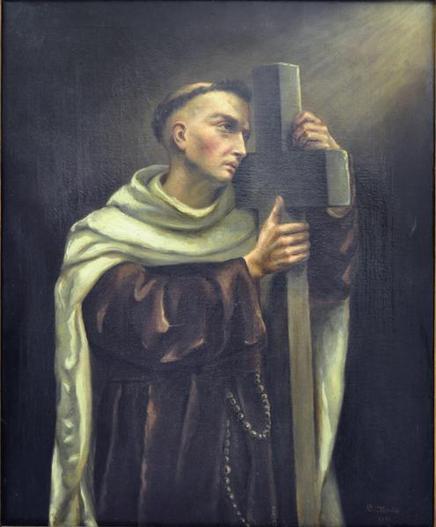
Image of St. John of the Cross painted by Sr. Genevieve of the Holy Face, OCD (Céline Martin) | Photo credit: Discalced Carmelites

The novena prayer was composed from approved sources by Professor Michael Ogunu, a member of the Discalced Carmelite Secular Order in Nigeria.

All scripture references in this novena are from the New Revised Standard Version Bible: Catholic Edition, copyright © 1989, 1993 the Division of Christian Education of the National Council of the Churches of Christ in the United States of America as accessed from the Bible Gateway website.

Don’t become discouraged and give up prayer, says St. John of the Cross. We offer varying novenas to Our Lady of Mount Carmel, as well as novenas to St. Teresa of Avila, St. John of the Cross, St. Thérèse of Lisieux, Sts. Louis and Zélie Martin, St. Elizabeth of the Trinity, and St. Joseph.

Let us unite in prayer

#conscience #devil #examinationOfConscience #humble #johnOfTheCross #littleTherese #manuscript #novena #pharisee #prevenientMercy #pride #sanJuanDeLaCruz #satan #selfRighteous #stJohnOfTheCross #stTherese #stThereseOfLisieux #stThereseOfTheChildJesus #taxCollector #trust

Explore the dramatic transformation of Saul to Paul! We delve into his past as a Pharisee, his persecution of early Christians, and his life-altering encounter with Jesus on the road to Damascus. Discover how arrogance turned to faith in this powerful biblical story! #SaulToPaul #BiblicalTransformation #RoadToDamascus #ReligiousAwakening #ChristianFaith #Pharisee #JesusEncounter #FaithJourney #SpiritualGrowth #BibleStudy
"Wenn ihr fastet, dann schaut nicht so drein wie die Heuchler! Sie setzen eine wehleidige Miene auf und vernachlässigen ihr Aussehen, damit jeder merkt, dass sie fasten. Ich versichere euch: Diese Leute haben ihren Lohn schon erhalten!" (Matthäus 6,16) #ItsACult #Pharisee #Hypocrite
Bluesky

Bluesky Social

Nicodemus was a #Pharisee and came to Jesus at night, confessing Him as a teacher from #God.

Jesus told him that unless a person is born again and/or from above, he cannot see God's reign.

Nicodemus was confused, wondering if a person could re-enter the womb when old and be born.

Jesus responded that one must be born of water and the Spirit, having received #baptism, to enter God's reign.

Word Search Puzzle 318

Word List : #solute #pharisee #walleye #eutocia #vesturer #unsaved #ovulite #bestamp #relievos #keepsaky #puzzling #brontide #updelve #villaget #prechill #crewman #tabards #steady

Kara Finance

"If you are a Justice, you have to disclose this kind of stuff. If that bothers you—if you are so committed to living a private life beyond the reach of disclosure—you can go be a urologist or something."

#conservative #corruption is a thing to behold as it comes down from the supposed #moral mountaintop of #christian #nationalism

#hypocrite #pharisee #scotus #clarence #thomas

https://slate.com/news-and-politics/2023/05/harlan-crow-school-payments-insult-injury.html

Why the Latest Clarence Thomas Revelation Is the Most Insulting

Of all the insulting things to come out of the past few weeks, this is perhaps the most insulting.

Slate

@ThisWeekInAS This is a good thread.

Christians who use 'Pharisees' as a handy insult for legalists miss the point in a few important ways. 1) they shouldn't be looking for blanket insults for anyone if they're reading their New Testaments for personal ethics; 2) Jesus and Paul were Pharisees; and 3) since the New Perspective of the 1970s the perceived legalism and works-righteousness of first-century Judaism has been largely dismantled, and seen as a projection of medieval Catholicism onto scripture by early Protestants.

The second point is probably the key one to communicate. As the #Jewish Scholar of early #Christianity Alan Segal writes, the only first-century #Pharisee to have left us writings from their own hand was... The Apostle Paul in the New Testament.* Both Paul and Jesus are clearly marked as Pharisees by their belief in a general resurrection and their approach to the Jewish scritpures. Jesus had his sharpest conflicts with his fellow Pharisees because that's how conflict works: it takes a lot of common ground to get a proper disagreement going, since you have to expect better of the other party. Moreover, when Paul and the gospel writers refer to 'the Jews', this was the same term as 'the Judaeans' (hoi Ioudaioi). The Romans didn't care what people believed, just that they were governable; 'The Judaeans' were, in general use, the people who observed the customs of Judaea, and not a race.

* Segal thinks, as many now do, that Josephus was really an Essene.

As I shift more to Mastodon, I want to try a different approach this week. Instead of a handful of examples of antisemitism, I’m going to focus on one tweet. The message of the tweet isn’t antisemitic, but the aftermath of posting it was problematic.

CW: I don’t think anyone will be offended by anything in the following thread, but I will unpack how the word “Pharisee” has been misused by Christians.

1/8
#Antisemitism #Racism #Christian #Pharisee #ThisWeekInAS