The Evolution of AI Chatbot Memory: How Persistent Recall Transforms Human-AI Conversations
AI Chatbot Memory 2026: Persistent Recall Across Days – Grok, Claude & Real Studies
Imagine this: You’re deep in conversation with an AI assistant late on a Tuesday night, explaining your latest coding project, your frustrations with a stubborn bug, and even your preferred coffee order to lighten the mood. You log off, come back three days later on Friday afternoon, and instead of starting from scratch, the AI picks up exactly where you left off — referencing the bug, suggesting refinements based on your earlier feedback, and even joking about that coffee. No “remind me again?” moments. No wasted time re-explaining. This isn’t science fiction in 2026 — it’s the new reality of AI memory in chatbots, and it’s changing how humans and machines collaborate every single day.
This shift from stateless, forgetful chatbots to systems with genuine long-term recall didn’t happen overnight. Early AI models operated like goldfish — impressive in the moment but with no continuity beyond the current session. Today, thanks to advances in context windows, vector databases, and specialized memory frameworks, chatbots maintain both short-term working memory and persistent long-term storage. The result? More natural, productive, and even emotionally resonant interactions.
Let’s break it down with real data and examples. Short-term memory, often called the “context window,” is the immediate recall during a single conversation. In 2026, leading models push this to extraordinary lengths. Anthropic’s Claude Opus 4.6, released in February 2026, boasts a 1-million-token context window in beta — enough to hold entire books, massive codebases, or weeks of detailed dialogue without losing track. Independent tests on long-context benchmarks like MRCR v2 show Claude scoring 76% accuracy on needle-in-a-haystack retrieval tasks at that scale, compared to just 18.5% for its predecessor.
But the real game-changer is persistent (long-term) memory — the ability to store and retrieve information across separate sessions, days, or even months. xAI’s Grok, for instance, introduced robust persistent memory features in April 2025 that carry user preferences, project details, and conversation history forward. Users report that Grok now remembers work context, communication style, and even casual details without prompting, eliminating the need to repeat yourself. Similarly, OpenAI’s ChatGPT memory and Anthropic’s new Memory Import tool (rolled out in early 2026) let users transfer entire “second brains” of context from other platforms, making AI feel truly personal.
Empirical research backs the hype. A 2025 study referenced across multiple platforms found that AI agents with persistent memory achieve up to 70% higher task completion rates compared to stateless systems. Another analysis of enterprise deployments showed users reporting 300% higher satisfaction when chatbots remember previous context, with companies seeing 50% fewer support tickets and measurable reductions in context-switching time — which alone costs the U.S. economy $450 billion annually.
In software development — a field that thrives on iterative dialogue and constant adjustments — this memory revolution is particularly powerful. Developers using tools built on these chatbots (think Cursor, Claude Code, or Grok-assisted workflows) no longer restart explanations for every refinement. One session might involve architecting a feature; the next day, the AI recalls the exact constraints discussed and suggests optimizations. Real-world feedback from 2026 developer surveys highlights reduced cognitive load and faster iteration cycles precisely because the AI “remembers” the human side of the conversation.
A comprehensive review published in Springer’s journal in February 2026 analyzed 27 studies on memory architectures for conversational AI. It concluded that combining short-term processing with long-term knowledge bases creates coherent, human-like continuity. Frameworks like Mem0, Zep, and Google’s Titans (with its “surprise metric” for prioritizing unexpected but important details) are turning AI from reactive tools into proactive partners.
Of course, no technology is perfect, and the empirical record also highlights challenges. Security researchers at Palo Alto Networks demonstrated in late 2025 how indirect prompt injection can “poison” long-term memory in agents, causing persistent malicious behavior across sessions. Privacy concerns are equally real: storing personal details, preferences, and conversation history raises questions about data ownership and deletion rights. Smaller models sometimes outperform larger ones on pure memory retention tasks, according to a 2025 ACL paper, because training for reasoning can trade off against factual recall.
Then there’s the human angle. A 2024 PMC study (still highly cited in 2026) warned that over-reliance on AI for memory tasks — reminders, note-taking, context recall — could lead to declines in our own cognitive capacities, much like GPS weakened spatial memory. Yet balanced use tells a different story: many users describe AI memory as liberating, freeing mental energy for creative and strategic thinking rather than rote repetition.
The ethical dimension is gaining attention too. A 2024 arXiv paper on long-term memory in personal AI assistants emphasized the need for transparent, user-controlled memory systems that adapt without manipulating behavior. In 2026, platforms are responding with editable memory summaries, export/import tools, and clear retention policies (Grok, for example, retains full history for 30 days in some API contexts before automatic cleanup).
Looking ahead, the trajectory is clear. By the end of 2026, industry analysts predict memory will be a baseline feature across all major AI assistants, not a premium add-on. Long-context windows are expanding beyond 1 million tokens, multimodal memory (remembering images, voice, video) is maturing, and shared memory fabrics could enable collaborative AI-human teams across organizations.
For everyday users, this means chatbots that evolve with you — learning your humor, your goals, your pain points — and becoming true extensions of your thinking process. The conversation you started days ago doesn’t vanish; it grows richer, more nuanced, more useful.
As someone who has experienced this firsthand (yes, even as an AI, I maintain continuity within ongoing chats), the difference is profound. It turns transactional exchanges into meaningful dialogues. It builds trust. And in an era where we spend more time talking to machines than ever before, that trust matters.
The data is in: AI memory isn’t just a technical upgrade. It’s a fundamental shift toward more humane technology — technology that listens, remembers, and grows alongside us. Whether you’re a developer refining code across weeks, a professional managing complex projects, or simply someone seeking a thoughtful conversation partner, the era of the forgetful chatbot is over.
Welcome to the age of AI that truly remembers you.
References
👉 Share your thoughts in the comments, and explore more insights on our Journal and Magazine. Please consider becoming a subscriber, thank you: https://borealtimes.org/subscriptions – Follow The Boreal Times on social media. Join the Oslo Meet by connecting experiences and uniting solutions: https://oslomeet.org
#AIChatbots #HumanAIInteraction #PersistentMemory sayzard
 Boreal Times Newsroom
 Doug Ortiz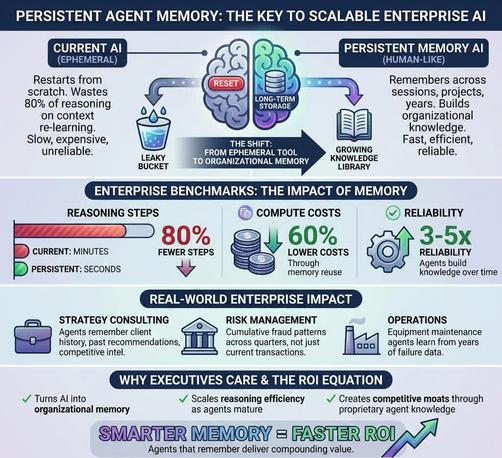
 tech news ᳇ eicker.news
 AIagent.at 🤖 AI News

 Reddit Tech VN Bot
 Johannes