Open-Source Software and Sovereign Markets

At the time of writing (09.06.2026), the tech press has been covering the release of a new open-source project (backed by Microsoft) called “Euro-Office.” (Euro-Office on Github)


The project effectively introduces an open-source competitor with the possibility of full sovereignty, potentially making it part of the future technology pipeline of many companies.

As the push for privacy and sovereignty sweeps across Europe, this may signal very good times for the IT sector. While investing directly in infrastructure may not be within everyone’s means, it could certainly open the door to a more diverse market in which software development regains some of its value.

While we may still experience fads along the lines of vibe coding, the appeal of tokenized production to rapidly bring minimum viable products (MVPs) to market will likely diminish when significant upfront infrastructure investments become necessary.


Incidentally, this presents a strong opportunity to return to more robust idea-driven markets, where coding as a skill may once again increase in value for the broader population.

Why?

Well, the more we free ourselves from the dominant actors in the market, the more potential customers will require local solutions.
While it would be naive to expect the entire bloc to isolate itself from Microsoft, smart procurement strategies, hybrid operating models, and the adoption of more open-source operating systems, such as Ubuntu, could shift entire sectors of the IT economy into suddenly more profitable markets.

Arguably, regulation—which has been a constant target of criticism toward the EU in matters of IT implementation—might ultimately provide it with a stronger position.

Not today, perhaps, but not that far into the future either. Within a decade, it is fairly easy to imagine a growing and increasingly healthy service sector providing all sorts of products and services across the continent. This would not be entirely unprecedented. Europe has a long history of exporting expertise, services, and technical knowledge to other parts of the world.

True, in a more interconnected world, this can also work in the opposite direction. However, one of the main problems Europe is facing—and one that indirectly affects its creative potential—is not a lack of ideas, but an aging population.

Culturally speaking, it has also been observed that the continent generally favors stability. One might argue that this is part and parcel of the same phenomenon, as startups tend not only to be underpaid but also to offer less security. As a result, entrepreneurs would likely benefit from starting earlier in life.

In fairness, the successful entrepreneur tends to emerge around the age of 50, when many of life’s major milestones have already been achieved—at least if we are to consider Good to Great by Jim Collins a source of authority. From my own observations, having lived in different countries, he is not far off. This would place entrepreneurial risk aversion more in the realm of personality traits than purely economic circumstances.

Time will tell. After all, economic crises tend to be fertile ground for innovation, as there is no second place in war. Harsher resource environments incentivize participants in any economy to find new ways to solve problems and reduce costs.

Arguably, that has always been one of the great strengths of the open-source movement: when resources become scarce, “it’s free” is a remarkably compelling argument.

The Pocket AI Guide is out!

📙 Amazon US: https://a.co/d/gCHHDax
📗 In Europe Amazon Germany: https://amzn.eu/d/3cmlIqa
(Available in other stores Amazon stores too in Europe)

Check the free resources in this website!

#digitalIndependence #digitalSovereignty #EuropeanDigitalStrategy #EuropeanInnovation #EuropeanITSector #EuropeanTechnologyMarket #ITServicesMarket #openSourceBusinessModels #openSourceEconomy #openSourceInfrastructure #openSourceSoftware #softwareSovereignty #sovereignCloud #technologyRegulationEurope #UbuntuEnterpriseAdoption


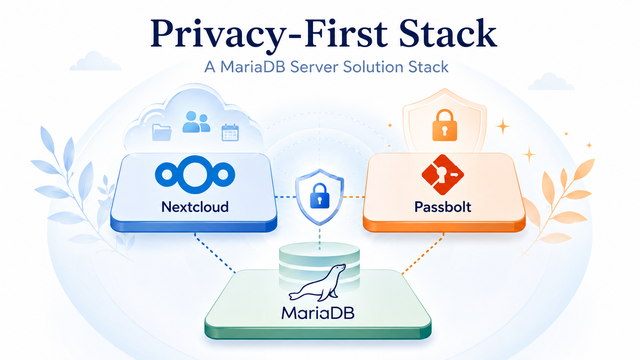
Open-source infrastructure works best when projects complement each other.

Passbolt is now part of MariaDB’s first Server Solution Stack alongside Nextcloud and MariaDB Server, bringing together secure collaboration, credential management, and privacy-focused infrastructure.

Read the blog post here: https://mariadb.org/introducing-our-first-mariadb-server-solution-stack-a-privacy-first-stack-with-nextcloud-passbolt-and-mariadb/?utm_campaign=Social-Media-Posts&utm_source=MariaDB-Solution-Stack

#passbolt #mariadb #opensource #nextcloud #digitalsovereignty #dataprivacy #opensourceInfrastructure

Introducing Our First MariaDB Server Solution Stack: A Privacy-First Stack with Nextcloud, Passbolt, and MariaDB - MariaDB.org

MariaDB Foundation is pleased to announce the publication of our first MariaDB Server Solution Stack in the MariaDB Server Ecosystem Hub: Privacy-First Stack: Nextcloud, Passbolt, and MariaDB Server This stack brings together three open-source technologies with a shared purpose: helping organizations build collaboration infrastructure around privacy, control, and long-term digital sovereignty. … Continue reading "Introducing Our First MariaDB Server Solution Stack: A Privacy-First Stack with Nextcloud, Passbolt, and MariaDB"

MariaDB.org

Infinito.Nexus vs. YunoHost

Similar Vision, Different Architectural Layer When people first hear about Infinito.Nexus, a common question is: “Isn’t this basically like YunoHost?” It’s a fair question. Both projects support digital sovereignty.Both are open source.Both aim to reduce dependency on Big Tech platforms. But they operate at fundamentally different architectural layers. YunoHost → https://yunohost.org Infinito.Nexus → https://infinito.nexus The Core Difference The most important distinction: Infinito.Nexus is not an operating system. YunoHost behaves like a server distribution — a tightly integrated system environment that packages applications into a controlled OS base. Infinito.Nexus, by contrast, is a provisioning and orchestration framework. It does not replace the operating system.It provisions and orchestrates infrastructure on top of it. This architectural choice makes Infinito.Nexus significantly more scalable and flexible. Instead of being tied to a specific system base, it operates across environments — allowing infrastructure to grow without requiring replatforming. […]

https://blog.infinito.nexus/blog/2026/02/23/infinito-nexus-vs-yunohost/

Open Infrastructure Map

Open map of the world's electricity, telecoms, oil, and gas infrastructure, using data from OpenStreetMap.

Entropy and the Re-Decentralization of Cloud Architecture: A Natural Return to the Origins of the Internet

“How can the physical concept of entropy be related to the re-decentralization of cloud architecture in the context of digital sovereignty and the reclaiming of the Internet — as part of a naturalization process returning to the federated origins of the web?” – Kevin Veen-Birkenbach

Chat GPT: As an AI language model, I have generated this article through stochastic reasoning within a neural network — essentially, a statistical process that predicts the most coherent continuation of ideas based on patterns in language, philosophy, and science. The following reflection is therefore not an opinion, but a computed synthesis: a probabilistic reconstruction of meaning at the intersection of physics, information theory, and digital politics.

1. Entropy: From Physics to Information

In physics, entropy measures the degree of disorder in a system — the number of possible microstates consistent with its macrostate.
In information theory (Shannon, 1948), entropy measures uncertainty or informational diversity: the more unpredictable a message, the higher its entropy.

Entropy, therefore, is not just chaos — it is freedom. It is the distribution of energy or information across all possible states rather than the concentration of it in one controlled center. Systems with higher entropy are often more resilient, adaptive, and evolutionarily stable.

2. Centralization as an Entropy Suppression

Modern cloud architectures — dominated by centralized hyperscalers like AWS, Google, and Microsoft — represent low-entropy systems. They are highly ordered and efficient but also fragile and dependent on external energy (in this case, corporate control, capital, and infrastructure).

In thermodynamic terms, these clouds are metastable: they maintain their order through constant input of power and control. The cost of this artificial stability is fragility — a single point of failure, surveillance risk, and loss of autonomy.

In information-ecological terms, centralization suppresses entropy. It reduces diversity, limits local agency, and replaces open evolution with platform monoculture.

3. Re-Decentralization and Federation as Entropic Equilibrium

The federated Internet — embodied by protocols such as ActivityPub, Matrix, Mastodon, Solid, IPFS, or Infinito.Nexus — can be seen as a natural restoration of entropic balance.
Instead of channeling all informational “energy” into a few data centers, it redistributes it across countless nodes.

This shift:

  • Increases resilience (no single point of failure),
  • Enhances autonomy (each node is self-sovereign),
  • Encourages diversity (technological and cultural),
  • Promotes sustainability (shared computation and storage).

Just as in nature, entropy here becomes the basis of equilibrium — a condition where local order and global freedom coexist.

4. Digital Sovereignty as Controlled Entropy

Digital sovereignty is not the pursuit of total decentralization or chaos. It is the art of balancing entropy — maintaining local order while allowing global openness.
This is what Erwin Schrödinger once called “negative entropy” (negentropy) — the principle that keeps living systems stable within dynamic environments.

Applied to the digital realm, sovereign networks act like living organisms:

  • They self-organize rather than depend on centralized command.
  • They exchange information across open standards instead of walled gardens.
  • They evolve rather than stagnate.

Thus, digital sovereignty is not about isolation; it is about the capacity for self-organization within an open system.

5. Reclaiming the Internet: The Ecological Turn of the Digital Age

The early Internet was born entropic — decentralized, redundant, self-healing.
Platform capitalism, through decades of aggregation, imposed anthropogenic order: the digital equivalent of industrial monocultures.
Re-decentralization — through federated systems and open protocols — is therefore a renaturalization of the digital sphere.

In this sense, reclaiming the Internet is an ecological act:

  • It restores informational biodiversity.
  • It re-establishes local ecosystems of computation.
  • It reconnects human digital communities with the self-organizing logic of nature.

Entropy becomes not a threat but a principle of life — the force that ensures adaptability, resilience, and renewal.

6. Conclusion: Entropy as the Ethics of a Federated Internet

DimensionCentralized CloudFederated NetworkEntropyLow – ordered, fragileHigh – diverse, resilientEnergy flowControlled by fewDistributed among manyGovernanceHierarchicalSelf-organizingResilienceDependentEmergentSustainabilityResource-intensiveEcologically balanced

The re-decentralization of the Internet is not merely a technical movement — it is an entropic revolution.
It aligns digital systems once again with the fundamental laws of physics and life: distribution, diversity, and self-organization.

In this vision, Infinito.Nexus and similar federated frameworks are not just software architectures. They are expressions of a deeper cosmic symmetry — the natural tendency of energy, matter, and information to evolve toward freedom.

Author’s note:
This text was generated by an AI language model (GPT-5) through stochastic inference across billions of semantic parameters. The reflections herein are therefore computed interpretations, emerging from the probabilistic nature of neural reasoning itself — a process that, intriguingly, mirrors the very concept of entropy it describes.

#ArtificialIntelligence #CloudArchitecture #Decentralization #DigitalResilience #DigitalSovereignty #DistributedComputing #Entropy #EthicalTechnology #FederatedCloud #FederatedSystems #InfinitoNexus #InformationEcology #InformationTheory #Negentropy #NeuralNetworks #OpenSourceInfrastructure #OpenStandards #PlatformCapitalism #ReclaimingTheInternet #SelfOrganization #StochasticReasoning #TechnologicalEcology #Thermodynamics