RE: https://mastodon.social/@gutenberg_org/116096840859015826

I love this image by Camillo #Golgi of a dog’s #OlfactoryBulb from his "Sulla fina anatomia degli organi centrali del sistema nervoso" (1885)!

This article highlights how #reading engages and regulates the nervous system. Interesting read 👌

#Neuroscience 🧪

Also the #iBehave seminar series continues. First speaker will be Prof. Dr. Veronica Egger (University of Regensburg), talking about "Rhythms in the #OlfactoryBulb: From #NeuronalNetwork #oscillations to heartbeat interoception"

📅 Jan 12, 2026, 10:30 am
👤 Host: Gaia Tavosanis
💻 Zoom link via [email protected]

#CompNeuro #neuroscience #olfaction

Have a friend your dog hates? They dislike people for a reason most wouldn't consider.

https://fed.brid.gy/r/https://www.upworthy.com/have-a-friend-your-dog-hates-they-dislike-people-for-a-reason-most-wouldnt-consider

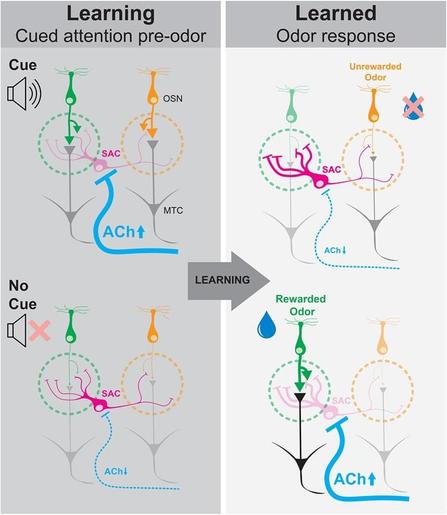
This Primer explores two @PLOSBiology studies that reveal how short axon cells in the #OlfactoryBulb integrate #cholinergic input from the basal #forebrain to dynamically regulate #olfactory input. Papers: https://plos.io/4pvost3 https://plos.io/3VnO1hT Primer: https://plos.io/3Ivzcqy

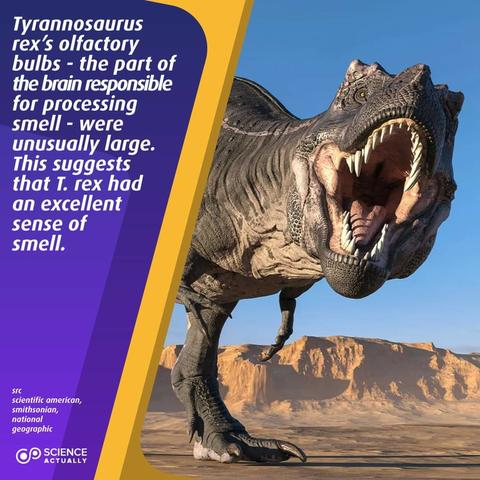
Tyrannosaurus rex's olfactory bulbs - the part of the brain responsible for processing smell - were unusually large. This suggests that T. rex had an excellent sense of smell, possibly one of the best among terrestrial animals, rivaling even modern vultures.

#science #sciencefacts #trex #tyrannosaurusrex #olfactorybulb #senseofsmell #smell

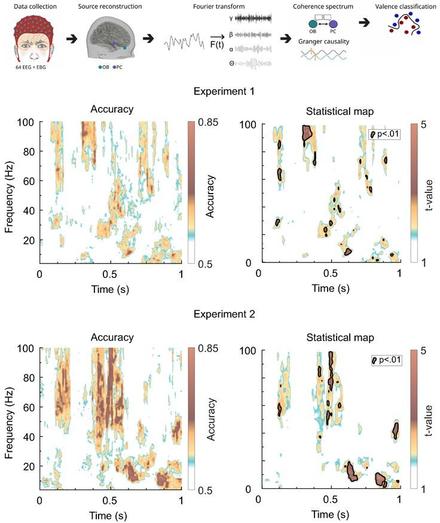
How is odor valence info communicated from our #OlfactoryBulb to #OlfactoryCortex? @NordenNeuro @OdorJohan &co reveal when subjective valence info is communicated, as well the type of info and the frequency band in which it is transferred #PLOSBiology https://plos.io/3NrX79q
The human olfactory bulb communicates perceived odor valence to the piriform cortex in the gamma band and receives a refined representation back in the beta band

How is information about odor valence communicated from the olfactory bulb to the olfactory cortex in humans? This neuroimaging study reveals when the subjective valence information is communicated, as well the type of information and the frequency band in which it is transferred.

Microplastics in the Olfactory Bulb of the Human Brain
16 September 2024
https://jamanetwork.com/journals/jamanetworkopen/fullarticle/2823787

doi:10.1001/jamanetworkopen.2024.40018

Quote from the article: "The cribriform plate reaches maturation at 1 to 2 years of age, which is a critical time window during which MP penetration into the brain could have negative effects on the organ maturation. n this study, the MP polymeric matrix found in the OB corresponds to the most produced and manufactured plastics, such as polypropylene, nylon/polyamide, polyethylene and polyethylene vinyl acetate, present in packaging, clothes and home accessories*, suggesting indoor environments as a major source of inhaled MPs."

~

When my niece was a toddler she would pull bits of fluff from her synthetic fiber blankie and stick it in her fist under her nose while she was sucking her thumb. It seemed cute at the time (40 years ago), now I worry for her.

* I'm guessing fleece blankets and carpeting are sources.

#health #microplastics #brain #OlfactoryBulb #neuroscience

Microplastics in the Olfactory Bulb of the Human Brain

This case series investigates microplastics in the olfactory bulbs of deceased individuals and examines their size, morphology, color, and polymeric composition.

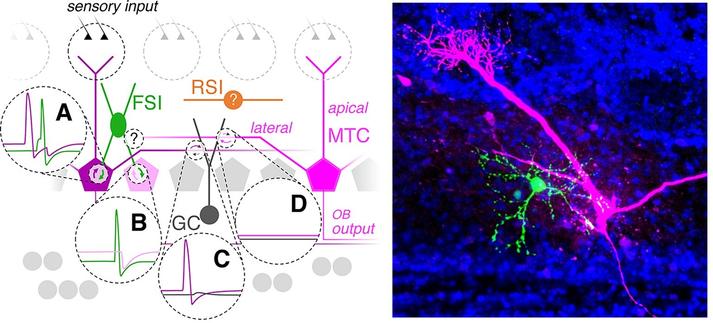
Inhibitory circuits in the #OlfactoryBulb shape info on its way from peripheral receptors to the cortex downstream. @NNUrban &co show that fast-spiking #interneurons perisomatically inhibit projection #neurons in the OB via synaptic detonation #PLOSBiology https://plos.io/4cFxDiV
Fast-spiking interneuron detonation drives high-fidelity inhibition in the olfactory bulb

Inhibitory circuits in the mammalian olfactory bulb shape information as it propagates from peripheral receptors to the downstream cortex. This study reveals that fast-spiking interneurons perisomatically inhibit projection neurons in the mammalian olfactory bulb via synaptic detonation.

Smelling danger in the water: Schreckstoff mystery solved after 86 years

Researchers led by Yoshihiro Yoshihara at the RIKEN Center for Brain Science in Japan have solved a fishy mystery dating back to 1938: What is the schreckstoff—or alarm substance—that fish smell when their shoal-mates are injured?

Phys.org