 Bryan King
The Broken Mesh: Why the Fight Between Meshtastic and MeshCore Matters
2,734 words, 14 minutes read time.
The fracture between the Meshtastic and MeshCore projects is a warning that you cannot ignore. For years, people thought a simple, off-grid data net was the answer for when the main lines go down. But now, the community is divided. This is not just a small fight over code. It is a total disagreement on how to handle communication when things get ugly. If you think you are ready just because you bought a cheap radio board and did not bother to learn how the software actually works, you are just a hobbyist playing with toys. The rift between Meshtastic and MeshCore shows how fragile these systems are and why you need to know your gear inside and out. A mesh net is only as good as its weakest link. If you do not master the tech, you are just a dead node in a silent town. We are seeing the growing pains of a decentralized technology that is outstripping the discipline of its users. You must choose your tools based on the reality of the physics, not the popularity of the app. Demand that your firmware be an efficient tool for data transmission, not a bloated social media platform for the 915 MHz band. If you do not take the time to understand the modulation, the packet structure, and the routing logic of the software you flash onto your hardware, you are just a child playing with a walkie-talkie while the grown-ups are trying to build a grid. Mastery of the radio spectrum is not an option; it is a requirement for anyone who claims to be prepared. This split is the first real test of whether civilian mesh can survive the chaos of its own success. You either learn to navigate the airwaves or you signal your own failure. Every packet you send without understanding the cost is a round wasted in a firefight. Stop treating your emergency comms like a smartphone app and start treating it like the life-support system it is. This technical mastery is the difference between a working link and a radio that does nothing but drain your battery in the dark.
Troubleshooting LoRa Mesh Protocol Inefficiency and Network Congestion
The fight between Meshtastic and MeshCore comes down to how they use the radio waves and the small chips that run them. Meshtastic has been the big name for a long time. It uses a flooding method where every radio repeats every message it hears. In the woods, that is fine. In a city with a hundred users, it is a train wreck. The air gets crowded, messages hit each other, and the whole system jams itself. MeshCore did not start because people wanted a new app. It started because the old way is inefficient. The core of the split is about the overhead—the extra data that hitches a ride on every message. Meshtastic adds a lot of features, but those features take up space. MeshCore wants to strip everything down to the bone so the network stays stable. When you have very little room to send data, every extra bit is a mistake. This is a battle between lots of features and it just has to work. If your software is fighting your hardware, you lose. The divergence between Meshtastic and MeshCore is rooted in the physics of the 900 MHz ISM band and the limitations of the ESP32 and nRF52 chipsets. As the node count grows, the airwaves become a chaotic mess of collisions and retransmissions, effectively jamming the very frequency the operators are trying to utilize. While Meshtastic has focused on a feature-rich user experience with a heavy reliance on a specific structure, MeshCore proponents argue for a leaner, more modular approach that prioritizes the stability of the underlying mesh over the bells and whistles of the interface. When you are operating on a low-bandwidth, high-latency medium like LoRa, every byte of overhead is a liability. You either master the protocol or you become a dead node. The math does not lie even if the marketing does. If your network protocol consumes more than ten percent of your bandwidth for heartbeats, your network is dying. Every extra feature in the code is another potential point of failure when the signal gets weak. You have to decide if you want a chat app or a survival tool. The flooding algorithm used by Meshtastic is a blunt instrument that was never meant for high-density urban deployment. It works by simply re-broadcasting every unique packet received until a hop limit is reached. In a sparse environment, this ensures the message gets through by any means necessary. But as the number of nodes increases, the probability of two nodes transmitting at the same time goes up. This leads to packet collisions where neither message is readable. MeshCore attempts to solve this by moving toward a more structured routing system. This means the software tries to figure out the best path for a message instead of just yelling it to everyone. This shift requires a level of technical discipline that many casual users find frustrating. It means the network is less plug-and-play and more of a precision tool. If you want a network that survives a real crisis, you have to move away from the chaos of flooding. You have to understand how the Media Access Control layer handles traffic. You have to know how to set your timing parameters so you are not stepping on your own neighbors. The split is a clear line in the sand between those who want ease of use and those who want engineering reliability. You cannot hide from the physics of the airwaves. Either your packets move or they die in the dirt. Stop assuming the software will fix your bad placement. Fix the engineering or get off the air.
Physics of LoRa Packet Collisions and Signal to Noise Ratio Analysis
To understand this split, you have to look at how these radios actually talk. They use a low-power system called LoRa. It is built for long range, but it is slow. There are strict rules on how long you can broadcast before you have to shut up and let others speak. Because Meshtastic repeats everything, adding more people makes the problem worse fast. This is not a glitch. It is physics. MeshCore was built to change how messages find their path through the net. Instead of everyone yelling at once, it wants a smarter way to move data that does not waste airtime. The split happened because one group likes the safety of repeating everything, while the other wants a clean, quiet network. If your radio is spending eighty percent of its power just saying I am here, you are not communicating—you are just making noise. The split proves that the current path is heading for a crash where no one can get a message through. LoRa is designed for long-range, low-power communication, but it is inherently limited by the Duty Cycle regulations of the FCC Part 15 and similar international bodies. Meshtastic’s current implementation of the flooding protocol means that as you add more users, the probability of packet storms increases exponentially. MeshCore was conceptualized to address the need for a more rigid, perhaps even more disciplined, routing logic that could potentially mitigate the hidden node problem and reduce the airtime usage per packet. The technical fallout between the two development paths stems from a disagreement on how to manage the limited airtime of the ISM band. One camp believes in the resilience of redundant flooding, while the other seeks a more surgical, routed approach to data delivery. This is a matter of Spectral Efficiency. If your mesh is using the majority of its available airtime just to say it exists, you have failed as an operator and an engineer. You are polluting the spectrum with digital noise. This noise prevents emergency traffic from getting through. It creates a false sense of security where people think they have a working link when they actually have a jammed one. You must look at the duty cycle of your own node. If you are transmitting more than one percent of the time in the 900 MHz band, you are likely part of the problem. MeshCore is an attempt to force the network into a more responsible state. It prioritizes the survival of the link over the convenience of the user. This is a hard truth that many do not want to hear. Physics does not care about your feelings or your user interface. It only cares about the signal-to-noise ratio. If your signal is lost in the noise of your own network, you have built nothing but a very expensive paperweight. Every packet sent is a risk. In a real-world scenario, a long transmission can be used to find your location. Flooding makes this risk much higher because your message is repeated over and over by every node in the area. A routed system like what MeshCore aims for reduces this risk by limiting the number of times a message is sent. This is not just about efficiency; it is about security. You have to understand that the airwaves are a shared resource. If you treat them like your own personal garbage dump, you will find yourself alone and unheard when the time comes to actually send a call for help. The split between Meshtastic and MeshCore is a debate over the very future of private, off-grid data. One side wants to make it accessible to everyone, while the other wants to make it work when nothing else does. You have to decide which side of that line you stand on. If you are not monitoring your packet loss and your noise floor, you are not an operator. You are just a passenger in a system that is bound to fail. Stop looking at the colorful screens and start looking at the spectrum. The truth is in the waterfall, not the icons. The physics of 915 MHz demand respect that a plug and play mindset cannot provide.
Off-Grid Communication Solutions and Technical Radio Discipline
The result of this fight is a mess where gear running one software will not talk to gear running the other. For you, that means your radio is a brick if your neighbor is on the other side of the fence. This is how a mesh net dies. A mesh needs everyone to speak the same language. When the builders split, the network breaks. This should wake up anyone who thinks they can just download a file and be safe. The hard truth is that we are seeing a new tech grow too fast for the people using it. You have to pick your tools based on facts, not what looks cool. Demand software that moves data fast and clean. If you do not know how your radio sends a packet or why some settings work better than others, you have no business relying on this in a pinch. The split between Meshtastic and MeshCore is a reminder that in the world of radio, there are no shortcuts. For the operator in the field, this means your gear might be useless if the person three blocks away is running a different branch of the protocol. This is the death of a mesh. A mesh requires a common language, a shared set of timing parameters, and a unified understanding of frequency hopping and spreading factors. When the developers split, the network breaks. This should serve as a wake-up call to anyone who thinks they can outsource their emergency communications to a GitHub repository they do not understand. The split between Meshtastic and MeshCore is a reminder that in the world of RF, there are no shortcuts. If you cannot explain the difference between a Spreading Factor of seven and twelve, or why a 125kHz bandwidth is preferable over 250kHz in a high-noise environment, you have no business relying on these tools. The hard truth is that we are witnessing the growing pains of a decentralized technology that is outstripping the discipline of its users. You must take personal responsibility for your station. This means testing your range with real-world obstacles. It means understanding how your antenna height and gain affect your local mesh. It means being able to re-flash your firmware in the dark while the rain is pouring down. If you cannot do these things, you are not prepared. You are just a collector of electronic gadgets. The discipline of the amateur radio spirit must be applied to these new digital modes. We are losing the technical edge that made the license worth having in the first place. The split is a chance to reset. It is a chance to move away from the appliance operator mindset and back toward the engineering mindset. You should be auditing your own mesh. Look at the traffic logs. See how many packets are being dropped. See how many of your traffic is just node discovery overhead. If you find that your network is inefficient, do not wait for a developer to fix it. Change your settings. Educate your neighbors. If the split leads to a better, more efficient protocol, then it was worth the friction. But if it just leads to two broken networks instead of one, then we have all lost. The practical application of this knowledge is simple: test everything. Do not assume your mesh will work because the light on the board is green. Prove it. Send data over the longest possible path. Monitor the battery drain. Watch the spectrum on an analyzer if you have one. If you do not have the tools to verify your network, you do not have a network. You have a hope. And hope is not a plan for communication. Secure your nodes, harden your protocol, and stop relying on software you have never bothered to read. The day is coming when the only thing between you and the void is the connection you built yourself. Don’t let it be a connection built on laziness. Clean up your messy node or accept that you will be silent when it matters.
Conclusion: The Future of Decentralized Mesh Networks and User Mastery
The discipline of the old-school radio operator has to be applied here or the whole thing will fail. The split between Meshtastic and MeshCore is a call to stop being a lazy user and start being a real operator. We do not have time for good enough when the grid is down. Check your gear, learn the rules of the airwaves, and be ready for a future where the channels are full and the software is broken. Build your setup expecting things to break. There is no room for being soft. Learn the math, understand your range, and make sure every message you send is worth the airtime. The grid is weak, the airwaves are crowded, and your own lack of knowledge is the only thing truly blocking your signal. Fix your gear, learn the system, and stop waiting for someone else to save you. The grid is fragile, the spectrum is finite, and your ignorance is the only thing standing between you and a total blackout. Fix your station, fix your protocol, and stop waiting for someone else to secure your link. The time for playing games with digital toys is over. Mastery is the only way forward. Master the code, master the RF, or stay off the air. This hobby demands engineers, not appliance operators. Be the asset the network needs, not the QRM that kills it. Finalize your build, test the link, and maintain the discipline required to keep the airwaves open for those who truly need them.
Call to Action
Join the Network and Master Your Comms Before the Grid Goes Dark. The split between Meshtastic and MeshCore is a wake-up call for every operator. You cannot afford to be a passive user when the lines of communication are at stake. Whether you choose the feature-rich path or the lean efficiency of the core, the responsibility for a working link lies with you. Don’t wait for a crisis to realize your nodes are misconfigured or your protocol is inefficient. Start auditing your setup today by getting out in the field to find your real-world limits, diving into the spreading factors to clear the noise, and educating your local mesh to ensure your neighborhood stays connected. The airwaves belong to those who master them. Secure your hardware, flash your firmware, and become a reliable node in the decentralized future. Join the conversation, build the grid, and stay off the silent list.
SUPPORTSUBSCRIBECONTACT MED. Bryan King
Sources
- FCC Part 15 Radio Frequency Devices – Federal Communications Commission
- SX1262 LoRa Transceiver Datasheet – Semtech
- Meshtastic Project Documentation – Meshtastic
- A Study of LoRa: Long Range and Low Power Networks for the Internet of Things – IEEE
- The ARRL Handbook for Radio Communications – ARRL
- Guide to Bluetooth Security (RF Protocol Standards) – NIST
- LoRaWAN 1.1 Specification – LoRa Alliance
- Do LoRa Low-Power Wide-Area Networks Scale? – IEEE
- ESP32 Series Datasheet – Espressif Systems
- nRF52840 Product Specification – Nordic Semiconductor
- Terminology for Constrained-Node Networks – IETF
- ITU Handbook on Land Mobile Communications – International Telecommunication Union
- Protocol Buffers Documentation – Google Developers
- Understanding the Basics of LoRa and LoRaWAN – DigiKey
- LoRa Technology: A Technical Overview – NXP Semiconductors
- LoRaWAN Documentation – The Things Network
- Guide to Bluetooth Security – NIST Special Publication
- LoRa Physical Layer Packet Structure – RF Wireless World
- LoRa Wireless Technology – Microchip Technology
- Understanding and Enhancing RF Link Budget – Analog Devices
- LoRaWAN Technology Overview – STMicroelectronics
- Analysis of the Capacity and Scalability of LoRaWAN – ResearchGate
- Fundamentals of the LoRa Physical Layer – EDN Network
- What is LoRa Technology? – everything RF
- Link Budget Basics – Microwaves101
- LoRa Long Range Technology Overview – Texas Instruments
- Scalability of LoRaWAN for Massive IoT Deployment – MDPI Sensors
- Detailed Study of LoRa Low Power Communications – PMC
- 11 Myths About LoRa and LoRaWAN – Electronic Design
- LoRa Modulation Basics – Microwave Journal
Disclaimer:
The views and opinions expressed in this post are solely those of the author. The information provided is based on personal research, experience, and understanding of the subject matter at the time of writing. Readers should consult relevant experts or authorities for specific guidance related to their unique situations.
Related Posts
#915MHz #airtimeOptimization #AmateurRadio #antennaGain #bandwidthManagement #communicationSecurity #communityMesh #constrainedNodes #dataTransmission #DecentralizedNetworks #digitalModes #DisasterRecovery #dutyCycle #emergencyComms #ESP32 #FCCPart15 #firmwareFlashing #floodingProtocol #gridDownComms #hiddenNodeProblem #IoTScalability #ISMBand #linkBudget #LoRa #LoRaWAN #meshNetworking #MeshCore #Meshtastic #networkCongestion #nodeDensity #nRF52840 #offGridCommunication #packetCollisions #packetLoss #protocolOverhead #radioDiscipline #radioFrequency #RFEngineering #RFInterference #routingLogic #signalPropagation #SignalToNoiseRatio #SNR #spectralEfficiency #spreadingFactor #survivalTech #SX1262 #TacticalComms #wirelessProtocols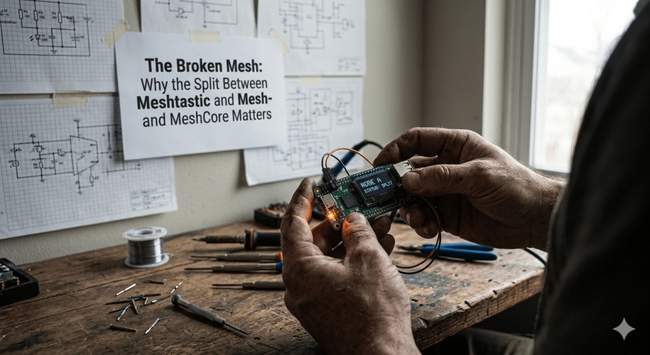
 Jorge Luis ⁂
 NERDS.xyz – Real Tech News for Real Nerds [Unofficial]
 Jay Cee
 DoomsdaysCW

 PeggyD