 Davide Madrisan 🚴♂️🎵
Most likely the last update in the year 2024 of my #HadCRUT5 global temperature data plot.
#GitHub project @ https://github.com/madrisan/HadCRUT5
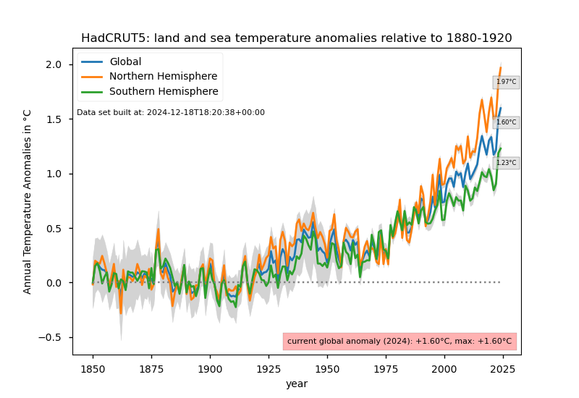
Most likely the last update in the year 2024 of my #HadCRUT5 global temperature data plot.
#GitHub project @ https://github.com/madrisan/HadCRUT5
#HelloWorld Underwhelming result
The picture is but a copy paste of this code https://stackoverflow.com/questions/61527498/how-to-insert-txt-data-into-netcdf-in-python
Amending my data to fit the example took 2 minutes.
But getting rid of the numerous error messages beforehand took 2 full days of fiddling with #python and #NetCDF4 versions on my Mac .
Glad I documented the process from the very beginning so I can backtrace my install configuration in case I run into more errors. Which I probably will, having had to install old versions of almost everything as one of the workarounds.
Incredible, the problems one needs to solve before you can <start> using a new language like python.
What do we see? A screenshot of a Panoply map plot with Germany in the center. And coloured squares which stand for the difference in January maximum precipitation 1960-1990 versus 2000-2023, averaged on 1°x1° fields.
Where it is blue – in the western half of Germany – January had higher maximum precipitation in mm from 1960-1990 compared to 2000-2023.
And in the East, the January maxima used to be lower than they are nowadays.
I won't explain more right now regarding methods and data.
Am just tooting this as a hello-world-sort-of-thing. With a big sigh of relief that I made it to this project milestone, at all. Wanted to give up more than once in the past 48 hours...phew!
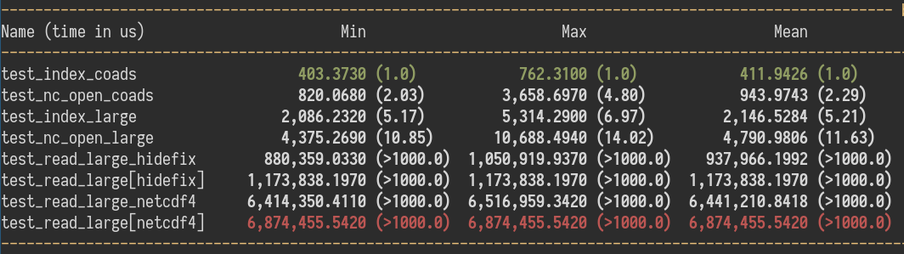
hidefix (https://github.com/gauteh/hidefix) can now be used as an #xarray backend: more than 6x faster on a 8 CPU machine!
This reads a full variable of about 370mb.
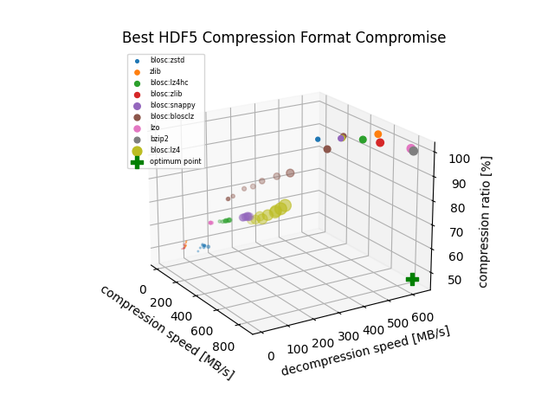
@thfriedrich I benchmarked the different compression algorithms in #HDF5 once if you're interested: https://gitlab.com/-/snippets/2043808
With the metric I use there (distance to optimum 'fast and small'), blosc:lz4 is the best compromise.
I still hit a wall with #HDF5 at some point though, I guess the compression prevented something from being done, I don't remember...
Also, #NetCDF4 is a subtype of #HDF5 so you'll feel familiar.
 anlomedad
 gauteh
 Yann Büchau
 Thomas Friedrich