 Education & Knowledge
How Memories Form

How Memories Form
Thomas Misgeld talks about the SyNergy #ClusterofExcellence in the new EXplained episode. The cluster explores interactions between #nervecells, #immune- and #vascularsystems with the goal to develop new therapies: https://go.tum.de/499143
📷 ProLehre
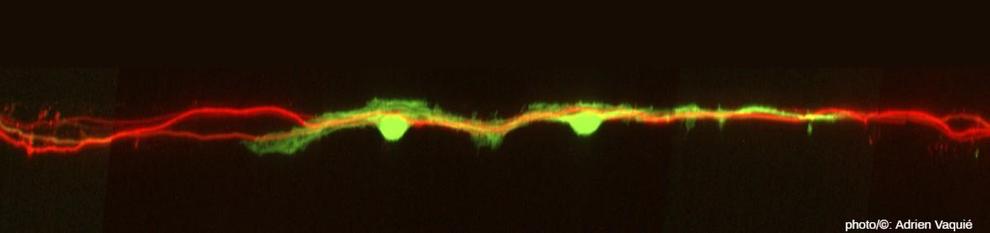
Ablation of #HDAC8 accelerates the regeneration of neurons and the recovery of the sensory function: Histone deacetylase 8 converts sensory Schwann cells into their repair phenotype following injuries to the peripheral nervous system 👉 https://press.uni-mainz.de/ablation-of-hdac8-accelerates-the-regeneration-of-neurons-and-the-recovery-of-the-sensory-function/
#neurobiology #NeuralRegeneration #neurons #SchwannCells #NervousSystem #NerveCells #hypoxia


No brains, no problem 🤷♂️
"#Jellyfish change their behaviour based on past experiences, researchers have revealed, in a study that suggests #learning could be a fundamental property of the way #NerveCells work."
Jellyfish show how you don’t need a #brain to learn, say researchers | #AnimalBehaviour | The Guardian
https://www.theguardian.com/science/2023/sep/22/jellyfish-learning-behaviour-neurons-study

#Jellyfish shown to learn from past experience for the first time https://phys.org/news/2023-09-jellyfish-shown.html
Associative #learning in the #BoxJellyfish #Tripedalia cystophora https://www.cell.com/current-biology/fulltext/S0960-9822(23)01136-3
"#CaribbeanBoxJellyfish can learn at a much more complex level than ever imagined—despite only having one thousand #NerveCells and no centralized #brain."
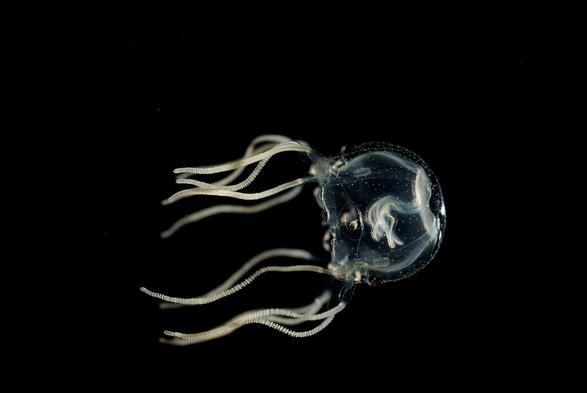

Jellyfish are more advanced than once thought. A new study from the University of Copenhagen has demonstrated that Caribbean box jellyfish can learn at a much more complex level than ever imagined—despite only having one thousand nerve cells and no centralized brain. The finding changes our fundamental understanding of the brain and could enlighten us about our own mysterious brains.

People with Huntington’s disease lose control of their bodies and minds. The symptoms are caused by protein clumps in the nerve cells. Supported by a Marie Skłodowska-Curie Individual Fellowship, Andrea Quezada aims to create atomic models of these fibrils at the Max Delbrück Center.
Referenced link: https://medicalxpress.com/news/2023-06-poorly-insulated-nerve-cells-shown.html
Discuss on https://discu.eu/q/https://medicalxpress.com/news/2023-06-poorly-insulated-nerve-cells-shown.html
Originally posted by Phys.org / @physorg_com: http://nitter.platypush.tech/medical_xpress/status/1664639520770334729#m
RT by @physorg_com: Poorly insulated #nervecells shown to promote #Alzheimer'sdisease in old age @nature https://www.nature.com/articles/s41586-023-06120-6 https://medicalxpress.com/news/2023-06-poorly-insulated-nerve-cells-shown.html

Alzheimer's disease, an irreversible form of dementia, is considered the world's most common neurodegenerative disease. The prime risk factor for Alzheimer's is age, although it remains unclear why. It is known that the insulating layer around nerve cells in the brain, named myelin, degenerates with age. Researchers at the Max Planck Institute (MPI) for Multidisciplinary Sciences in Göttingen have now shown that such defective myelin actively promotes disease-related changes in Alzheimer's. Slowing down age-related myelin damage could open up new ways to prevent the disease or delay its progression in the future.
 Technische Universität München
 Mainz University
 Angstrom Minerals
 Norobiik @
 Lukas VFN 🇪🇺
 Max Delbrück Center
 Matt Willemsen
 Phys.org