
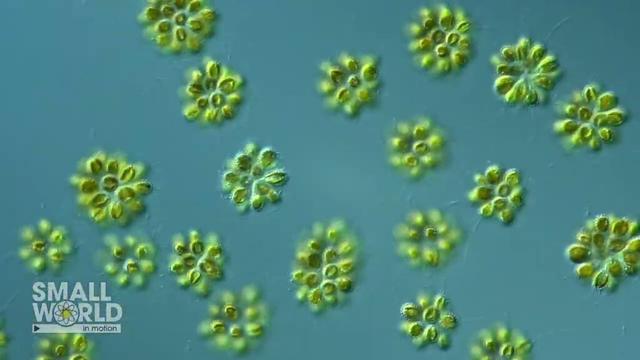
Like most microswimmers, these Synura uvella algae use cilia to swim. Cilia are tiny, hair-like appendages that flap to produce thrust. Even under a microscope, the cilia are hard to see because they are so thin and move quickly in and out of the microscope’s narrow focus. A cilia’s stroke is always asymmetric — no simple back-and-forth motions for them — because, at the algae’s scale, symmetric motion won’t move you anywhere. This is a peculiar feature of small swimmers in viscous fluids. At the human scale, we can mimic the same physics by mixing and unmixing fluids like corn syrup. (Video and image credit: L. Cesteros; via Nikon Small World in Motion)

Synura uvella algae swimming under magnification.

https://fyfluiddynamics.com/2024/10/swimming-with-cilia/

#biology #cilia #fluidDynamics #laminarFlow #microswimmer #physics #science #viscousFlow
2024 Small World in Motion Competition

View the winning entries from the 2024 Small World in Motion Competition

Nikon Small World

Just like human swimmers, microswimmers have to coordinate their motion to swim. But unlike humans, swimmers like the freshwater alga Chlamydomonas reinhardtii doesn’t have a brain to help it synchronize its cilia. To investigate how these microswimmers manage their stroke, researchers built a biorobot with mechanically linked segments that mimic the alga’s swimming once a motor sets the robot vibrating.

When the robot’s base is allowed to rotate, the cilia synchronize in the freestyle-like R-mode. When allowed to move along an axis, the biorobot’s cilia synchronize in the X-mode, which resembles the breaststroke.

The researchers found two strokes that mirrored the real-life alga. In one, allowing the robot’s base to rotate produced a freestyle-like stroke they called R-mode. The other came from allowing the robot’s base to move forward and backward, which created a breaststroke-like X-mode. In the wild, only the X-mode provides helpful motion, but, oddly enough, the researchers found this mode was the most energy intensive. (Image credit: top – J. Larson, others – Y. Xia et al.; research credit: Y. Xia et al.; via APS Physics)

https://fyfluiddynamics.com/2024/09/synchronizing-cilia/

#biology #biorobotics #fluidDynamics #microswimmer #physics #science #synchronization

Photo by Jonathan Larson on Unsplash

There are few places more still than a swamp near sundown. – Download this photo by Jonathan Larson on Unsplash

#SoftMatter have just published the results of a project that Renato Assante, Davide Marenduzzo, Alexander Morozov, and I recently worked on together! What did we do and what’s new? Briefly…

#Microswimmer suspensions behave in a similar way to fluids containing kinesin and microtubules. Both systems can be described by the same system of three coupled nonlinear #PDEs.

A #LinearStabilityAnalysis of these equations suggests that variations in concentration across the system don’t significantly affect emergent #phaseBehaviour. How then can we explain #experiments that show visible inhomogeneities in #microtubule#kinesin mixtures, for instance?

With increasing activity, we move away from the quiescent regime, past the onset of #SpontaneousFlow, and deeper into the active phase, where #nonlinearities become more important. What role do concentration inhomogeneities play here?

We investigated these questions, taking advantage of the #openSource #Dedalus #spectral framework to simulate the full nonlinear time evolution. This led us to predict a #novel regime of #spontaneous #microphaseSeparation into active (nematically ordered) and passive domains.

Active flow arrests macrophase separation in this regime, counteracting domain coarsening due to thermodynamic coupling between active matter concentration and #nematic order. As a result, domains reach a characteristic size that decreases with increasing activity.

This regime is one part of the #PhaseDiagram we mapped out. Along with our other findings, you can read all about it here!

low #ReynoldsNumber #turbulence #ActiveTurbulence #CahnHilliard #ActiveMatter #NavierStokes #BerisEdwards #CondensedMatter #PhaseTransitions #TheoreticalPhysics #BioPhysics #StatisticalPhysics #FluidDynamics #ComputationalPhysics #Simulation #FieldTheory #paperthread #NewPaper #science #research #ActiveGel #activeNematic #analytic #cytoskeleton #hydrodynamics #MPI #theory

Active turbulence and spontaneous phase separation in inhomogeneous extensile active gels

We report numerical results for the hydrodynamics of inhomogeneous lyotropic and extensile active nematic gels. By simulating the coupled Cahn–Hilliard, Navier–Stokes, and Beris–Edwards equation for the evolution of the composition, flow and orientational order of an active nematic, we ask whether compositio