Redirecting
📢 Our next #DFG -funded symposium on
"Recent advances in #MetaAnalysis"
will be taking place May 28/29 in Göttingen.
For more details, see here:
➡️ https://medstat.umg.eu/aktuelles/symposium-meta-analysis-2026/
and stay tuned for updates!
This synthesis aggregates findings from more than 200 meta-analyses, clarifying which ADHD treatments show real benefit and supporting evidence-based practice for clinicians, psychologists, psychiatrists, therapists, and social workers.
A companion interactive public website enables people with ADHD and care teams to explore what actually works, promoting shared decision-making; it also flags that most solid evidence covers short-term effects, highlighting a gap in long-term data.
Article Title: A massive ADHD study reveals what actually works
Link to Science Daily Mind-Brain News: https://ift dot tt/t4VM6L1
#ADHD #EvidenceBasedPractice #MetaAnalysis #MentalHealthProfessionals #ClinicalDecisionMaking
Copy and paste broken link above into your browser and replace "dot" with "." for link to work.
We have to do it this way to avoid display of copyrighted images.
Meta-Mar - AI-integrated {meta-analysis platform}
The tool supports a wide range of meta-analytic procedures, from basic effect size calculations to advanced heterogeneity assessment and publication bias evaluation.
Trong Magic: The Gathering Arena, cùng hạng nhưng người chơi có thể gặp các meta khác nhau vì MMR ẩn, trọng số bộ bài và cách xếp hàng. Câu hỏi: làm sao xác thực meta thực tế cho từng người và tránh bias? #MagicArena #Gaming #MetaAnalysis #MagicTheGathering #TròChơi #PhânTíchMeta
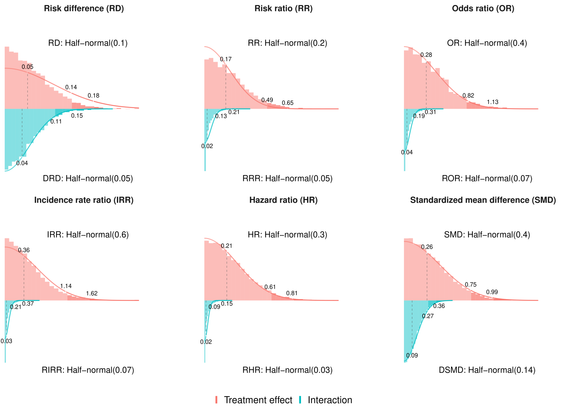
🤔 Meta-analyses considering differences between subgroups within each study ("treatment-by-subgroup interactions") do not necessarily yield matching estimates for effects within subgroups and the difference between them.
💡 @panaro worked out how explicit consideration of information fractions contributed by subgroups in the analysis model allows to fix this counterintuitive behaviour; see here for details:
➡️ https://arxiv.org/abs/2512.18785
(joint work with @friede1).

Commonly, clinical trials report effects not only for the full study population but also for patient subgroups. Meta-analyses of subgroup-specific effects and treatment-by-subgroup interactions may be inconsistent, especially when trials apply different subgroup weightings. We show that meta-regression can, in principle, with a contribution adjustment, recover the same interaction inference regardless of whether interaction data or subgroup data are used. Our Bayesian framework for subgroup-data interaction meta-analysis inherently (i) adjusts for varying relative subgroup contribution, quantified by the information fraction (IF) within a trial; (ii) is robust to prevalence imbalance and variation; (iii) provides a self-contained, model-based approach; and (iv) can be used to incorporate prior information into interaction meta-analyses with few studies.The method is demonstrated using an example with as few as seven trials of disease-modifying therapies in relapsing-remitting multiple sclerosis. The Bayesian Contribution-adjusted Meta-analysis by Subgroup (CAMS) indicates a stronger treatment-by-disability interaction (relapse rate reduction) in patients with lower disability (EDSS <= 3.5) compared with the unadjusted model, while results for younger patients (age < 40 years) are unchanged.By controlling subgroup contribution while retaining subgroup interpretability, this approach enables reliable interaction decision-making when published subgroup data are available.Although the proposed CAMS approach is presented in a Bayesian context, it can also be implemented in frequentist or likelihood frameworks.
Irregular Diet and Esophageal Cancer:
🍽️ 6 studies analyzed
📊 Found RR of 4.181 (95% CI 2.196 – 7.960)
🔬 Heterogeneity sources: non-disease, nurses, Asians
#EsophagealCancer #IrregularDiet #MetaAnalysis #Genetics #Pub2Post https://tnyp.me/gQApwmOQ/m

People tend to perceive their personal risk from climate change as lower than the risk faced by others, which can demotivate engaging in mitigation actions. A meta-analysis now quantifies this perception gap, showing that its global and regional variation depends on who the ‘other’ is.
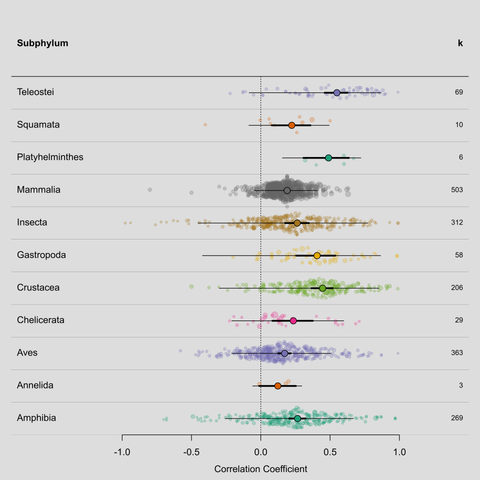
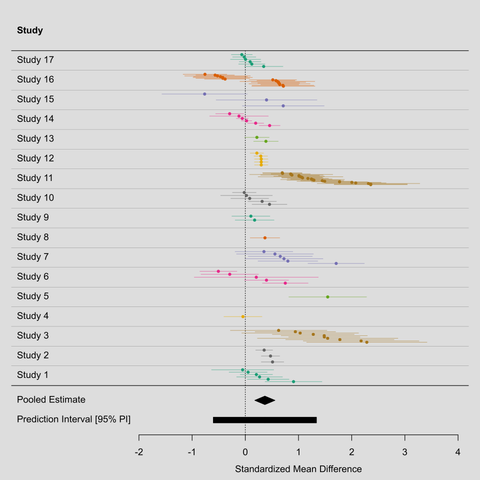
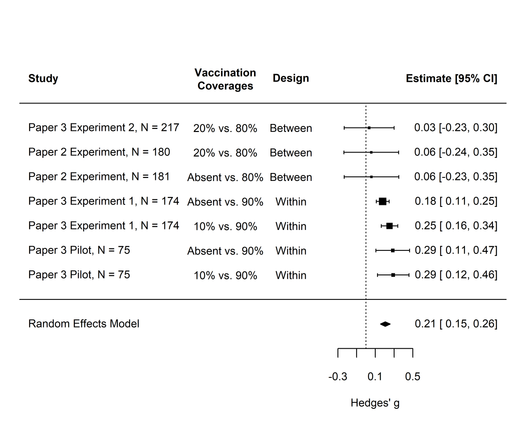
I did end up making some plots with orchaRd 2.0 last night. Not as pretty as the figures in the package authors' paper (these are rough versions), but I think they still show how informative these plots can be!