Quote of the day, 14 March: St. Raphael Kalinowski

[In 1874, Saint Raphael] Kalinowski was already living a quasi-Carmelite life before he had even decided to join the Carmelites.

“I long for a regulated life, because nothing disturbs interior harmony so much as the absence of exterior peace—and how destructive that is! I’m beginning to convince myself that the worst thing in this world is to spend your time being torn apart inside. I aspire after one thing: to maintain purity of heart, because a conscience free from all sin allows the soul to lift itself up to God and helps it sustain the burden of life with a good heart. Also I am very stressed and today I started to look for an occupation which could engage all the hours of my day. Unemployment, in effect, is most injurious to an interior life, because it opens the door of our soul to the devil.”

In March 1874, Kalinowski had begun a novena to his patron St. Joseph, and this reminded him to write to his parents and thank them, especially his mother, for inculcating in him a devotion to St. Joseph.

Kalinowski wrote to Father Fiszer, his spiritual director in Irkutsk, and included in it a letter for the exiled Bishop [Kaspar] Borowski. In replying to this letter, Fiszer remarked:

“I read your letter aloud to His Excellency. The good old man listened benevolently and in regard to your desire to consecrate yourself to the service of God, he gave me this message: ‘go to a warm country and put it into effect.’ His Excellency is quite sure that the sacrifice of your life will be of benefit to humanity and will redound to God’s glory and that you will find immense good.”

Timothy Tierney, o.c.d.

Chapter 9, Transition Period

Tierney, T  2016,  Saint Raphael Kalinowski: Apprenticed to Sainthood in Siberia,  Balboa Press  Australia.

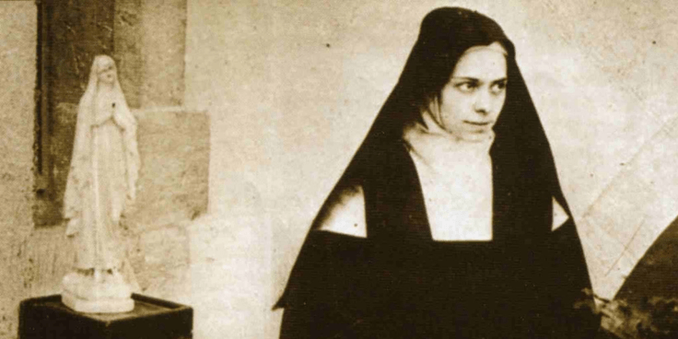
Featured image: Saint Raphael of St. Joseph Kalinowski, edited from the photo taken 30 March 1897. Photo credit: Discalced Carmelites (Used by permission)

#Carmelite #interiorLife #StJoseph #StRaphaelKalinowski #vocation

Jesus, the Spring of Living Water — Silvio José Báez, ocd

Dear brothers and sisters,

During the coming Sundays of Lent, we will hear three beautiful passages from the Gospel of John. Since ancient times, the Church has used these texts as a catechesis for those preparing to receive baptism at Easter—and as a help for all of us who are already baptized to renew our baptismal faith.

They are the encounter of Jesus with the Samaritan woman, which reveals him as the source of living water; the healing of the man born blind, which shows him as the light that heals our blindness; and the raising of Lazarus, which presents him as the life that conquers death.

So the three great Paschal symbols that will accompany us in the liturgy beginning today are water, light, and life.

Today, we heard the story of Jesus meeting a Samaritan woman. Jesus arrives at a small village in Samaria. It’s midday. He’s tired from the journey and thirsty, so he sits down beside a well.

Just then, a Samaritan woman comes to draw water. She’s anonymous. Her life is fragile and complicated. She belongs to a people whose religious practices were far from the Lord and mixed with other beliefs.

This woman represents the people of Samaria—but also all humanity, each one of us. She’s like a bride who has gone after other loves, yet whom God now wants to win back and draw again with his love.

Jesus says to her, “Give me a drink” (Jn 4:7).

She’s surprised that a Jewish man would ask her for water, since Jews and Samaritans didn’t associate with one another. But in those simple words—“Give me a drink”—something very profound is revealed. God is thirsty. Not thirsty for water, but thirsty to be welcomed and loved.

God thirsts for you and for me. He thirsts for humanity.

That’s why Jesus tells her: “If you knew the gift of God, and who it is that is saying to you, ‘Give me a drink,’ you would have asked him, and he would have given you living water” (Jn 4:10).

Notice that Jesus doesn’t argue with the woman. He doesn’t scold her or accuse her. Instead, he speaks to her about a gift—the “gift of God.”

A gift is something freely given. It isn’t earned or deserved.

That woman knows only effort and fatigue. Every day she has to come to the well and draw water. But Jesus offers her a different kind of water—one that doesn’t depend on human effort or on our own merits and virtues.

Jesus explains: “Everyone who drinks of this water will be thirsty again. But those who drink of the water that I will give them will never be thirsty. The water that I will give will become in them a spring of water gushing up to eternal life” (Jn 4:13–14).

The woman becomes excited and asks for that water. And who wouldn’t? Who wouldn’t want a gift that could change life forever?

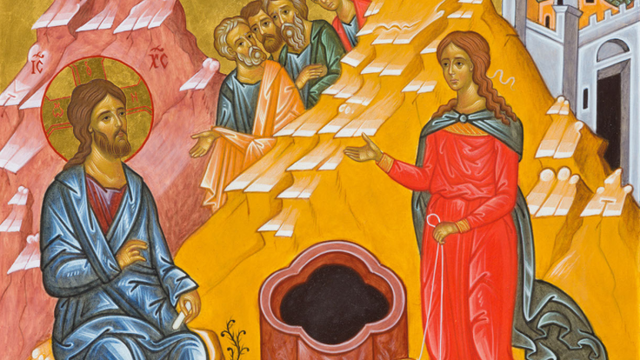
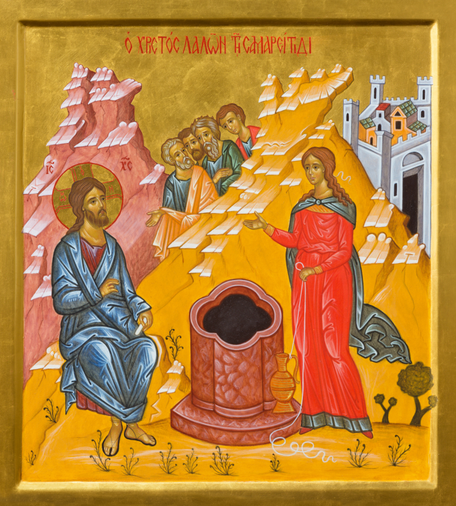
Jesus and the Samaritan woman at the well, Byzantine icon by Giancarlo Pellegrini, Chiesa di San Pietro, Bologna, Italy.
Image credit: Renáta Sedmáková / Adobe Stock

So many times we drink from different wells—success, possessions, pleasure, recognition—yet we remain thirsty. Jesus offers us something different: living water that springs up from within and fills our whole life.

In the Jewish tradition, the well symbolized the law of Moses with its commandments and norms. It was like water that nourished good works. In that sense, the well represented a religion centered on external observance of the law.

Jesus offers something deeper. He doesn’t speak about rituals or rules to fulfill. He speaks about an interior spring—a life within us that makes us free, joyful, and full.

The water Jesus offers is the love of God. It’s like a spring that flows endlessly within us, giving life, healing wounds, and helping life grow and mature. It’s a source that satisfies our deepest thirst for love and meaning. And it doesn’t stay closed within us—it overflows into the lives of others.

Even if our jar is cracked and our thirst isn’t completely satisfied yet, we can still become a source of living water for others—a fresh cup of water, or even just a drop of the life-giving love of God.

The living water of the Spirit also responds to the thirst of peoples for justice and peace. Oppressive regimes, unjust social systems, and corrupt forms of power can’t be overcome by human effort alone.

True social transformation begins with the transformation of the human heart. Without men and women who are free, converted, and purified from idols—people who are honest, capable of fraternity, and committed to justice—efforts to change society often end up repeating new forms of oppression.

It isn’t enough to change structures. God must renew our hearts.

The spring of living water is Jesus himself. He is God’s answer to our thirst. From the day of our baptism, his word and his Spirit have been alive within us, giving us a life that is strong, luminous, and free.

But over time, that spring can become buried. Sometimes it seems as if it has disappeared. The heavy stones of suffering, the fine sand of our fears, and the foul debris of our sins can slowly cover over the living water within us.

Lent is the time to clear away those obstacles—to free the heart so the water of Christ can flow again.

Recently, speaking to Spanish seminarians, Pope Leo used a striking image. He said:

“It is said that trees ‘die standing’: they remain upright, they retain their appearance, but inside they are already dry… Spiritual life does not bear fruit because of what is visible, but because of what is deeply rooted in God. When that root is neglected, everything ends up drying up inside, until, silently, it ends up ‘dying standing upright.’”

Something like that can happen to us, too. We can be very busy. We move from one activity to another. We carry out projects, we fulfill responsibilities—we even come to church.

But inside we may feel empty, restless, or sad—because we’ve lost living contact with the Lord.

When we neglect our interior life, when the living water of God’s love stops flowing within us, everything slowly dries up.

That’s why today’s Gospel invites us to return to the heart.

Let’s return to prayer.
Let’s listen again to the Word of God.
Let’s rediscover the grace of the sacraments.

Let’s return to the heart.

At one point, the Samaritan woman asks Jesus: “Where should we worship God? On this mountain, or in Jerusalem?”

Jesus’ answer is surprising. Worship is not limited to a place—not to a mountain or a temple. The true place of encounter with God is within.

You are the temple where God lives. In your heart, he has placed a spring of water that never stops flowing.

Let’s allow Jesus to quench our thirst with the living water of his love. Let’s not settle for “dying standing”—looking alive on the outside, but dry within.

Silvio José Báez, o.c.d.

Auxiliary Bishop of Managua
Homily for the Third Sunday in Lent, 8 March 2026

Translation from the Spanish text is the blogger’s own work product and may not be reproduced without permission.

#interiorLife #JesusChrist #livingWater #loveOfGod #SamaritanWoman

Dois extremos do espectro mangá: a entrada num mundo novo e a persistência num mar sem fim. A estante agradece, e a ansiedade do dentista amanhã vai ter muita distração de qualidade.

#Mangá #HiromuArakawa #DaemonsOfTheShadowRealm #OnePiece #Timbaúva #InteriorLife

É a matemática perfeita do interior: usar uma obrigação de saúde futura como desculpa totalmente válida para um tour cultural-farmacológico na cidade grande mais próxima.

Volto pra casa com a mochila cheia e a consciência tranquila de que, pelo menos, meus interesses pessoais estão em dia. O dentista que espere.

#InteriorLife #SantaMaria #Mangá #CulturaDeRua #LogísticaPessoal #FugindoDaRotina

Quote of the day, 28 October: Jessica Powers

The saints and mystics
had a name
for that deep
inwardness of flame,
the height or depth
or ground or goal
Which is God’s dwelling
in the soul.

Not capax Dei
do you say;
nor yet
scintilla animae
nor synderesis
all are fair—
but heaven,
because God is there.

All day and when
you wake at night
think of that place
of living light,
yours and within you
and aglow
where only God
and you can go.

None can assail you
in that place
save your own evil,
routing grace.
Not even angels
see or hear,
nor the dark spirits
prowling near.

But there are days
when watching eyes
could guess that you
hold Paradise.
Sometimes the shining
overflows
and everyone
around you knows.

Sister Miriam of the Holy Spirit, OCD (Jessica Powers)

For a Child of God (1953)

Powers, J 1999, The Selected Poetry of Jessica Powers, Siegfried, R & Morneau, RF (eds.), ICS Publications, Washington DC.

Featured image: Jude Beck / Unsplash (Stock photo)

#ChildOfGod #indwelling #interiorLife #JessicaPowers #poetry

Quote of the day, 14 August: Brother Lawrence

The [practice of the] presence of God is an application of our mind to God, or a remembrance of God present, that can be brought about by either the imagination or the understanding.

I know someone who, for forty years [Brother Lawrence is speaking of himself], has been practicing an intellectual presence of God to which he gives several other names. Sometimes he calls it a “simple act,” a “clear and distinct knowledge of God,” an “indistinct view,” or a “general and loving awareness of God.” Other times he names it “attention to God” “silent conversation with God,” “trust in God,” or “the soul’s life and peace.”

This person told me that all these forms of God’s presence are nothing but synonyms for the same thing, and that it is at present second nature to him. Here is how:

This person says that the habit is formed by the repetition of acts and by frequently bringing the mind back into God’s presence. He says that as soon as he is free from his occupations, and often even when he is most taken up by them, the recesses of his mind [esprit] or the innermost depths of his soul are raised with no effort on his part and remain suspended and fixed in God, above all things, as in its center and resting place.

Since he is generally aware that his mind, thus held in suspension, is accompanied by faith, he is satisfied. This is what he calls “actual presence of God,” which includes all the other types of presence and much more besides, so that he now lives as if only he and God were in the world. He converses with God everywhere, asks him for what he needs, and rejoices continuously with him in countless ways.

It is important, however, to realize that this conversation with God takes place in the depths and center of the soul. It is there that the soul speaks to God heart to heart, and always in a deep and profound peace that the soul enjoys in God.

Everything that takes place outside the soul means no more to it than a lit straw that goes out as soon as it is ignited, and almost never, or very rarely, disturbs its inner peace.

Brother Lawrence of the Resurrection, o.c.d.

Spiritual Maxims, 20–23

Lawrence of the Resurrection, B; De Meester, C 1994, Writings and Conversations on the Practice of the Presence of God,  translated from the French by Salvatore Sciurba, OCD, ICS Publications, Washington DC.

Featured image: Sister Vanesa Guerrero of the Purity of Mary Sisters looks out over the Balearic Sea at Valldemosa, Mallorca. Image credit: Vanesa Guerrero, rpm / Cathopic

#BrotherLawrenceOfTheResurrection #conversation #habit #interiorLife #presenceOfGod

Quote of the day, 26 May: St. Teresa Margaret

During the little chapter read at Terce on all the Sundays after the Epiphany and Pentecost, the following words from the first epistle of Saint John are chanted: “God is love, and he who dwells in love dwells in God and God in him” [1 Jn 4:16].

In 1767, probably toward the end of January, while Sister Teresa Margaret was assisting at the recitation of the Divine Office, she was seized with a type of rapture when she heard these words recited by the Hebdomadary [i.e., the nun assigned to lead the Divine Office]. It was so profound that its effects could still be noticed about three days later.

Although Teresa Margaret was extremely diligent in hiding the secrets of her interior life, this time she was so overwhelmed by the divine action that she could not detach herself from it. She went through the cloister so elated that she seemed to disregard her natural carefulness regarding the hidden life.

Frequently, she repeated the words “God is love” to herself. Others heard her and, wondering about this peculiar behavior, asked her why she repeated these words so often.

The saint, realizing that she had betrayed herself, said: “having heard them one Sunday at the little chapter of Terce, I found such sweetness in them and they made such an impression on me that I feel that I must repeat them.”

Father Gabriel of St. Mary Magdalene, O.C.D.

Part II, The Mystical Period

di Santa Maria Maddalena O.C.D., G 2006, From the Sacred Heart to the Trinity the spiritual itinerary of Saint Teresa Margaret of the Sacred Heart, O.C.D., translated from the Italian by Ramge, S, ICS Publications, Washington DC.

Featured image: Silhouette of a person sitting beside a calm lake at sunset. Image credit: Download a pic Donate a buck! / Pexels (Stock photo).

⬦ Reflection Question ⬦
Do I truly believe—deep down—that God is love, and that He loves me?
Join the conversation in the comments.

#DivineOffice #FrGabrielOfStMaryMagdalene #GodIsLove #interiorLife #mysticalExperience #rapture #StTeresaMargaretOfTheSacredHeart

The Church established the use of images for two principal reasons: the reverence given to the saints through them; and both the motivation of the will and the awakening of devotion to the saints by their means. Insofar as they serve this purpose their use is profitable and necessary.

We should consequently choose those images that are more lifelike and move the will more to devotion. Our concentration should be centered on this devotion more than on the elaborateness of the workmanship and its ornamentation.

There are, as I say, some people who pay more attention to the workmanship and value of the statue than to the object represented. And the interior devotion, which they should direct spiritually toward the invisible saint in immediate forgetfulness of the statue—since the purpose of the statue is to give motivation—is so taken up with the exterior artistry and ornamentation that the senses receive satisfaction and delight; then both the love and joy of the will dwell on that satisfaction. This is a total obstacle to authentic spirituality, which demands annihilation of the affections in all particular things.

Such an attitude is obvious in the abominable custom some have in these times of ours.

Without any abhorrence of vain worldly fashions, they adorn statues with the jewelry conceited people in the course of time invent to satisfy themselves in their pastimes and vanities, and they clothe the statues in garments that would be reprehensible if worn by themselves—a practice that was and still is abhorrent to the saints represented by the statues.

In company with the devil they strive to canonize their vanities, not without serious offense to the saints. By this practice the authentic and sincere devotion of the soul, which in itself uproots and rejects every vanity and trace of it, is reduced to little more than doll-dressing.

Some use the statues for nothing more than idols upon which they center their joy.

You will see some who never tire of adding statue on statue to their collection, or insist that the statue be of this particular kind and craftsmanship and placed in a certain niche and in a special way—all so these statues will give delight to the senses.

As for devotion of heart, there is very little. They are as attached as Micah and Laban were to their idols, for Micah left his house shouting because they were stolen; and Laban, after a long journey and being enraged, turned over all of Jacob’s household furnishings in search for them [Judg 18:23-24; Gen 31:23-35].

People who are truly devout direct their devotion mainly to the invisible object represented, have little need for many images, and use those that conform more to divine traits than to human ones. They bring these images—and themselves through them—into conformity with the fashion and condition of the other world, not with this one.

They do this so worldly images will not stir their appetite and so they will not even be reminded of the world, as they would in having before their eyes any object apparently a part of this world. Their heart is not attached to these goods, and if these are taken away, their grief is slight.

They seek the living image of Christ crucified within themselves, and thereby they are pleased rather to have everything taken from them and to be left with nothing.

Saint John of the Cross

The Ascent of Mount Carmel, III, ch. 35, nos. 3–5

John of the Cross, St. 1991, The Collected Works of St. John of the Cross, Revised Edition, translated from the Spanish by Kavanaugh, K and Rodriguez, O with revisions and introductions by Kavanaugh, K, ICS Publications, Washington DC.

Featured image: Photographer Marko Vombergar captured this image of a pilgrim to Argentina’s 2016 National Eucharistic Congress in Tucumán. Image credit: Marko Vombergar for aleteia.org / Flickr (Some rights reserved)

https://carmelitequotes.blog/2024/10/31/juan-subida-iii35/

#ChristCrucified #devotion #idolatry #image #interiorLife #motivation #prayer #StJohnOfTheCross #statue

Bible Gateway passage: Judges 18:23-24 - New Revised Standard Version Catholic Edition

They shouted to the Danites, who turned around and said to Micah, “What is the matter that you come with such a company?” He replied, “You take my gods that I made, and the priest, and go away, and what have I left? How then can you ask me, ‘What is the matter?’”

Bible Gateway

Rejoice, therefore, O my soul, that you can be the host of such a noble and excellent guest! Wash yourself, purify yourself, cleanse yourself, and banish far from your heart, through true contrition and repugnance, every stain of iniquity and sin, so as to prepare yourself to receive this Lord who dwells within you.

You have no need of anything from this guest, for He is Himself the author of all things. Tell me then, O my soul, will you not be blessed if you can find rest with your God and truly say: He who created me has taken rest in my tabernacle?

O my soul, tell me again, would you not consider yourself too miserly if the presence of such a noble Lord and guest were not enough to satisfy you, knowing that He is so generous that He will not fail to communicate His goods to you abundantly and will enrich you with an infinity of His gifts?

Blessed Mary of the Incarnation (Madame Acarie)

True Spiritual Exercises (excerpt)

Note: After assisting with the foundation of the Teresian Carmel in France and taking care of her husband Pierre until his death on 17 November 1613, then settling the inheritance, Madame Barbe Acarie, aged forty-eight, entered the Carmel of Amiens on 15 February 1614, taking the religious name of Sister Mary of the Incarnation. As a lay sister, she worked in the kitchen as much as her physical infirmities allowed her. With the agreement of the Prioress, she exercised a ministry of spiritual accompaniment to the Sisters, who asked for her help. Several months after the French Revolution’s Constituent Assembly suspended the profession of vows by religious men and women in France in October 1789, Pope Pius VI presided at the beatification of Madame Acarie on 5 June 1791 in Rome.

Translation from the French text is the blogger’s own work product and may not be reproduced without permission.

Featured image: Father Lawrence Lew, O.P. captured this image of the elevation of the Host at the requiem Mass of Dr. Mary Berry, CBE in 2008 at Dorchester Abbey. Image credit: Lawrence Lew, OP / Flickr (Some rights reserved)

https://carmelitequotes.blog/2024/06/04/acarie-tropavare/

#BlessedMaryOfTheIncarnation #cleanse #creator #generosity #gifts #indwelling #interiorLife #MadameAcarie #sin #soul