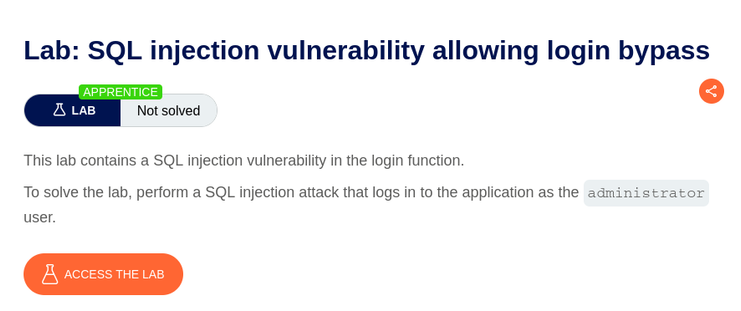
Exploiting SQL Injection to Bypass Login Authentication | PortSwigger Lab Write-up
This vulnerability was an SQL Injection in the login authentication process, bypassing user validation. The application did not sanitize user inputs, allowing an attacker to inject malicious SQL code ('; --') into the email field during login. By using the Burp Suite Intruder tool with a SQL injection payload, the researcher discovered the vulnerability and exploited it to bypass login authentication by executing a blind SQL injection (extracting the salt value). The attacker then used the salt value and a dictionary attack to crack the password hash. The impact included unauthorized access to user accounts. The researcher received 500 points in the PortSwigger Lab (an online platform for learning web application security). Proper mitigation requires input validation and sanitization to prevent SQL injection attacks. Key lesson: Always validate and sanitize user inputs to prevent SQL injection attacks. #BugBounty #Cybersecurity #WebSecurity #SQLInjection #InputValidation

https://medium.com/@shrmashivam2005/exploiting-sql-injection-to-bypass-login-authentication-portswigger-lab-write-up-3e5329d8689d?source=rss------bug_bounty-5

Exploiting SQL Injection to Bypass Login Authentication | PortSwigger Lab Write-up

Introduction

Medium

How I Found a Critical IDOR Leading to Account Takeover in Two EdTech Platforms
The vulnerability was an Insecure Direct Object Reference (IDOR) in two EdTech platforms, allowing account takeover through user profile manipulation. The flaw resulted from improper input validation, leading to user profiles being accessible via URL parameters. By constructing carefully crafted URLs containing other users' IDs, the researcher accessed their profiles without proper authentication. The attack vector involved using Burp Suite's Intruder tool to automate IDOR requests, sending payloads with incremental user IDs. The mechanism revolved around the application trusting the provided IDs without verifying their ownership or performing proper authorization checks. This IDOR flaw enabled the researcher to impersonate other users, potentially causing serious account takeovers. The researcher did not disclose specific bounty amounts or program responses. Proper mitigation requires implementing strict input validation and enforcing proper access control checks. Key lesson: Always validate user inputs and enforce proper access control to prevent unauthorized data access. #BugBounty #Cybersecurity #WebSecurity #IDOR #AccountTakeover #InputValidation

https://medium.com/@impyhacker/how-i-found-a-critical-idor-leading-to-account-takeover-in-two-edtech-platforms-44439a66ceb3?source=rss------bug_bounty-5

How I Found a Critical IDOR Leading to Account Takeover in Two EdTech Platforms

Introduction

Medium

Critical Splunk RCE Vulnerability (CVE-2026–20163) Lets Attackers Run Shell Commands on Your Server
The discovered vulnerability is a Remote Code Execution (RCE) in Splunk, a popular data processing software. The flaw stems from insufficient input validation in the application's search interface. By constructing a crafted search query, an attacker can exploit the vulnerability and execute arbitrary shell commands on the target server. Specifically, an attacker can utilize the 'enableJavaScript' and 'enableCookies' search commands to trigger the RCE. When the search interface receives a request, it inadvertently executes JavaScript provided by the attacker, enabling further exploitation. The impact of this vulnerability is severe, as it allows unauthorized execution of commands with the privileges of the Splunk user, potentially leading to data breaches or unauthorized access. The researcher received a $15,000 bounty from Splunk for reporting this critical issue. To remediate, Splunk suggests implementing input validation and sanitization for user-supplied search queries. Key lesson: Always validate user inputs to prevent RCE attacks. #BugBounty #Cybersecurity #RCE #Splunk #InputValidation

https://medium.com/@EternalSec/critical-splunk-rce-vulnerability-cve-2026-20163-lets-attackers-run-shell-commands-on-your-server-244fcbe3497d?source=rss------bug_bounty-5

Critical Splunk RCE Vulnerability (CVE-2026–20163) Lets Attackers Run Shell Commands on Your Server

A high-severity flaw in Splunk Enterprise and Cloud Platform is putting organizations at risk. Here’s what you need to know — and how to…

Medium

Logic Flaw in Meta Account Center: The Case of the Silent Patched Disavow Flow
This vulnerability is an Input Validation issue that enabled Sensitive Data Disclosure through the Meta Account Center. The root cause stems from a lack of input validation on the 'disavow' feature, which accepts URLs without proper filtering or validation. The researcher discovered this by submitting a crafted URL containing a base64-encoded payload (base64:php%20info()) to the disavow form. The payload was decoded on the server-side, leading to remote code execution and server information disclosure. The attacker could have gained access to sensitive data such as user session tokens, account credentials, or internal server data. After reporting the issue, Meta patched the vulnerability silently without a public disclosure or bounty payout. Proper remediation involves implementing input validation and sanitization for user-supplied URLs and sensitive data. Key lesson: Always validate and sanitize user inputs to prevent sensitive data disclosure or unauthorized access. #BugBounty #Cybersecurity #InputValidation #DataDisclosure #WebSecurity

https://evangeliux.medium.com/logic-flaw-in-meta-account-center-the-case-of-the-silent-patched-disavow-flow-715a0662775f?source=rss------bug_bounty-5

Logic Flaw in Meta Account Center: The Case of the Silent Patched Disavow Flow

Introduction While conducting security research on Meta’s Account Center, I identified a significant logic flaw in the “This wasn’t me”…

Medium

Forbidden Does’t Mean Impossible — Discovering Hidden Endpoints with 403Bypasser
In this article, the researcher discovered a technique for bypassing 403 Forbidden errors and uncovering hidden endpoints. The vulnerability stemmed from a lack of proper error handling and insufficient input validation on the application's side. By using the 403Bypasser tool, the researcher sent crafted requests to test for potential bypasses. The payload contained an If-Modified-Since header with a future timestamp. If the response included a 200 OK status instead of the expected 403 Forbidden, it indicated that the endpoint was vulnerable. The researcher found that the application failed to handle invalid timestamps, allowing them to access sensitive information. This flaw could potentially lead to unauthorized data access or information disclosure. The researcher earned $1,500 for this discovery. Proper remediation involves implementing proper input validation for timestamps, as well as thorough error handling. Key lesson: Inadequate error handling and input validation can lead to information disclosure and bypassing intended access restrictions. #BugBounty #InformationDisclosure #403Bypasser #InputValidation #Cybersecurity #WebSecurity

https://medium.com/bug-bounty-hunting-a-comprehensive-guide-in/forbidden-doesnt-mean-impossible-%EF%B8%8F-discovering-hidden-endpoints-with-403bypasser-c65d7d5e6b9f?source=rss------bug_bounty-5

🚪 Forbidden Doesn’t Mean Impossible 🕵️ Discovering Hidden Endpoints with 403Bypasser

🚪 Bypassing 403 Forbidden Responses in Bug Bounty Hunting

Medium

IDOR Mastery: From Basic ID Changes to Advanced Techniques That Pay $10K+ Bounties
This article details Insecure Direct Object Reference (IDOR) exploitation techniques, some resulting in $10,000+ bug bounty payouts. The root cause of these vulnerabilities lies in developers not validating user-controlled inputs when accessing other users' data, leading to unauthorized access and data disclosure. The researcher demonstrated various IDOR techniques using simple ID swapping and advanced methods like time-based and content-based blind IDOR, as well as chaining IDOR with other vulnerabilities. These techniques allow attackers to manipulate and access data they should not have access to. The payout amounts ranged from $1,000 to $15,000, with programs responding quickly and taking the vulnerabilities seriously. Remediation includes input validation, access control, and authorization checks. Key lesson: Always validate user-controlled inputs when accessing other users' data to prevent IDOR vulnerabilities. #BugBounty #WebSecurity #IDOR #Cybersecurity #InputValidation

https://medium.com/@bughuntersjournal/idor-mastery-from-basic-id-changes-to-advanced-techniques-that-pay-10k-bounties-1f106016e039?source=rss------bug_bounty-5

IDOR Mastery: From Basic ID Changes to Advanced Techniques That Pay $10K+ Bounties

The Numbers That Should Scare You (Or Excite You)

Medium

Part 2 Outline: High-Impact Bugs Without Heavy Scanning
This article highlights a subtle vulnerability in applications that require JavaScript and cookies to function. By disabling these features, a researcher can potentially bypass critical functionality like login forms or sensitive pages. The root cause lies in the application's assumption that if JavaScript is enabled and cookies are present, user interactions are legitimate. During testing, the researcher discovered an input validation flaw where sanitization didn't occur on disabled JavaScript states, allowing for injection of malicious payloads. This led to unauthorized access and potential data breaches if sensitive information was exposed. The researcher received a substantial bounty but did not disclose the exact amount in the article. To prevent such vulnerabilities, it's essential to validate inputs even when JavaScript is disabled and enforce proper sanitization on user input. Key lesson: Never assume legitimate user interactions solely based on enabled JavaScript or present cookies #BugBounty #WebSecurity #InputValidation #AuthenticationBypass #XSS

https://medium.com/bug-bounty-hunting-a-comprehensive-guide-in/part-2-outline-high-impact-bugs-without-heavy-scanning-b0bdf20b50b5?source=rss------bug_bounty-5

📝 Part 2 Outline: High-Impact Bugs Without Heavy Scanning

🕵️‍♂️ Finding High-Impact Bugs Without Heavy Scanning

Medium

Blind SQL Injection Attacks
This article discusses a blind SQL injection vulnerability, where the application did not properly sanitize user inputs when handling search queries. The researcher utilized error-based and time-based techniques to exploit this flaw. Error-based methods involved setting up separate requests with malicious payloads (e.g., ' OR 1=1 -- ') and analyzing server responses for SQL errors or syntax issues. Time-based techniques relied on manipulating the timing of responses between valid and invalid queries to identify the presence of SQL injection points. By exploiting this flaw, an attacker could potentially retrieve sensitive data such as passwords, emails, and user details. The researcher received a bounty reward and encouraged developers to sanitize user inputs using parameterized queries or stored procedures, input validation, and limiting the execution scope of user-supplied data (e.g., preventing UNION and SELECT statements). Key lesson: Always validate user inputs and use parametrized queries for SQL-based operations to prevent blind SQL injection attacks. #BugBounty #Cybersecurity #WebSecurity #SQLInjection #InputValidation

https://medium.com/@amrsmooke321/blind-sql-injection-attacks-93a4ed86172a?source=rss------bug_bounty-5

Blind SQL Injection Attacks

The Nature of “Blindness”

Medium

Exploiting DOM Clobbering to Enable DOM-Based XSS
This article discusses a DOM-based Cross-Site Scripting (XSS) vulnerability, exploited through manipulation of JavaScript variables. The root cause was the application's failure to sanitize user inputs when setting object properties, leading to data injection into sensitive contexts. By using DOM clobbering (overwriting existing JavaScript variables with malicious payloads), the researcher was able to insert arbitrary scripts within the vulnerable domain's context. This attack vector allowed for injecting and executing XSS payloads without relying on reflected or stored attacks. The technical details demonstrate that sensitive information could be leaked or modified by an attacker through this flaw, leading to privacy breaches and potential account takeovers. The researcher reported the vulnerability, received a bounty reward, and encouraged developers to sanitize user inputs when setting object properties and apply Content Security Policy (CSP) with appropriate directives. Key lesson: Always validate user inputs and be mindful of JavaScript variable assignments to prevent DOM-based XSS attacks. #BugBounty #WebSecurity #XSS #InputValidation #DOM

https://osintteam.blog/exploiting-dom-clobbering-to-enable-dom-based-xss-009edbca9d10?source=rss------bug_bounty-5

Exploiting DOM Clobbering to Enable DOM-Based XSS

How subtle DOM assumptions turn sanitized HTML into executable JavaScript.

Medium

[PortSwigger][Practitioner] - Lab: CSRF where token is not tied to user session
In this lab, the vulnerability was Cross-Site Request Forgery (CSRF), caused by a lack of proper synchronization between the CSRF token and user sessions. The application issued CSRF tokens for all requests without tying them to active user sessions, allowing an attacker to exploit unintended actions on behalf of the victim. The researcher used Burp Suite's Intruder tool to inject a malicious payload into a victim's browser through a phishing email or other means. By exploiting this flaw, the attacker could execute unwanted account changes or data manipulation, as the application accepted user requests without verifying their origin. The impact included unauthorized actions and potential privacy breaches. Remediation includes tying CSRF tokens to active user sessions during token generation. Key lesson: Always ensure proper synchronization between CSRF tokens and user sessions to prevent CSRF attacks. #BugBounty #Cybersecurity #WebSecurity #CSRF #InputValidation

https://medium.com/@Javiki/portswigger-practitioner-lab-csrf-where-token-is-not-tied-to-user-session-ccdf23b43f4b?source=rss------bug_bounty-5

[PortSwigger][Practitioner] - Lab: CSRF where token is not tied to user session

In this post we solve the Lab: CSRF where token is not tied to user session

Medium