Strontium signatures from German burial mounds point to long-distance mobility and elite networks between Scandinavia, Central Europe, and Italy.
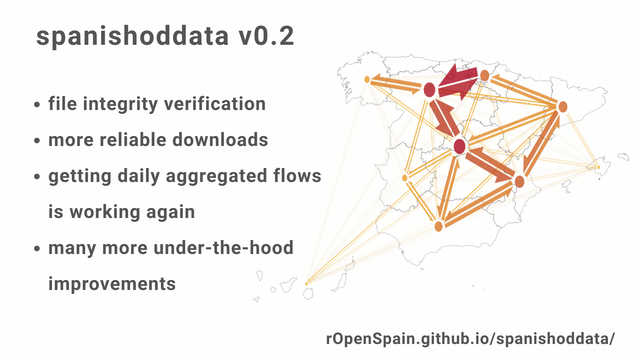
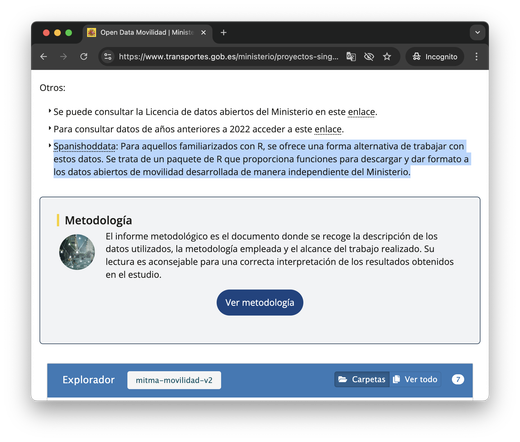
๐ ๐๐ฝ๐ฎ๐ป๐ถ๐๐ต๐ผ๐ฑ๐ฑ๐ฎ๐๐ฎ 0.2.0 is here. As before, you are getting nicely formatted Open Mobility Big Data released by the Spanish Ministry of Transport and Sustainable Mobility (MITMS) in a reproducible way. #rstats #opendata #HumanMobility #spanishoddata
- downloads more reliable
- file verification,
- improved docs
- quickly getting daily pre-aggregated data is working again
- more...
Get the package: https://ropenspain.github.io/spanishoddata/
Full change log: https://ropenspain.github.io/spanishoddata/news/index.html
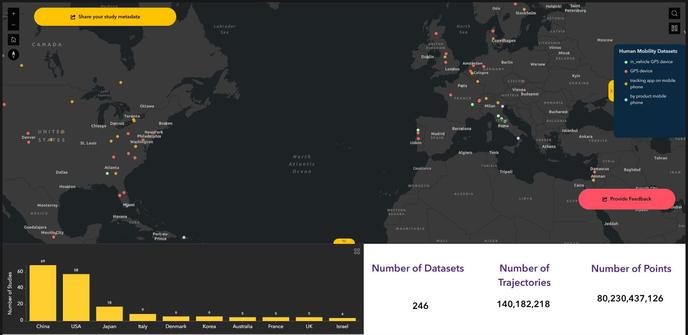
Ever wish you knew who already collected the GPS data you need?
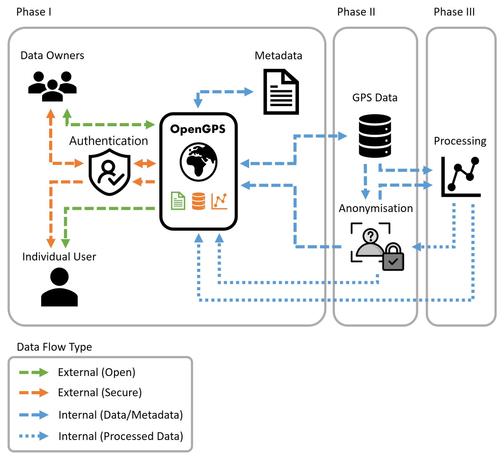
We propose OpenGPSโa platform to share, store & process human mobility tracking data.
๐ Phase I: metadata sharing, find out who has what
๐ฆ Phase II: data storage & sharing
๐ง Phase III: privacy-aware cloud-based analysis tools
โ Prototype already live
With @jedalong, @udemsar, Katarzyna Sila-Nowicka, Vanessa Brum-Bastos, Jinhyung Lee & Hui Jeong Ha.
๐ Paper: https://doi.org/10.1016/j.dib.2025.111603
Direct links for convenience ...
๐ Paper: https://www.mdpi.com/2071-1050/17/8/3634
Code: https://github.com/plus-mobilitylab/netascore/tree/v0.9.0
#Walkability #HumanMobility #MobilityDataScience #GIScience #GISchat #OSM
Even more human #MovementBehavior research:
Elkin-Frankston et al. (2025). Beyond boundaries: a location-based toolkit for quantifying group dynamics in diverse contexts. Cogn. Research 10, 10 (2025).
https://doi.org/10.1186/s41235-025-00617-6
"We first segmented time periods when the group was in motion by identifying break periods using the stop detection feature from the MovingPandas Python package"
#MovementDataAnalysis #MobilityDataAnalytics #MobilityDataScience #HumanMobility
Existing toolkits for analyzing movement dynamics in animal ecology primarily focus on individual or group behavior in habitats without predefined boundaries, while methods for studying human activity often cater to bounded environments, such as team sports played on defined fields. This leaves a gap in tools for modeling and analyzing human group dynamics in large-scale, unbounded, or semi-constrained environments. Examples of such contexts include tourist groups, cycling teams, search and rescue teams, and military units. To address this issue, we survey existing methods and metrics for characterizing individual and collective movement in humans and animals. Using a rich GPS dataset from groups of military personnel engaged in a foot march, we develop a comprehensive, general-purpose toolkit for quantifying group dynamics using location-based metrics during goal-directed movement in open environments. This toolkit includes a repository of Python functions for extracting and analyzing movement data, integrating cognitive factors such as decision-making, situational awareness, and group coordination. By extending location-based analytics to non-traditional domains, this toolkit enhances the understanding of collective movement, group behavior, and emergent properties shaped by cognitive processes. To demonstrate its practical utility, we present a use case utilizing metrics derived from the foot march data to predict group performance during a subsequent strategic and tactical exercise, highlighting the influence of cognitive and decision-making behaviors on team effectiveness.
#Introduction ๐
Hi everyone! FINALLY, Iโm happy to join Mastodon!
Iโm a #Postdoc at the University of Helsinki, working on #UrbanPlanning, #Transportation, #HumanMobility, and #AI.
Excited to connect, explore your work, and share mine!
Letโs talk #Science, #BigData, #SmartCities, #Sustainability, and more.
Gain seamless access to origin-destination (OD) data from the Spanish Ministry of Transport, hosted at <https://www.transportes.gob.es/ministerio/proyectos-singulares/estudios-de-movilidad-con-big-data/opendata-movilidad>. This package simplifies the management of these large datasets by providing tools to download zone boundaries, handle associated origin-destination data, and process it efficiently with the duckdb database interface. Local caching minimizes repeated downloads, streamlining workflows for researchers and analysts. Extensive documentation is available at <https://ropenspain.github.io/spanishoddata/index.html>, offering guides on creating static and dynamic mobility flow visualizations and transforming large datasets into analysis-ready formats.