How is cybersecurity law applied across European countries? How do its state members fit into the global picture? What's discretionary, and how can they ensure compliance?

#cybersecurity #europe #EU #europeanUnion #cybersecurityLaw #sovereignty #cyberGovernance #harmonization #NIS2 #GDPR #DORA #CRA #eIDAS2 #ECCC #ENISA

https://negativepid.blog/cybersecurity-in-europe-an-overview/


Cybersecurity in Europe: an overview - PID Perspectives

If 2013 marked the year Europe began to take cybersecurity seriously, the decade that followed transformed it into a legal and political priority.

PID Perspectives
🎶 Ah, the complexities of choral music—so elusive, they require a secret browser configuration just to discuss. Apparently, appreciating harmonized voices now demands a degree in web development. 😂🔧
https://marginalrevolution.com/marginalrevolution/2025/08/why-is-choral-music-harder-to-appreciate.html #choralmusic #webdevelopment #humor #harmonization #technology #HackerNews #ngated
Why is choral music harder to appreciate? - Marginal REVOLUTION

It has struck me that most recommenders and lovers of choral music and themselves singers (or conductors) of choral music.  It helps a great deal to be right there.  So it occurred to me there are a few reasons why choral music is harder to appreciate than say either symphonies or chamber music: 1. Mixtures […]

Marginal REVOLUTION

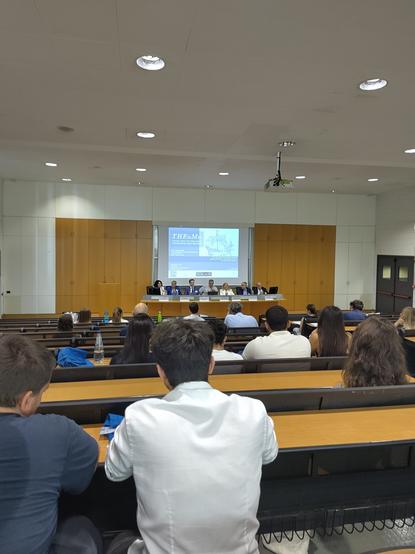
It's a wonderful morning here in #Milano - and we're starting day 2 of the #THEuMa Jean Monnet #Conference "Towards a #History of European Markets: #Institutionalization, #Standardization and Legal #Harmonization"!

https://theuma.net

#Bicocca #THEuMaConference #THEuMa2025 #JeanMonnet #Erasmus #Law #Economics #Science #EU #EuropeanUnion #Europa

The #THEuMa Jean Monnet #Conference "Towards a #History of European Markets: #Institutionalization, #Standardization and Legal #Harmonization" featuring over 45 speakers from all around the world is starting today, 14:00h at the University of #Milano #Bicocca!

#THEuMaConference #THEuMa2025 #JeanMonnet #Erasmus #Law #Economics #Science #EU #EuropeanUnion #Europa

https://theuma.net

@GESIS
Thanks for sharing the talk!
Here is the Question-Link R-Package and an in depth tutorial on using it:
https://matroth.github.io/questionlink/index.html

And please note that we also offer consultations regarding harmonization techniques (and other survey method topics).
https://www.gesis.org/en/consulting/survey-methods-consulting

#surveymethods #harmonization #rstats

Harmonizing single item survey questions on the same construct

What the package does (one paragraph).

#MeetTheExperts #mte
New #video on #YouTube: Meet our expert Dr. Ranjit Singh @https://fediscience.org/@[email protected] who will (1) briefly explain the #harmonization challenge, (2) explain how #QuestionLink resolves this challenge, and (3) give some practical guidance on how to tell if QuestionLink is the right fit for your project.
https://youtu.be/lJYqPFIvOog
Meet the Experts: Automating Survey Data Harmonization: The QuestionLink R-Package

YouTube

Matthias Roth (@rothm) and I published a new paper on survey data harmonization.

"One harmonization fits all? – Impact of missing population invariance on harmonization error when harmonizing social science survey questions with equating"

The paper again corroborates that observed score equating outperforms linear stretching on average. However, it also shows that it is better to derive a harmonization solution for single-item measures from a sample that is drawn from a similar population to the population you are interested in researching.

https://doi.org/10.1080/13645579.2025.2481112

#surveyresearch #surveymethods #harmonization

In a new paper, I simulate the consequences of combining survey data without proper harmonization techniques.

I demonstrate that there is a plausible risk of biased correlative analyses based on the integrated data, if we do not harmonize measurement units across different survey sources and instruments first.

#surveyresearch #surveymethods #harmonization

https://doi.org/10.5964/miss.11217

Biased Bivariate Correlations in Combined Survey Data Measured With Different Instruments| Measurement Instruments for the Social Sciences

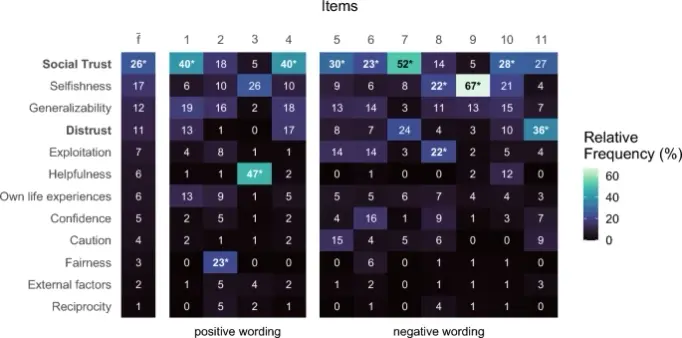
Together with Cornelia Neuert and Tenko Raykov, I looked into "Assessing conceptual comparability of single-item survey instruments with a mixed-methods approach".
Innovations are using a confirmatory factor analysis on a collection of single item instruments and comparing it with qualitative findings from probing questions.

To illustrate the approach, we assessed the comparability of social (dis-)trust questions.

#surveyresearch #harmonization

https://doi.org/10.1007/s11135-023-01801-w

Assessing conceptual comparability of single-item survey instruments with a mixed-methods approach - Quality & Quantity

An increasing number of research projects and infrastructure services involve pooling data across different survey programs. Creating a homogenous integrated dataset from heterogeneous source data is the domain of ex-post harmonization. The harmonization process involves various considerations. However, chief among them is whether two survey measurement instruments have captured the same concept. This issue of conceptual comparability is a fundamental precondition for pooling different source variables to form a harmonized target variable. Our paper explores this issue with a mixed-methods approach. On the one hand, we use psychometric latent variable modeling by presenting several single-item wordings for social trust to respondents and then performing factor analytic procedures. On the other hand, we complement and contrast these quantitative findings with qualitative findings gained with an open-ended web probe. The combined approach gave valuable insights into the conceptual comparability of the eleven social-trust-related single-item wordings. For example, we find that negative, distrust-related wordings and positive, trust-related wordings should not be pooled into an integrated variable. However, the paper will also illustrate and discuss why it is easier to disprove conceptual comparability than fully prove it.

SpringerLink