The Great Attractor: The Magnetic Pull of $14^\circ$ Sag 🧲
#SoulMission #GreatAttractor
Revisiting the Great Attractor: The Local Group's streamline trajectory, cosmic velocity and dynamical fate
We revisit the Great Attractor using the Manticore-Local suite of digital twins of the nearby Universe. The Great Attractor concept has been proposed as an answer to three distinct questions: what sources the Local Group velocity in the cosmic microwave background frame, where present-day velocity streamlines converge, and where the Local Group is moving to. Addressing the original motivation of the Great Attractor -- explaining the Local Group cosmic velocity -- we find that mass within $155~h^{-1}\mathrm{Mpc}$ accounts for only ${\sim}72\%$ of that velocity magnitude with ${\sim}38\,°$ directional offset. We show that even in the purely linear regime convergence within this volume is not guaranteed, particularly when also accounting for small-scale contributions to the observer velocity; no single structure, including the proposed Great Attractor, would be expected to dominate the velocity budget. Streamline convergence is smoothing-scale-dependent, transitioning from Virgo at small scales through the Hydra--Centaurus region at intermediate scales to Shapley at large scales; at intermediate smoothing the convergence point lies near Abell 3565 with an asymmetric basin of mass $\log( M / (h^{-1} \mathrm{M}_\odot)) = 16.4 \pm 0.1$ that excludes Norma. To address the third question, we evolve the Manticore-Local realisations to scale factor $a = 10$ in a new Beyond-Present-Time simulation suite and identify the asymptotic future location of the Local Group. We find that the dominant motion is towards Virgo, but even it contributes at most one third of the Local Group velocity. Our results demonstrate that the classical Great Attractor is not a dynamically dominant structure but an artifact of the instantaneous velocity field, and that no single attractor is likely to account for the Local Group motion in the cosmic rest frame.
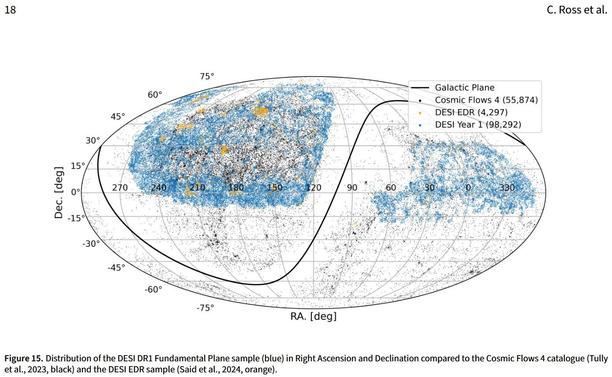
Wow 98,000 peculiar velocities
The DESI DR1 Peculiar Velocity Survey: Fundamental Plane Catalogue
by C.E. Ross and co-authors
https://arxiv.org/abs/2512.03226
For comparison: the Great Attractor was discovered with 400 PVs, Laniakea with 8000 PVs, South Pole Wall with 18,000 PVs
#Cosmicflows #Cosmology #DESI #Laniakea #GreatAttractor #SouthPoleWall #science #news #astrodon #arXiv #galaxies #peculiarvelocities
in the #arXiv
Revealing Hidden Cosmic Flows through the Zone of Avoidance with Deep Learning
by Alexandra Dupuy and co-authors
https://arxiv.org/abs/2511.03919
#Cosmology #Cosmicflows #GreatAttractor #Laniakea
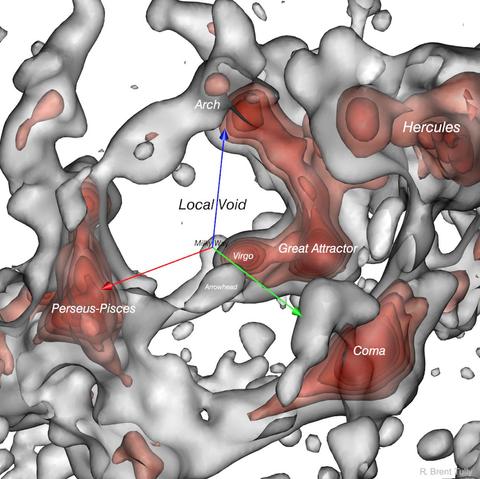
A map of the structure surrounding the Local Void
In this map our Milky Way galaxy lies at the origin of the red-green-blue orientation arrows, each 200 million lightyears in length.
☑️ this is Fig.1 of https://ui.adsabs.harvard.edu/abs/2019ApJ...880...24T/abstract
☑️ more insights by APOD: https://apod.nasa.gov/apod/ap190806.html
#Cosmology #Cosmography #LocalVoid #APOD #GreatAttractor #map #astronomy #astrophysics #astrodon #science #STEM #MilkyWay #galaxy #galaxies #CosmicWeb
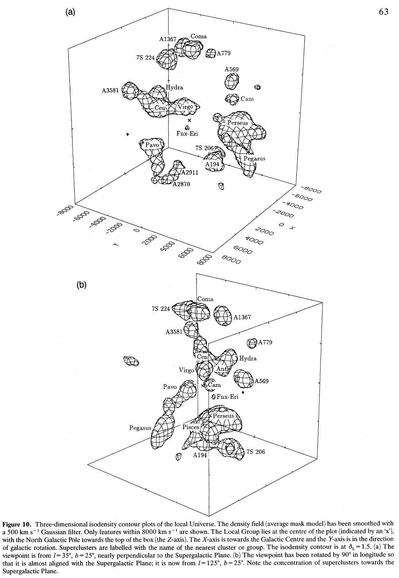
Optical galaxies within 8000 kms -1- I. The density field.
The density field of optical galaxies to a depth of 8000 km s^-1^ over 67 per cent of the sky is determined using the UGC and ESO catalogues. The reconstruction method compensates for the varying completeness of the redshift data and for the galaxies that are not selected in the catalogues. The optical density field is dominated by supercluster complexes with dimensions in excess of 6000 km s^-1^. The most prominent of these are Perseus-Pisces and Centaurus-Hydra-Virgo-Pavo. The same complexes are seen in maps of IRAS galaxies, but the contrast of the optical maps is higher by a factor of 1.35+/-0.16 when measured in 2500 km s^-1^ cells. By comparing the overdensity of galaxies in the Virgo supercluster to Virgo infall and assuming that mass follows light, we obtain {OMEGA} = 0.20_-0.14_^+0.30^. The `Great Attractor Region' covered by Dressler's Supergalactic Plane Survey is overdense to 6000 km s^-1^, well beyond the Cen 30 cluster. However, unless there is a massive supercluster hidden in the zone of avoidance, this region is not sufficiently overdense for it to be identified with the Great Attractor inferred from D_n_ - σ and Tully-Fisher peculiar velocities. Furthermore, within the Centaurus-Hydra-Virgo-Pavo complex, the density field peaks close to the Cen 30 cluster, which suggests that large-scale streaming motions may be better described by a weak 200+/-150 km s^-1^ infall centred near Cen 30, plus a bulk dipole motion of 400+/-150 km s^- 1^ in the CMB frame.
Effects of local cosmic inhomogeneities on the gravitational wave event rate
The local universe is highly inhomogeneous and anisotropic. We live in a relatively sparse region of the Laniakea supercluster at the edge of a large 80 Mpc-wide void. We study the effect of these inhomogeneities on the measured gravitational wave event rates. In particular, we estimate how the measured merger rate of compact binaries is biased by the local matter distribution. The effect of the inhomogeneities on the merger rate is suppressed by the low angular resolution of gravitational wave detectors coupled with their smoothly decreasing population-averaged sensitivity with distance. We estimate the effect on the compact binary coalescence event rate to be at most 6% depending of the chirp mass of the target binary system and the sensitivity and orientation of the detectors.
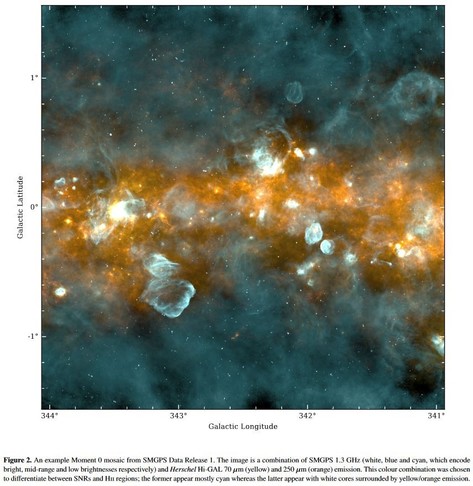

The SARAO MeerKAT 1.3 GHz Galactic Plane Survey
We present the SARAO MeerKAT Galactic Plane Survey (SMGPS), a 1.3 GHz continuum survey of almost half of the Galactic Plane (251°$\le l \le$ 358°and 2°$\le l \le$ 61°at $|b| \le 1.5°$). SMGPS is the largest, most sensitive and highest angular resolution 1 GHz survey of the Plane yet carried out, with an angular resolution of 8" and a broadband RMS sensitivity of $\sim$10--20 $μ$ Jy/beam. Here we describe the first publicly available data release from SMGPS which comprises data cubes of frequency-resolved images over 908--1656 MHz, power law fits to the images, and broadband zeroth moment integrated intensity images. A thorough assessment of the data quality and guidance for future usage of the data products are given. Finally, we discuss the tremendous potential of SMGPS by showcasing highlights of the Galactic and extragalactic science that it permits. These highlights include the discovery of a new population of non-thermal radio filaments; identification of new candidate supernova remnants, pulsar wind nebulae and planetary nebulae; improved radio/mid-IR classification of rare Luminous Blue Variables and discovery of associated extended radio nebulae; new radio stars identified by Bayesian cross-matching techniques; the realisation that many of the largest radio-quiet WISE HII region candidates are not true HII regions; and a large sample of previously undiscovered background HI galaxies in the Zone of Avoidance.
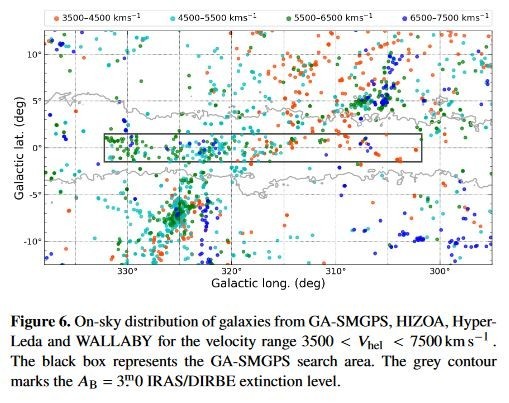
HI Galaxy Signatures in the SARAO MeerKAT Galactic Plane Survey $-$ I. Probing the richness of the Great Attractor Wall across the inner Zone of Avoidance
This paper presents the first HI results extracted from the SARAO MeerKAT Galactic Plane Survey (SMGPS) $-$ a narrow strip ($b \sim 3^\circ$) along the southern Milky Way. The primary goal consisted in tracing the Great Attractor (GA) Wall across the innermost Zone of Avoidance. We reduced a segment spanning the longitude range $302^\circ \leq \ell \leq 332^\circ$ for the redshift range $z \leq 0.08$. The superb SMGPS sensitivity (rms = 0.3-0.5 mJy beam$^{-1}$ per 44 kms$^{-1}$ channel) and angular resolution ($\sim$ 31" $\times$ 26") lead to a detection limit of log$(M_{\rm HI}/$M$_\odot) \geq$ 8.5 at the GA distance ($V_{\rm hel} \sim 3500 - 6500$ kms$^{-1}$). A total of 477 galaxy candidates were identified over the full redshift range. A comparison of the few HI detections with counterparts in the literature (mostly HIZOA) found the HI fluxes and other HI parameters to be highly consistent. The continuation of the GA Wall is confirmed through a prominent overdensity of $N = 214$ detections in the GA distance range. At higher latitudes, the wall moves to higher redshifts, supportive of a possible link with the Ophiuchus cluster located behind the Galactic Bulge. This deep interferometric HI survey demonstrates the power of the SMGPS in improving our insight of large-scale structures at these extremely low latitudes, despite the high obscuration and continuum background.
 Soul of the Cosmos
 Daniel Pomarède