 GM7077
One of the very few #galaxies in the #LocalVoid: KK 246, also known as ESO 461-036
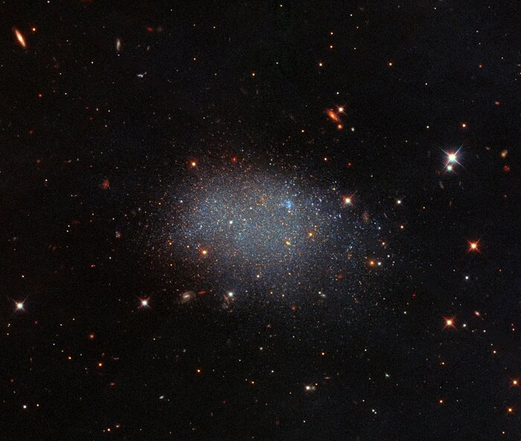
One of the very few #galaxies in the #LocalVoid: KK 246, also known as ESO 461-036
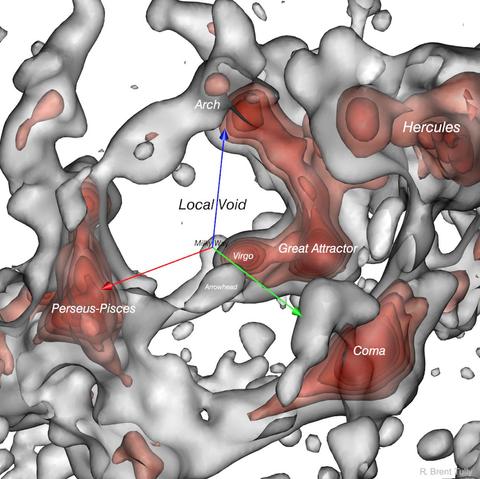
A map of the structure surrounding the Local Void
In this map our Milky Way galaxy lies at the origin of the red-green-blue orientation arrows, each 200 million lightyears in length.
☑️ this is Fig.1 of https://ui.adsabs.harvard.edu/abs/2019ApJ...880...24T/abstract
☑️ more insights by APOD: https://apod.nasa.gov/apod/ap190806.html
#Cosmology #Cosmography #LocalVoid #APOD #GreatAttractor #map #astronomy #astrophysics #astrodon #science #STEM #MilkyWay #galaxy #galaxies #CosmicWeb
O mistério do Local Cosmic Void
by Camila Franco and co-authors
https://periodicos.ufes.br/astronomia/article/view/44878
#Cosmology #Cosmography #LocalVoid #Astronomy #Astrophysics #Astrodon #science #research

in the #arXiv
Beyond the Local Void: A comprehensive view on the origins of the Amaterasu particle
by Nadine Bourriche and Francesca Capel
https://arxiv.org/abs/2406.16483
#amaterasu #cosmic #ray #cosmicray #particle #physics #astrophysics #astronomy #astrodon #universe #cosmology #localvoid #space #science #research #telescope #array #telescopearray #utah #japan #japanese #goddess #sun #mythology

We use the reconstructed properties of the Amaterasu particle, the second-highest energy cosmic ray ever detected, to map out three-dimensional constraints on the location of its unknown source. We highlight possible astrophysical sources that are compatible with these regions and requirements. Among these, M82, a powerful starburst galaxy, stands out as a strong candidate due to its position and proximity. To derive our constraints, we use CRPropa 3 to model all relevant propagation effects, including deflections in the Galactic and extra-Galactic magnetic fields. We consider key input quantities such as source distance, position, energy, and the strength and coherence length of the extra-Galactic magnetic field as free parameters. We then infer constraints on these parameters by applying approximate Bayesian computation. We present our results, demonstrating the impact of different assumptions for the arrival mass of the Amaterasu particle and the systematic uncertainties on the energy scale.
in the #arXiv
a study of the effects of local cosmic inhomogeneities (inferred from Cosmicflows-4) on the gravitational wave event rate
by Gonzalo Morras and Juan García-Bellido
https://arxiv.org/abs/2406.00691
#GravitationalWaves #Cosmicflows #Cosmology #Laniakea #supercluster #galaxies #LaniakeaSupercluster #GreatAttractor #LocalVoid #SloanGreatWall #LIGO #Virgo #KAGRA #interferometers #CosmicExplorer #EinsteinTelescope #Universe #Astronomy #Astrophysics #Astrodon #science #physics #blackholes
The local universe is highly inhomogeneous and anisotropic. We live in a relatively sparse region of the Laniakea supercluster at the edge of a large 80 Mpc-wide void. We study the effect of these inhomogeneities on the measured gravitational wave event rates. In particular, we estimate how the measured merger rate of compact binaries is biased by the local matter distribution. The effect of the inhomogeneities on the merger rate is suppressed by the low angular resolution of gravitational wave detectors coupled with their smoothly decreasing population-averaged sensitivity with distance. We estimate the effect on the compact binary coalescence event rate to be at most 6% depending of the chirp mass of the target binary system and the sensitivity and orientation of the detectors.
in the #arXiv
The SARAO MeerKAT 1.3 GHz Galactic Plane Survey
... with new insights on what's lurking in the Zone of Avoidance:
⭐️ The Vela Supercluster
⭐️ The Great Attractor
⭐️ The Local Void
by Sharmila Goedhart and co-authors
https://arxiv.org/abs/2312.07275
#sarao #meerkat #ska #ska_africa #survey #zoneofavoidance #galaxies #velasupercluster #greatattractor #localvoid #milkyway #galaxy #cosmography #map #maps #universe #astronomy #astrophysics #astrodon #space #science #research #southafrica
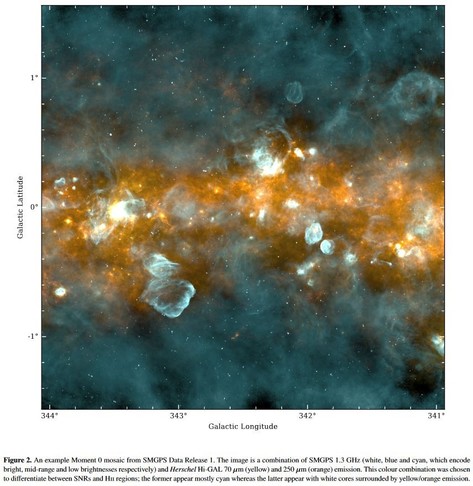

We present the SARAO MeerKAT Galactic Plane Survey (SMGPS), a 1.3 GHz continuum survey of almost half of the Galactic Plane (251°$\le l \le$ 358°and 2°$\le l \le$ 61°at $|b| \le 1.5°$). SMGPS is the largest, most sensitive and highest angular resolution 1 GHz survey of the Plane yet carried out, with an angular resolution of 8" and a broadband RMS sensitivity of $\sim$10--20 $μ$ Jy/beam. Here we describe the first publicly available data release from SMGPS which comprises data cubes of frequency-resolved images over 908--1656 MHz, power law fits to the images, and broadband zeroth moment integrated intensity images. A thorough assessment of the data quality and guidance for future usage of the data products are given. Finally, we discuss the tremendous potential of SMGPS by showcasing highlights of the Galactic and extragalactic science that it permits. These highlights include the discovery of a new population of non-thermal radio filaments; identification of new candidate supernova remnants, pulsar wind nebulae and planetary nebulae; improved radio/mid-IR classification of rare Luminous Blue Variables and discovery of associated extended radio nebulae; new radio stars identified by Bayesian cross-matching techniques; the realisation that many of the largest radio-quiet WISE HII region candidates are not true HII regions; and a large sample of previously undiscovered background HI galaxies in the Zone of Avoidance.
A search for dwarf galaxies in the Local Void, using data of the DESI Legacy Imaging Surveys
by Igor Karachentsev and co-authors
https://arxiv.org/abs/2312.04930
📷 Images of 12 new dwarf galaxies from DESI Legacy Imaging Surveys found in the Local Void region. Each image size is 2′ × 2′. North is to the top and East is to the left.
#galaxies #dwarfgalaxies #localvoid #void #voids #desi #survey #desisurvey #cosmology #cosmography #astronomy #astrophysics #astodon #space #science #research
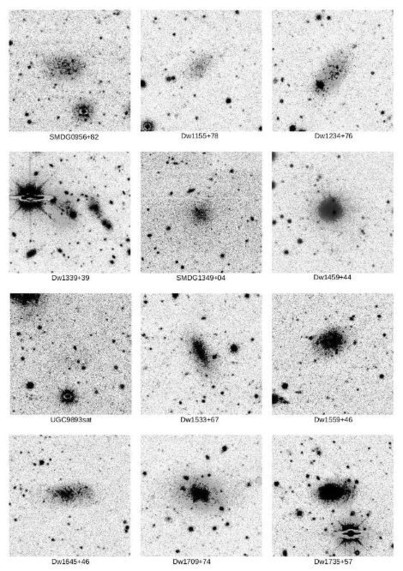
We undertook a search for new nearby dwarf galaxies outside the known groups in the Local Volume using the data on DESI Legacy Imaging Surveys. In a wide sky area of $\sim$5000 square degrees directed toward the Local Void, we found only 12 candidates to nearby low mass galaxies. Almost all of them are classified as irregular or transition type dwarfs. Additionally, we examined areas of the sky exposed with the Hyper Suprime Camera of the Subaru telescope ($\sim$700 square degrees) and found nine more candidates to nearby dwarfs. Finally, nine candidates to the Local Volume were selected by us from the Zaritsky's SMUDG catalog that contains 7070 ultra-diffuse objects automatically detected in the whole area of the DESI surveys. We estimated a fraction of quiescent dSph galaxies in the general cosmic field to be less than 10 percent.
in the #arXiv
galaxies in the Local Void, detected by the SARAO MeerKAT Galactic Plane Survey
by Sushma Kurapati and co-authors
https://arxiv.org/abs/2312.05237
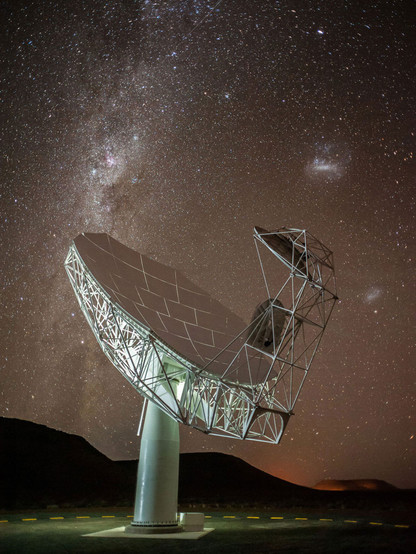
📷 One of the 64 antennas of the MeerKAT radio telescope, located in the Karoo, South Africa.
#galaxies #localvoid #milkyway #galaxy #zoneofavoidance #ska #ska_africa #sarao #meerkat #survey #cosmography #map #maps #cosmology #universe #astronomy #astrophysics #astrodon #space #science #research #karoo #southafrica
The Local Void is one of the nearest large voids, located at a distance of 23 Mpc. It lies largely behind the Galactic Bulge and is therefore extremely difficult to observe. We use HI 21 cm emission observations from the SARAO MeerKAT Galactic Plane Survey (SMGPS) to study the Local Void and its surroundings over the Galactic longitude range 329$^{\circ}< \ell <$ 55$^{\circ}$, Galactic latitude $|b| <$ 1.5$^{\circ}$, and redshift $cz <$ 7500 km/s. We have detected 291 galaxies to median rms sensitivity of 0.44 mJy per beam per 44 km/s channel. We find 17 galaxies deep inside the Void, 96 at the border of the Void, while the remaining 178 galaxies are in average density environments. The extent of the Void is ~ 58 Mpc. It is severely under-dense for the longitude range 350$^{\circ}< \ell <$ 35$^{\circ}$ up to redshift $z <$ 4500 km/s. The galaxies in the Void tend to have \HI masses that are lower (by approximately 0.25 dex) than their average density counterparts. We find several potential candidates for small groups of galaxies, of which two groups (with 3 members and 5 members) in the Void show signs of filamentary substructure within the Void.
The Amaterasu paper is on #arXiv
https://arxiv.org/abs/2311.14231
Congratulations to my friend Noémie Globus who co-authored this discovery!
Check out this Research Highlight by her: https://www.noemieglobus.com/post/a-new-extreme-energy-cosmic-ray-event
#amaterasu #cosmic #ray #cosmicray #particle #physics #astrophysics #astronomy #astrodon #universe #cosmology #localvoid #space #science #research #telescope #array #telescopearray #utah
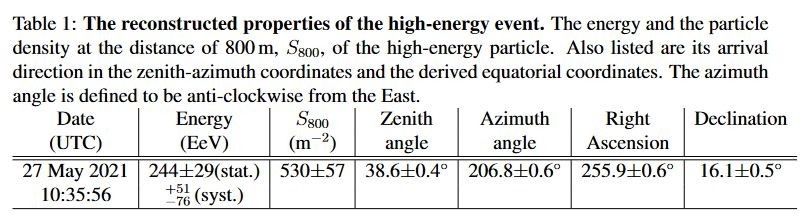
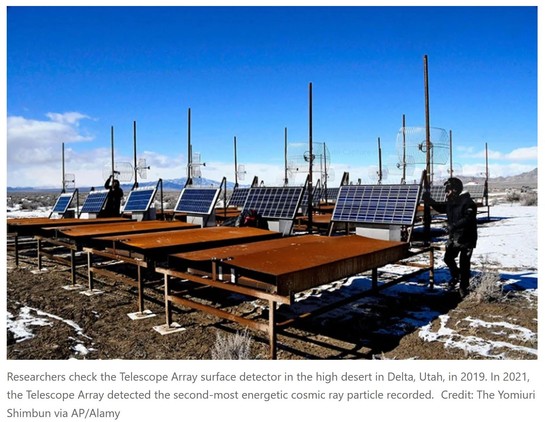
Cosmic rays are energetic charged particles from extraterrestrial sources, with the highest energy events thought to come from extragalactic sources. Their arrival is infrequent, so detection requires instruments with large collecting areas. In this work, we report the detection of an extremely energetic particle recorded by the surface detector array of the Telescope Array experiment. We calculate the particle's energy as 244 +- 29 (stat.) +51,-76 (syst.) exa-electron volts (~40 joules). Its arrival direction points back to a void in the large-scale structure of the Universe. Possible explanations include a large deflection by the foreground magnetic field, an unidentified source in the local extragalactic neighborhood or an incomplete knowledge of particle physics.
The most powerful cosmic ray since the Oh-My-God particle puzzles scientists
Scientists spot a particle of intense energy, but explaining where it came from might require some new physics.
✍️ by Gemma Conroy
https://nature.com/articles/d41586-023-03677-0
#amaterasu #cosmic #ray #cosmicray #particle #physics #astrophysics #astronomy #astrodon #universe #cosmology #localvoid #space #science #research #telescope #array #telescopearray #utah #japan #japanese #goddess #sun #mythology
 Daniel Pomarède