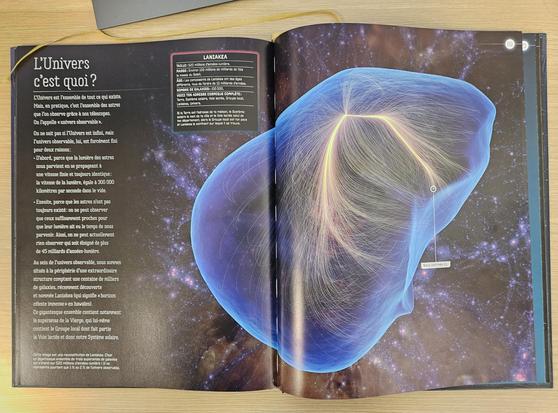
Got a copy of Roland Lehoucq's latest book "Astronomie". It features a beautiful double-page rendering of Laniakea, our Home supercluster of galaxies, produced by Félix Pharand-Deschênes.
https://www.flammarion-jeunesse.fr/astronomie/9782080481368
#Astronomie #Laniakea #RolandLehoucq #Jupiter #book #science #astrodon #galaxies #cosmicweb #LaniakeaSupercluster

Peculiar velocities at low Galactic latitude
The Laniakea Supercluster is the closest large scale structure of galaxies. Is such a structure expected in the standard cold dark matter model of cosmology? This would be a relatively simple question to answer, were it not for the fact that the Zone of Avoidance (ZOA) runs right through it. Recent improvements to this paucity of data in the innermost ZOA can be made from systematic 21 cm surveys using the MeerKAT telescope (e.g. Kraan-Korteweg et al. 2024), and implementing these HI-redshifts as an extension to the CosmicFlows4 database for reconstruction (Hollinger et al. 2026). In this paper we test the assumption that for the purpose of reconstruction, additional HI detected galaxies without peculiar velocity determinations could be placed at their Hubble distances. We present infrared photometry of 163 of these in HI detected MeerKAT ZOA galaxies, in addition to 2MASS Extended Sources in the ZOA to determine their peculiar velocities. Averaging these peculiar velocities into redshift bins, we find that peculiar velocity corrections in the Laniakea Supercluster ZoA region are not prohibitively large, and that one can proceed with its reconstruction using the copious redshift data now available.
#OxLancs2026
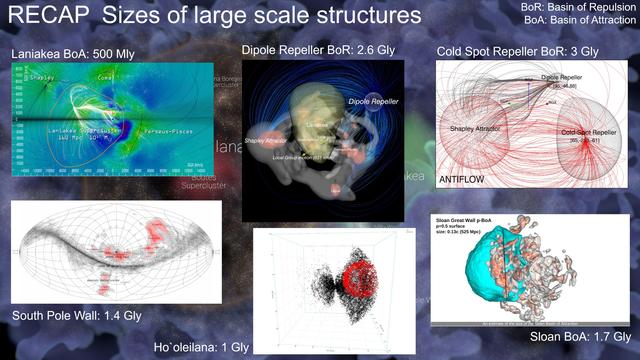
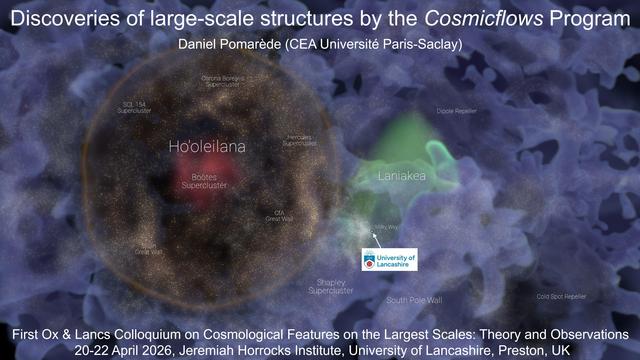
Final slide of my talk this morning at the First Ox & Lancs Colloquium on Cosmological Features on the Largest Scales, held at the University of Lancashire: a recap of the discoveries of the Cosmicflows program.
https://www.star.uclan.ac.uk/ox-lancs-2026/
#Cosmology #Laniakea #DipoleRepeller #ColdSpotRepeller #SouthPoleWall #Hooleilana #SloanBasinOfAttraction #cosmography #cosmicflows #astrodon
#OxLancs2026
Preparing my talk for the 1st Ox & Lancs Colloquium on Cosmological Features on the Largest Scales at U. of Lancashire. Highlight of the meeting: a talk by Sir Roger Penrose (Nobel Prize 2020) on "Dark matter in Conformal Cyclic Cosmology and Lopez Galactic Rings".
https://www.star.uclan.ac.uk/ox-lancs-2026/
#Cosmology #OxLancs #science #conference #Oxford #Lancashire #university #universities #ULancs #astrodon #astronomy #astrophysics #cosmicflows #Hooleilana #Laniakea #supercluster #galaxies
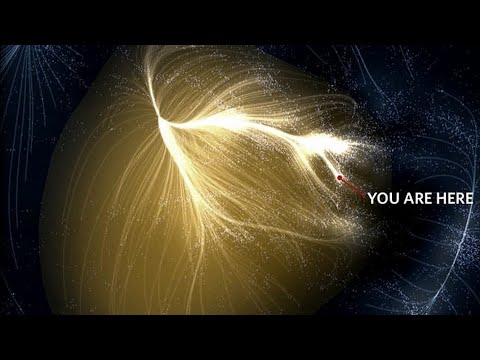
The Laniakea Supercluster
RE: https://mastodon.social/@pomarede/115860719793606685
"[...] in a **modest neighborhood** called The Solar System [...]", "solar *interstellar neighborhood*", "[...] it's like a huge collected **city** [...]": Mr. Hawking seemed to be well aware it was all our **home**! 🛖 It has been so exciting to join him in the "ultimate voyage" which is his *Genius* documentary...! I recommend it if you want to get a bit more familiar with your cosmic neighborhood! 🌌 🗺️ ✨
#Laniakea #Astronomy #StephenHawking #Milkyway #LaniakeaSupercluster #Solarsystem #Earth
Die Rakete pres. Rush + Kiss Klub Floor Makrobe @ Die Rakete - 14 Mar feat. LANI AKEA
#SESH #LANIAKEA
https://sesh.sx/e/1730767

Hidden Vela Supercluster Revealed by First Hybrid Redshift & Peculiar Velocity Reconstruction
A large fraction of the extragalactic sky is obscured by foreground dust and stars along the plane of the Milky Way, leaving a major gap (~ 20%) in whole-sky maps of large-scale structures -- an incompleteness that is even more severe for peculiar velocity samples. This has long limited an unambiguous interpretation of observed cosmic flows and their connection to the underlying mass-density field.
We present a new hybrid reconstruction methodology which combines 65,518 galaxy peculiar velocity distances from the CF4++ catalogue (Courtois2025) with 8283 new galaxy redshifts observed near the southern Galactic plane (|b| <= 10 degrees) Zone of Avoidance. A major advance is the inclusion of 2176 high-sensitivity, interferometric HI redshifts obtained with the SARAO MeerKAT telescope which for the first time provide coverage of the innermost 3degrees-wide strip of the southern ZOA and to unprecedented depth.
This hybrid redshifts & peculiar velocities approach yields a substantially revised view of the inferred overdensities in and around the ZOA. In particular, the Vela supercluster emerges as a dominant mass concentration, rivaling the Shapley concentration and exceeding the mass associated with Laniakea and the Great Attractor region. With a total mass of 33.8 10^16 Msol, a characteristic radius of 70 hmpc, and a double core morphology at a distance of 189 hmpc, Vela dominates the mass budget and gravitational influence of the southern Zone of Avoidance. These results provide the most complete and dynamically consistent picture to date of the southern Zone of Avoidance and demonstrate the transformative potential of hybrid reconstruction techniques tailored for the next generation of large-scale surveys.

Structures cosmiques : une famille de géantes
Comment Quipu, structure parmi les plus grandes, a-t-elle été identifiée ? De quoi sont composés les filaments de galaxies et de matière noire qui forment les structures de l'univers ? En quoi leur identification permet-elle de préciser notre compréhension de la cosmologie ?
Revisiting the Great Attractor: The Local Group's streamline trajectory, cosmic velocity and dynamical fate
We revisit the Great Attractor using the Manticore-Local suite of digital twins of the nearby Universe. The Great Attractor concept has been proposed as an answer to three distinct questions: what sources the Local Group velocity in the cosmic microwave background frame, where present-day velocity streamlines converge, and where the Local Group is moving to. Addressing the original motivation of the Great Attractor -- explaining the Local Group cosmic velocity -- we find that mass within $155~h^{-1}\mathrm{Mpc}$ accounts for only ${\sim}72\%$ of that velocity magnitude with ${\sim}38\,°$ directional offset. We show that even in the purely linear regime convergence within this volume is not guaranteed, particularly when also accounting for small-scale contributions to the observer velocity; no single structure, including the proposed Great Attractor, would be expected to dominate the velocity budget. Streamline convergence is smoothing-scale-dependent, transitioning from Virgo at small scales through the Hydra--Centaurus region at intermediate scales to Shapley at large scales; at intermediate smoothing the convergence point lies near Abell 3565 with an asymmetric basin of mass $\log( M / (h^{-1} \mathrm{M}_\odot)) = 16.4 \pm 0.1$ that excludes Norma. To address the third question, we evolve the Manticore-Local realisations to scale factor $a = 10$ in a new Beyond-Present-Time simulation suite and identify the asymptotic future location of the Local Group. We find that the dominant motion is towards Virgo, but even it contributes at most one third of the Local Group velocity. Our results demonstrate that the classical Great Attractor is not a dynamically dominant structure but an artifact of the instantaneous velocity field, and that no single attractor is likely to account for the Local Group motion in the cosmic rest frame.
 Daniel Pomarède
 Dobviews
 Lara Djurvänlig | La 🌓upla
 SESH.sx