Starbirth fireworks

What is more majestic than the fireworks of stars being born?

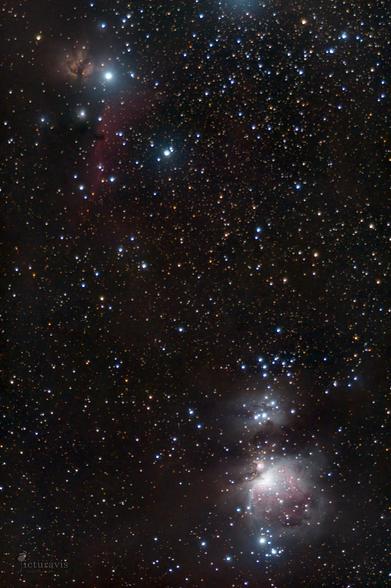
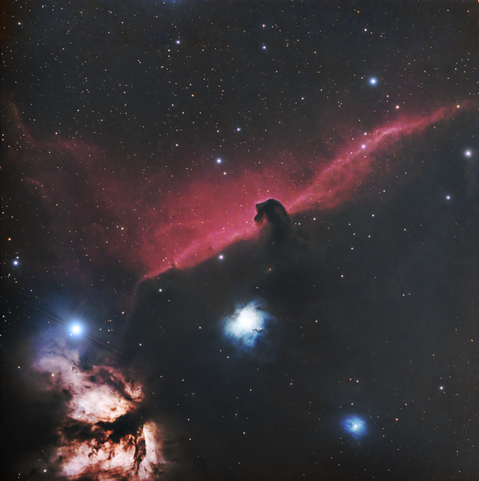
The region visible in the center of the Orion constellation is a region of star birth, also called the Orion complex. Material from earlier star deaths (like supernovae) forms dust and gas clouds that, if dense enough, start the formation process of new stars. During and after the formation of a star, it flings out a lot of material and radiation that push away less dense material. The radiation ionizes the atoms in the surrounding area, making them emit visible light during recombination, resulting in emission nebulae. Reflection nebulae on the other hand reflect light from nearby stars.

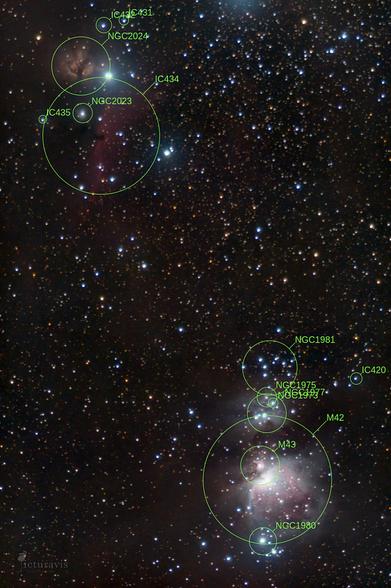
The brightest area at the bottom of the image is the Great Orion Nebula (M 42), where hydrogen is especially excited, emitting red light. Surrounding dust clouds obstruct the nebula or reflect the light from the newborn stars, giving it the form we see in the night sky. It is bright enough to be seen with the naked eye on dark nights.

Just above the Orion Nebula is the Running Man Nebula (NGC 1977). The reflection nebula is visible here, while there is also a hydrogen II emission nebula that is too faint to see.

In the top part of the image is an elongated red nebula, also called the Horsehead Nebula (IC 434). It is a large hydrogen II emission nebula whose view is obstructed by a dark nebula in the shape of a horse’s head.

Above and to the left is the orange Flame Nebula (NGC 2024). From what I could find, the color is the result of a combination of hydrogen II emission (red), oxygen III emission (green), reflected light from the nearby blue star Alnitak (ζ Orionis), as well as dust in front of the nebula filtering its visible spectrum.

This image was created with 658 × 2 s (21 m 56 s) integration time. I had to cut the session short as clouds were forming earlier than expected, but I got the image I was aiming for. I used #Stellarium to frame the image and processed it with #Siril, #GIMP, and #GMIC.

Happy New Year!

Nikon D500, Sigma 105mm EX DG OS HSM, 105 mm, f/2.8, 658x2 s, ISO 3200, tripod, no tracker
#Nebulae #Orion #OrionNebula #FlameNebula #HorseheadNebula #astrophotography #photography #germany #digikam
Here we go with the comparison between the Odyssey Pro and the s50. Here are the images of #IC434 #HorseheadNebula and #NGC2024 #FlameNebula. The first image is from the s50 and is a mosaic ar 1x zoom. Quick compared to the earlier failed 4x mosaic. The next two images are from the Odyssey Pro. The s50 will be awesome for nebulas than the Odyssey Pro. #unistellar #odysseypro #space #astronomy #amateur #seestar #S50
Last sample of the day. Object observed is #NGC2024 #FlameNebula. First the Odyssey Pro, second the s50. #unistellar #odysseypro #space #astronomy #amateur #SeeStar #s50
Sharing now the best observation of the morning. Close to the center is the #star #Alnitak. To the left of the image we have a guest appearance of the #FlameNebula. #unistellar #odysseypro #space #astronomy #amateur
New observation of the #FlameNebula from this morning. #unistellar #odysseypro #space #astronomy #amateur
Identification of a Turnover in the Initial Mass Function of a Young Stellar Cluster Down to 0.5 MJ: https://iopscience.iop.org/article/10.3847/2041-8213/adb96a -> NASA's Webb Peers Deeper into Mysterious #FlameNebula: https://webbtelescope.org/contents/news-releases/2025/news-2025-105
Radware Bot Manager Captcha

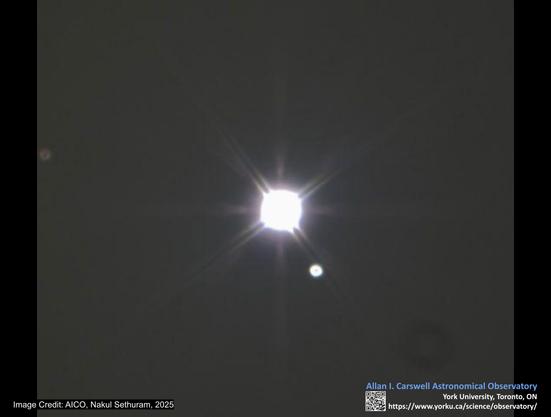
Alnitak is a bright bluish star located left of the Horsehead Nebula and just above the Flame Nebula. It is the easternmost star in Orion’s Belt. Alnitak shines ultraviolet light into the Flame Nebula that ionises the hydrogen gas within, causing it to emit its own light.

#YorkU #AllanICarswellObservatory #YorkUObservatory #Astronomy #Astronomer #Space #Star #SpaceFacts #Science #Alnitak #HorseheadNebula #FlameNebula #SpaceScienceSaturday #SpaceFacts
I remember seeing the Horsehead nebula in my parents’ encyclopedia as a kid. I was amazed at how such a thing could exist. And now technologyy has evolved so far, that I can take the same picture from my own backyard! Here it is accompanied by the Flame nebula in the lower left together with the star Allnitak, which is the left most star in Orion’s belt. #horsehead #B33 #NGC2023 #horseheadnebula #flamenebula #astronomy #astrophotography #deepsky #backyardastronomy #astroshots #astrophoto #Space #universe #galaxy #universetoday #nightsky #stars #galaxy #nightphotography #skywatcher #touptek #backyardastrophotography
I remember seeing the Horsehead nebula in my parents’ encyclopedia as a kid. I was amazed at how such a thing could exist. And now technologyy has evolved so far, that I can take the same picture from my own backyard!
Here it is accompanied by the Flame nebula in the lower left together with the star Allnitak, which is the left most star in Orion’s belt. #horsehead #B33 #NGC2023 #horseheadnebula #flamenebula #astronomy #astrophotography #deepsky #backyardastronomy #astroshots #astrophoto #Space #universe #galaxy #universetoday #nightsky #stars #galaxy #nightphotography #skywatcher #touptek #backyardastrophotography