Nika Zupanc brings "Alice in Wonderland ambience" to Morela eyewear store in Ljubljana

Massive lamps, rotating mirrors and a legion of drawers feature inside the Morela eyewear store, which Slovenian designer Nika Zupanc has completed in Ljubljana.

Morela has been offering optician services in the Slovenian capital since the early 2000s and went on to launch its own line of glasses in 2019.

Locally based Zupanc was brought in to design both the brand's debut eyewear collection and now the retail space to match.

Powder-blue drawers appear throughout the Morela eyewear store

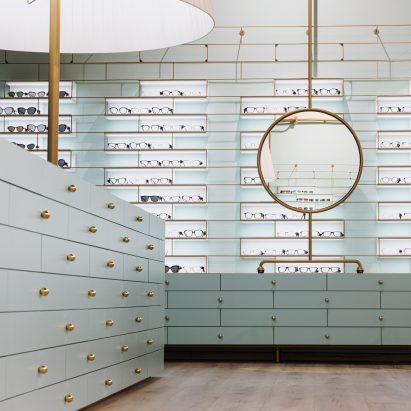
Set in Ljubljana's Citypark shopping centre, the store is defined by the slim powder-blue drawers with brass knobs, which appear everywhere from the cash desk to the base of the freestanding counters and low-lying sideboards.

"The client had a clear idea of how many glasses they wanted to display on the shelves, how many they wanted to put in the drawers and how many they wanted to display on the tables," explained Zupanc.

"Thus a drawer became a unit of measurement and served as a building block, from which the entire interior was created."

Brass-edged mirrors can be turned to show different angles of the store

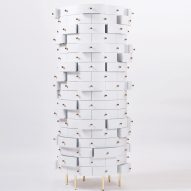
The abundant storage is also a nod to one of Zupanc's earlier designs – a 140-drawer cylindrical cabinet she created for Milan's Rossana Orlandi Gallery in 2017.

Eyewear models are displayed along the sides of the room inside brass-framed shelves that mirror the proportions of the drawers.

A curtain hides treatment rooms at the back of the store

To enhance the "Alice in Wonderland ambience" of the space, Zupanc introduced two huge floor lamps with pleated white shades, both handmade in Italy.

One towers above the cash desk while the other pokes out through a blush-coloured velvet pouf to provide both lighting and seating. Alternatively, customers can sit on velvet-upholstered high chairs that are dotted across the room.

[

Read:

Nika Zupanc designs a tower of drawers for storing keepsakes

](https://www.dezeen.com/2017/11/20/nika-zupanc-designs-a-tower-of-drawers-for-storing-keepsakes/)

Mirrors are suspended from a thin brass picture rail that runs along the perimeter of the room. Each is housed in a circular brass frame and can be rotated to reflect different angles of the room.

The rail also holds heavy powder-blue curtains that separate the main shop floor from a treatment area and repair room at the rear of the plan.

A brass pipe runs along the upper edge of the room

Other striking eyewear stores include Vision Studio in Melbourne, which hides behind a perforated aluminium facade, and the Cubitts shop in London's Soho, which nods to the sex shops and adult cinemas found in the notorious neighbourhood.

The photography is by Saša Hess.

The post Nika Zupanc brings "Alice in Wonderland ambience" to Morela eyewear store in Ljubljana appeared first on Dezeen.

#retail #all #interiors #slovenia #ljubljana #nikazupanc #shops #eyewearstores
Cubitts eyewear store in Leeds taps into seminal design movements throughout history

London design practice Child Studio has combined Victorian-style joinery with modernist and art deco touches inside the Cubitts eyewear store in Leeds.

Cubitts occupies a corner unit of the city's County Arcade shopping mall, which was constructed in 1898 and retains an array of original detailing from pink marble columns to mosaic ceilings.

Cubitts' Leeds store is set inside a 19th-century shopping arcade

Child Studio was brought on board to design the eyewear store's interior with the aim of honouring the arcade's Victorian origins while stirring up nostalgia for later design periods.

"New interiors within historic structures often fall into a pastiche or offer a sterile minimalist look that doesn't attempt to engage with the context," explained Che Huang and Alexy Kos who co-founded Child Studio.

The arcade still has a number of original details such as marble columns

"We wanted to take a more subtle approach and build a layered narrative that would acknowledge different chapters in the building's history," the duo added.

"We tried to imagine how the space could have evolved organically over time, fusing the Victorian cabinetry features with the art deco elements and modernist references."

Victorian-style display cabinets line the store's walls

The store is fringed with three-metre-high cabinets featuring brown-lacquered bordering and different eyewear models displayed on backlit shelves.

A 1930s bakelite clock produced by British company Genalex, which used to supply timepieces to factories and schools, has been placed on top of the cabinets.

Vintage furnishings have been placed at the centre of the store

At the centre of the room is a bespoke service counter. Based on the writing desks popularised by British designer Robin Day in the mid-20th century, it features a black glass tabletop with steel legs nestled over a cherry-wood storage cupboard.

Next to the counter sits a black leather edition of the Monk chair by Italian design duo Afra and Tobia Scarpa, which was originally created in the 1970s.

A domed lamp by Irish modernist Eileen Gray sits perched on top of the counter.

[

Read:

Child Studio's store for eyewear brand Cubitts is inspired by Soho sex venues

](https://www.dezeen.com/2021/06/13/child-studio-cubitts-eyewear-store-soho-london/)

Glossy chestnut-coloured paint covers the store's ceiling, while tiles in beige, terracotta and umber have been arranged in a geometric pattern across the floor.

Child Studio said it incorporated the tiles to pay tribute to the tin-glazed ceramic detailing that once featured inside the County Arcade.

Tiles form a geometric pattern on the floor

The entire interior is visible through Cubitts' ornate mahogany shopfront, which is inset with expansive windows.

Just above the lintel, the eyewear brand's logo is rendered in gilded glass using a traditional technique known as verre églomisé, in which gold leaf is applied to the rear face of glass to leave a mirrored finish.

Glasses are displayed on backlit shelves

This is not the first retail space that Child Studio has designed for Cubitts.

The studio was also responsible for the eyewear brand's branch in Soho, London, which features cheeky neon signage and a deep-red basement in reference to the sex clubs and adult cinemas that once populated the neighbourhood.

The photography is courtesy of Child Studio andFelix Speller.

The post Cubitts eyewear store in Leeds taps into seminal design movements throughout history appeared first on Dezeen.

#retail #all #interiors #uk #england #leeds #shops #childstudio #eyewearstores #cubitts

Cubitts eyewear store in Leeds taps into seminal design movements throughout history

London design practice Child Studio has combined Victorian-style joinery with modernist and art deco touches inside the Cubitts eyewear store in Leeds.

Dezeen

Stephanie Thatenhorst bedecks kid-friendly optician in graphic patterns

Triangular patterned tiles and an eyewear-dispensing machine feature in Stephanie Thatenhorst's playful interior for this children's optician in Munich.

Named Rookies, the specialist outlet takes up just 30 square metres in Munich's city centre and belongs to German eyewear brand Leidmann.

Local interior designer Thatenhorst conceived the shop as a "noisy, wild and unique paradise for children", with all seating and product displays adjusted for their height.

All walls in the Rookies store are finished with geometric tiles (top and above)

"When you enter the room, you enter unfamiliar terrain," she explained.

"The blue carpet signals that you are entering a new world. Every little detail is child-friendly without using the usual cliches."

Display areas are covered in a peach-hued fabric and fitted with blue hardware

Full of intriguing textures and bright colours, Rookies' walls and ceilings are wrapped in green and white triangular tiles and glasses are sparsely presented on apricot-coloured shelves.

A ribbed yellow column with a bench seat at its base stretches from the ceiling to the floor, while a series of U-shaped neon lights, designed to recall monkey swings in a zoo, illuminate the space.

U-shaped neon lights are designed to recall monkey swings

Fabric-wrapped drawers with contrasting blue handles provide storage space for stock, while a series of round and oval mirrors with blue frames are set in between each wall display.

"Everything is round, there are no corners to bump into," said Thatenhorst. "Even the showcases with the glasses are round and shaped for children's hands to open."

[

Read:

Pierre Brocas and Nada Oudghiri design gallery-like eyewear store informed by Memphis movement

](https://www.dezeen.com/2021/03/11/pierre-brocas-nada-oudghiri-eyewa-store-dhahran-interior/)

The eyewear-dispensing machine, which is set into the wall and allows children to pick up their new glasses, is a highlight of the interior. It is framed by red-checkered fabric that coordinates with the upholstery of the surrounding stools and benches.

"It is always an experience for the little glasses wearers when the machine comes to life and 'spits out' the new glasses," the designer explained. "Who would want to go home again?"

An eyewear-dispensing machine surrounded by a red-checkered print is set into the wall

Rookies has been shortlisted for small retail interior of the year at the 2021 Dezeen Awards.

Among the other projects nominated in the category is Flamingo Estate's Harvest Shop, which is anchored by a rammed-earth counter excavated from the brand's own garden.

Photography is byGünther Egger.

The post Stephanie Thatenhorst bedecks kid-friendly optician in graphic patterns appeared first on Dezeen.

#retail #all #interiors #munich #germany #patterns #shops #eyewearstores

Stephanie Thatenhorst uses bold patterns and colours to create a kid-friendly opticians in Munich

Triangular patterned tiles and a red checkered eyewear-dispensing machine feature in Stephanie Thatenhorst's playful interior for a children's eyewear store in Munich.

Studio Edwards conceals "jewel-like" eyewear store behind perforated aluminium facade

Cool-toned industrial materials such as aluminium and concrete are paired with marble surfaces and translucent pastel shelving in this eyewear store in Melbourne, Australia.

Designed by local firm Studio Edwards, the first flagship store by optometrist Vision Studio is housed in a shopping centre in the city's Glen Waverley suburb.

Vision Studio's perforated aluminium facade (top image) hinges open to reveal a jewel-like interior (above)

Half of the store's 3.6-metre-high perforated aluminium facade hinges open to reveal what the studio describes as a "jewel-like" interior, framed by marble tiles that contrast with the raw concrete of the existing shell.

Inside, Studio Edwards set out to create a space reminiscent of a gallery, including enough display space for 200 spectacles and storage for an additional 800 pairs alongside three consultation rooms with waiting areas and a staff and store area.

A bright orange tap and pastel pink doorframe act as pops of colour in the otherwise monochrome interior

To accommodate these functions, the floor plan is split into two zones with the store and display area at the front, and the optician and consulting spaces at the rear.

"The space is zoned via an angular plan configuration with the areas requiring most privacy to the rear and semi-private consulting spaces tapering to the front," Studio Edwards founder Ben Edwards told Dezeen.

"One challenge was to work with the existing air conditioning ceiling ductwork – we chose to expose them and include them within the overall aesthetic."

Pastel-coloured accents are applied to the shelving and cabinets that run along the walls on either side of the Vision Studio store.

The material palette, which the studio described as "a balance between raw and refined", blends industrial materials such as aluminium and concrete with marble surfaces and translucent shelving that seems to hang in midair.

The shop is located in a Glen Waverley shopping centre

Other studios that have combined industrial materials and soft, powdery colours include Spanish studio Lucas y Hernández-Gil, which contrasted pastel furnishings against concrete walls in this restaurant in Seville.

Photography is byTony Gorsevski.

The post Studio Edwards conceals "jewel-like" eyewear store behind perforated aluminium facade appeared first on Dezeen.

#retail #all #interiors #australia #melbourne #shops #studioedwards #eyewearstores

Studio Edwards conceals "jewel-like" eyewear store behind perforated aluminium facade

Cool-toned industrial materials such as aluminium and concrete are paired with marble surfaces and translucent pastel shelving in this eyewear store in Melbourne, Australia.

Child Studio channels peep show booths of London for Soho glasses shop

Featuring linoleum floors, Formica-clad walls and a deep red basement, Soho's peep show booths served as inspiration for the atmospheric interior of this London eyewear store by Child Studio for spectacle-maker Cubitts.

Perched on the corner of Marshall Street in London's Soho neighbourhood, the store occupies one of the early 19th-century buildings that form the area's narrow streets.

Black and white checkered linoleum flooring features throughout the store

The store is spread out over a small ground floor and basement space lined by a narrow staircase.

In terms of practical requirements, the store needed to incorporate a display of the 100 different coloured acetate chips that customers can choose from to create bespoke frames.

London-based Child Studio designed a space for Cubitts that aims to reflect the history of the local area and create a customer journey that would encourage people to explore the basement space.

A wall-mounted display case holds 100 different coloured acetate chips

"Cubitts wants each of its shops to have a unique design reflecting the history of the local neighbourhood," Child Studio co-founder Alexy Kos told Dezeen.

"The brand has a strong connection to London, where its glasses are made, and to Modernism as the guiding principle to its design aesthetic."

To design the interior, the studio drew upon Soho's colourful history as a destination for massage parlours, adult cinemas and sex shops in the postwar era.

"Gambling, drinking, religious and political dissent, clubbing and prostitution were all, at varying times, peculiar Soho specialities," said the studio.

"We have focussed our research on Soho's heyday in the postwar era, looking at the interiors of the neighbourhood's iconic venues, such as the Formica-clad Bar Italia and the legendary jazz venue 100 Club, with its all-red interiors."

Formica laminate partitions with aluminium trims divide up the space

Referencing the peep show booths of Soho, the store incorporates low partitions clad in a wood-effect Formica laminate and trimmed with aluminium to form a maze-like environment.

Display areas with illuminated acrylic shelving that showcase the spectacles and the colourful acetate chips are recessed into the walls. Lightbox signage integrated into the metal-trim cladding and black and white checkered linoleum flooring add to the store's nostalgic ambience.

An antique Caori cocktail table designed by Vico Magistretti in 1961 serves as a focal point on the ground floor.

Featuring a brushed aluminium tabletop and several concealed compartments for records and magazines, the piece was specially sourced by Child Studio and adapted to include a raised podium so that it is better serves the retail environment.

The basement is saturated with a deep red colour

"Every project tells a unique story and we always look for rare and unusual furniture pieces to add depth and authenticity to the narrative," said the design team.

"The desk lamp is another mid-century find, created by the Czech designer Josef Hurka for the manufacturer Napako in the 1960s."

Limited-edition sunglasses are displayed on shelves clad in aluminium-effect Formica

A narrow staircase leads to the basement, which is saturated in a deep red colour. Customers are guided to an eye examination room concealed behind a velvet curtain by neon signs.

Cubitt's moody basement lounge area is lit by the Conelight floor lamp by the British designer Ronald Homes and furnished with chrome and leather chairs designed by Giovanna Modonutti.

A collection of limited-edition sunglasses is displayed on illuminated shelves clad in aluminium-effect Formica that create a theatrical effect in the dark red surrounds.

A neon peep show sign hangs at the entrance to the eye examination room

Previously, the studio run by Kos and Che Huang has channelled the look of a 1950s cafe inside a vegan pizza restaurant in west London and transformed a former London post office into a sushi restaurant with a 1960s interior.

"We like to use the word 'cinematic' to describe the spaces designed by Child Studio," Kos told Dezeen. "With every project, we aim to capture a particular mood and atmosphere, rather than trying to recreate an interior from a specific era."

Photography is by Felix Speller and Child Studio.

The post Child Studio channels peep show booths of London for Soho glasses shop appeared first on Dezeen.

#retail #all #interiors #uk #london #childstudio #eyewearstores

Child Studio channels Soho's peep show booths for Cubitts eyewear store

Soho's peep show booths served as inspiration for the atmospheric interior of this London eyewear store by Child Studio for British spectacle-maker Cubitts.