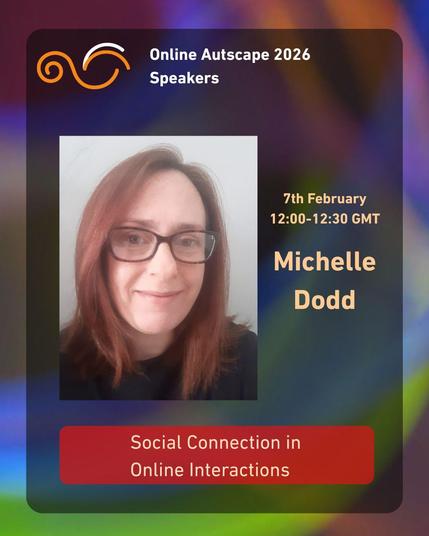
Michelle Dodd has researched topics that are at the core of the evolution of autistic online spaces. Her PhD examines how autistic people feel social connection in online interactions, focusing on video calls as an increasingly important social space, and testing which factors help conversations feel connected, or effortful.

Michelle's first study analysed recordings of online conversations from the general population, with findings that fit with the double empathy problem.

Her second study builds on this using newly recorded conversations between autistic and non-autistic participants, exploring how different interaction styles and camouflaging shape the experience of connection.

Together, this work aims to better understand autistic connection within evolving online autistic spaces.

Michelle will talk about her work on Saturday, 7th Feb, 12-12:30 GMT, with the title Social Connections in Online Interactions.

Registration now open! https://www.autscape.org/2026/online/registration

Full programme: https://www.autscape.org/2026/online

#autisticspace #autism #neurodiversity #communication #DoubleEmpathyProblem #onlineautscape2026 #onlinespace

Some neurotypical person may have to explain to me why the socially acceptable thing to do when someone calls you pretentious is to checks notes say thank you and lick their boot.

I'm autistic, so as we all know, I struggle to understand "common sense" things like that and am eager to learn so that I can be included in this delusionally toxic society of ours.

Some of that was likely sarcasm.

Things to keep in mind:

  • If you're a woman, and someone calls you manipulative, they're afraid of the only power they've allowed you to keep.
  • If you're an autist, and someone calls you pretentious, they are forcing you to do emotional labor to protect them, your attacker, from their own insecurity.

Never accept as feedback what is intended as abuse.

#SocialEngineering #BoundarySetting #EmotionalLabor #Sociology #Ontology #ActuallyAutistic #Neurodiversity #AutisticJoy #DoubleEmpathyProblem #Masking #IntersectionalFeminism #PowerDynamics #Assertiveness #InternalizedMisogyny

Rules of Thumb for Human Systems

We perceive through habit, expectation, bias, and assumption. The heuristics that guide us through our days are full of predictable biases (systematic errors). These unconscious, predictable biases are rooted in the machinery of our cognition.

When making judgments or decisions, people often rely on simplified information processing strategies called heuristics, which may result in systematic, predictable errors called cognitive biases (hereafter CB). For instance, people tend to overestimate the accuracy of their judgments (overconfidence bias), to perceive events as being more predictable once they have occurred (hindsight bias), or to seek and interpret evidence in ways that are partial to existing beliefs and expectations (confirmation bias).

The Impact of Cognitive Biases on Professionals’ Decision-Making: A Review of Four Occupational Areas – PMC

Jiggle the machinery of your cognition by adopting new framing. We can more easily change our framing by adopting new heuristics (rules of thumb). By changing our framing, we correct for the systematic error of predictable biases installed in us by structural and systemic forces.

Reason uses the logics of image-schemas, frames, conceptual metaphors, prototypes, and narratives.

The Neuroscience of Language and Thought, Dr. George Lakoff Professor of Linguistics – YouTube

Words activate frames, and frames are ways in which you structure the world. You cannot think without frames. You cannot speak without frames being there, and those frames are physical, they are circuitry in your brain that carries out all those inferences and imposes that structure. And that circuitry, once you learn a frame, is there mostly for life.

The Neuroscience of Language and Thought, Dr. George Lakoff Professor of Linguistics – YouTube

When we successfully reframe public discourse, we change what counts as common sense. Because language activates frames, new language is required for new frames. Thinking differently requires speaking differently.

The ALL NEW Don’t Think of an Elephant!: Know Your Values and Frame the Debate

Change your heuristics, and change your framing, so that you can perceive those of us on the margins and at the edges.

Common Sense = Neuronormative cultural reification

Post by @yeshes.online — Bluesky

Our designs, our societies, and the boundaries of our compassion are tested at the edges, where the truths told are of bias, inequality, injustice, and thoughtlessness.

The logistics of disability and difference in a structurally ableist and inaccessible world poisoned by bad framing are exhausting, often impossible. We are perpetual hackers, mappers, and testers of our systems by necessity of survival.

We need your help. We need you to help us bridge the Double Empathy Extreme Problem (DEEP). To do that, we all must change our framing.

Dewey’s democratic humanism is thus not a restatement of popular clichés about striving after our dreams; it is instead a recognition that actual social change is a long and difficult task of altering recalcitrant habits and developing new ones.

Crick, Nathan. Dewey for a New Age of Fascism: Teaching Democratic Habits (Rhetoric and Democratic Deliberation Book 22) (p. 12).

Use these rules of thumb to challenge and change your current framing so that you can be a true ally to marginalized people.

In politics our frames shape our social policies and the institutions we form to carry out policies. To change our frames is to change all of this. Reframing is social change.

The ALL NEW Don’t Think of an Elephant!: Know Your Values and Frame the Debate

Our Rules of Thumb for Human Systems

The links below are to our glossary/encyclopedia where you can read a plain language definition of the term followed by in-depth information.

Read “>” as “over”.

Choose the framing on the left over the framing on the right to understand the realities of marginalized people and help change those realities.

I used to tell my students that ideology never announces itself as ideology. It naturalizes itself like the air we breath. It doesn’t acknowledge that it is a way of looking at the word; it proceeds as if it is the only way of looking at the world. At its most effective, it renders itself unassailable: just the way things are. Not an opinion, not the result of centuries of implicit and explicit messaging, not a means of upholding a power structure. It just is.

the shame is ours

Making the Strange Familiar

Suddenly, even the most powerful people in society are forced to be fluent in the concerns of those with little power, if they want to hold on to the cultural relevance that thrust them into power in the first place. Being a comedian means having to say things that an audience finds funny; if an audience doesn’t find old, hackneyed, abusive jokes funny anymore, then that comedian has to do more work. And what we find is, the comedians with the most privilege resent having to keep working for a living. Wasn’t it good enough that they wrote that joke that some people found somewhat funny, some years ago? Why should they have to learn about current culture just to get paid to do comedy?

The price of relevance is fluency – Anil Dash

We lament the lack of folks willing to bridge the Double Empathy Extreme Problem by adopting anthropological and sociological lenses to “make the strange familiar”, instead siding with a familiar default that is much about the neuronormative domination of people we don’t bother to understand.

Physics has a “strange” particle. A stranger is someone from outside whose practices may be different. Strange can also indicate the uncanny, the peculiar, the “off.” Anthropology courses often begin by talking about our mandate to “make the strange familiar, and the familiar strange.” Making-strange, Verfremdung, a focal aspiration of the theater of the absurd, ostranenie, defamiliarization—all these allow us to see what we ordinarily take for granted, by causing a sense of wonder. That’s one reason anthropologists often begin our training by going to an unfamiliar—a strange—setting, because when things are unfamiliar, we notice much more. The challenge for my readers is to make schoolishness strange, to question the familiar.

Blum, Susan D.. Schoolishness: Alienated Education and the Quest for Authentic, Joyful Learning (p. 8). Cornell University Press.

We all gotta learn to set with our discomfort when listening to marginalized people speak about their lives. We must allow our framing to be challenged. We must question the familiar.

“making the strange familiar and making the familiar strange”

Margaret Mead 1901-1978
American Anthropologist

#bias #doubleEmpathyExtremeProblem #doubleEmpathyProblem #framing
Und noch ein paar Hashtags mehr, weil ich die Themen angesprochen/angedeutet habe:

#ActuallyAutistic #Autismus #Bürgergeld #DePol #DoubleEmpathyProblem #Grün #IchBinArmutsbetroffen #SPD #Woke

Spent the last 3.5 days at #AutismEuropeCongress and was so heartening to see the research happening around #Autism. Multiple presentations of research, and pretty much all the research was designed with the #DoubleEmpathyProblem at the forefront. It was a tonic to hear continuous neuro-affirming language.
Next step: increase diversity of people studied, to include non-speaking autistics, ethnic minorities, more people of colour etc.

@autistics
#Autistic

[...] "the concept of the double empathy problem has the potential to aid a reframing of autism itself from a social communication disorder to a description of a broad range of developmental differences and embodied experiences and how they play out in specific social and cultural contexts.": https://journals.sagepub.com/doi/10.1177/13623613221129123

#Autism #ActuallyAutistic #neurodivergent #neuroconvergent #DoubleEmpathyProblem

I just watched this vid by Parkrose Permaculture about how we're not grieving our losses while we have to watch the world we spent generations building being broken down and sold off as parts.

This got me thinking again about grief and how we #autistic folk grieve. Or at least how that feels for me, an autistic person. Big feelings like grieving the loss of a loved one are hard to process on your own, so we humans like to process them socially. That's why we have funerals, graduations, and going away parties. But being autistic means we have that #DoubleEmpathyProblem communication gap, and that also makes it harder to connect at an emotional level so you can process those feelings together.

And then there's masking. I remember the last memorial I attended, for an old boyfriend who had been killed in a senseless, random encounter with a stranger on the street. I was really broken up about it and on the verge of sobbing all day, but while I was at the service I was so occupied with trying to get the masking right to show grief both appropriately to the situation and in a way others could understand that I didn't have any bandwidth left to actually feel the grief, so I didn't get to process it at all.

All of my grieving got turned into a performance for the sake of others, and I had to wait to get home to work through my feelings on my own, which was not that helpful. And to top it off, my masking was probably bad and everyone probably thought my performance of grief was only performative instead of being my best attempt to show what I was authentically feeling in a way they could understand.

It feels like our world is burning down and the worst people have taken over everything. Every day is a new, shocking development and another heartbreak. And we autistics are often stuck without any emotional support that might help us process our grief. That's not healthy, and it's particularly bad for those of us who are already feeling isolated and without any emotional support.

There's something I hear a lot in these fraught times, and that's how we have to create our own systems for mutual aid and support to survive having the government as our enemy. That's all well and good for those who have the social appeal to get included in those systems, but we autistic people are famous for being excluded from almost every group for no reason other than we just seem too awkward for people to want to have us around for any reason. This infuriates me, that non-autistic people do this to us, that they exclude us from social systems that everyone needs to survive. That's a routine experience for many of us, like how all your non-autistic "friends" got organized to get tickets to a sold-out show but no one ever mentioned it to you until it was too late. I won't minimize the impact of being excluded that way on a daily basis, because that crap can really ruin someone's life, but somehow being unable to access emergency mutual aid systems because people exclude us by reflex feels even worse.

Add to that the fact that Bobby Brainworms has effectively declared war on autistic people and this is a really shitty time to be autistic in America. Definitely feels like I have a lot of grief to process. I used to try to wear black for mourning but these days people just think that's fashionable. So how should we grieve, and how do we do it in an autistic way that works for us?
#ActuallyAutistic

https://youtu.be/KBdRekUsbxo

Living in Tr*mp's America means we are deprived of this basic human experience

YouTube

@pathfinder Totally this 🩷

There is a great short on double empathy here by Morgan Foley (AuDHD), as well as a longer video here.

#neurodivergent #neurospicy #ActuallyAutistic #ADHD #AuDHD #DoubleEmpathy #DoubleEmpathyProblem

The autistic double empathy problem

YouTube

I've said for years that therapy is not just useless but often counterproductive for us #neurodivergent folk. This video is a nice example of that. It *seems* like good advice for the typical person: self-acceptance, self-confidence, growing past your childhood, handling trauma, the usual stuff. But, like every other psychology video I've seen that wasn't specifically focused on neurodivergence, it only speaks to neurotypicals. And the advice the therapist gives is not helpful for people like me.

I'm #AuDHD, so your mileage may vary, but for me, this advice is crap. My challenge isn't self-acceptance or overcoming some irrational fear of rejection. It's the #DoubleEmpathyProblem, and how neurotypicals judge me superficially based on neurological differences that prevent me from doing non-verbal affect their way so we can connect emotionally. It's the #SocialModelOfDisability that lets people declare me the one with the problem because I'm in the minority, so they expect me to always be the one to adapt to their communication style. It's that I don't get to process my childhood trauma of rejection, neglect, and abuse, because I continue to experience that even now in my 60s, and you can't process and heal trauma until you aren't in the traumatizing situation anymore.

If I took this therapist's advice to heart, I would just make things worse for myself. I know, because I have walked that road before, and all that happened was I got lost and hurt. An old therapist of mine told me I just need to be more confident and put myself out there, and people will respond. I actually laughed at her. Then I went out and found an autistic therapist so I didn't have to hear that crap anymore.

This is a big part of why it's hard to be neurodivergent in our society: we are excluded by default. We aren't even an afterthought - we're a neverthought. Nobody thinks of us unless we become a problem they have to deal with. So when we ask to be included, they see us as a problem and usually get defensive and then go on to justify why they forgot about us. How hard would it be for this Mended Light therapist to include a sentence or two saying this advice wasn't for ND folk and we should not try to follow it? How hard would it be for him to include some useful advice for us, which might also help NT folk watching the video to understand us better?

My dear neurokin, be careful consuming advice from people that don't understand us and that isn't meant for us. We're not the same as them, and we don't succeed by acting like we are. And to people making psychology videos, could you maybe remember we exist and include us even when you're not speaking specifically to us?

[Mended Light: How to Get Over the Pain of Rejection and Be Authentically YOU!]
https://youtu.be/3GpY1NefXuQ

#ActuallyAutistic #autistic #ADHD

How to Get Over the Pain of Rejection and Be Authentically YOU!

YouTube

@hosford42 Mhmm. Principled integrity. Moral compass. Who needs be adapting our thinking constantly, not having the same cerebelum short-hand and being in the minority, ... methinks them three fingers project much, eh, in such "rigid thinking" finger pointing we receive.

Rip the masks off! :D Maybe that will reveal to them how much we've been having to be flexible in our thinking. See if they could be as flexible as to meet us where we strive our whole lives to meet them, and their "rigid thinking". #latediagnosedcatharticgriping #actuallyautistic #doubleEmpathyProblem