 Hackaday [Unofficial]
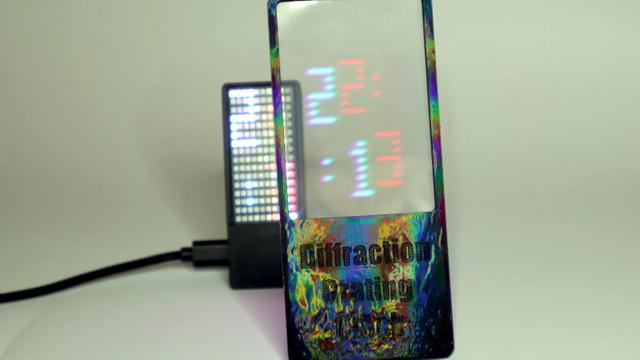
A Diffraction Grating Makes This Clock Readable
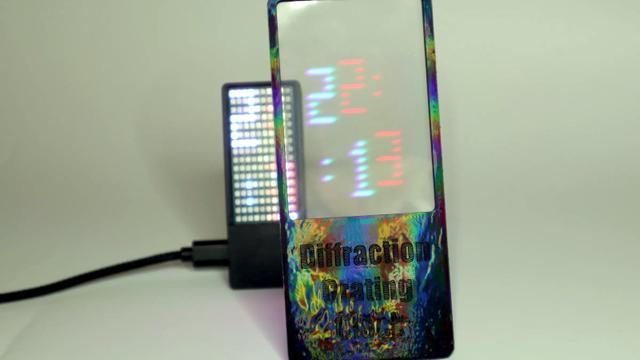
A Diffraction Grating Makes This Clock Readable
How To Get Your Diffraction Grating 3D Prints Right The First Time
Diffraction gratings are beautiful things, bending transmitted and reflected light and splitting it into its component wavelengths to create attractive iridescent rainbow patterns. It's the same effect you see on the bottom of a CD!
You can 3D print a functional diffraction grating, too, with the right techniques, as it turns out! The average 3D printer can't recreate the tiny-scaled patterns of a diffraction grating directly; a typical diffraction grating may have up to 1000 lines per mm. Instead, by 3D printing onto an existing diffraction grating, the print can pick up the texture on its base layer. It's a great way to add iridescence and shine to a print.
We've seen similar work before, but the guide from [All3DP] goes into greater detail on how to get the effect to work just right. Getting the bed as close to perfectly level is key here, as is the first layer height. This is because the first layer of plastic has to meld perfectly with the diffraction grating to pick up the pattern. Too high and the grooves won't transfer to the plastic, and too low, and it's likely you'll just melt the grating itself. Setting the Z-offset appropriately can help here.
Choosing the right bed temperature is also important to ensure the molten plastic is able to flow into the grooves of the grating. Again, the temperature at which the diffraction grating itself can survive is important to take into account; going above 90 degrees can be risky here. The guide also shows two methods of achieving the goal: one can either use an off-the-shelf grating, or one can prepare a no-longer-wanted CD into a suitable print surface.
Naturally, removing the print must be done delicately, lest one disturb the delicate structures key to generating the iridescent effect. [All3DP] recommends using a freezer to help separate the parts from the grating surface. It also bears noting that the print won't survive excessive handling, as the grating structures will get damaged by physical touch.
It's a great in-depth guide on how to get diffraction grating prints right. Meanwhile, consider diving deeper into the world of 3D printed optics!
[The Action Lab] had a very serious technical problem. His daughter wanted to 3D print sparkly unicorns. But how do you make a 3D print sparkly? Turns out, he had used a diffraction grating before to make rainbow-enhanced chocolate.
The method turns out to be surprisingly simple. Using a diffraction grating as a print bed, puts the pattern on the bottom of the 3D print and -- thanks to how a diffraction grating works -- the 3D print now works like a grating, too.
Of course, the science behind the diffraction grating is well-understood, but we never thought of imprinting it on a 3D print. The downside, of course, is you only get one diffracted surface, but the effect is still pretty awesome.
The real test, of course, was the daughter test. Judging from the video, she was pretty happy with the results. The white pieces seem to look best, but the technique also worked with colored PLA. Technically, these are called surface relief gratings, to differentiate them from other kinds of diffraction gratings. In the 1600s, people noticed the effect in bird feathers and a hundred or so years later, they were duplicating the effect with fine hairs. It would be the 1800s before science started to explain what was really going on.
We have seen this technique applied to candy and even chocolate, so it makes sense that it would work with PLA, too.
Vintage Monochromator Makes Monochromatic Light, Mechanically
A monochromator is an optical instrument that permits only a narrow selection of wavelengths to be transmitted from a source, and the particular model [Doug] obtained renders visual light monochromatic by way of a mechanically-adjusted system of mirrors and diffraction gratings that allows only the selected wavelength to pass. The big dial is how the operator selects the desired wavelength, and is labeled in 'mu' (or milli-micro), but [Doug] helpfully points out the more modern term for that is nanometers.
LCD monitor viewed through a monochromator set to pass red wavelength only, showing that images remain intact.
How does it work? Light enters the device via an opening at the base, and only the selected wavelength exits from the top. The dial's range is from 450 nm to 640 nm (representing violet-blue to red), which [Doug] demonstrates by shining a white LED flashlight into the unit and showing how only green, red, or blue will exit from the top depending on the setting of the dial.
An interesting side note is that with this particular device, images can be rendered monochromatic but otherwise remain intact. [Doug] demonstrates this by viewing a small section of his LCD monitor through the device, as shown in the photo he managed to capture.
It's an interesting piece of vintage equipment that shows what is possible with passive optical components and a clever mechanical design. These devices are therefore entirely manually-operated tools (at least until someone sticks a stepper motor to the adjustment dial to create an automated scanner, that is.)
#toolhacks #diffractiongrating #measurement #optical #tool #vintage #wavelength
Iridescent Rainbow Chocolate, Just Add Diffraction Grating!
Chocolate plus diffraction grating equals rainbow chocolate
Here's a great picture from [Jelly & Marshmallows] that shows off the wild effects of melted chocolate poured onto a diffraction grating. A diffraction grating is a kind of optical component whose micro-features act to disperse and scatter light. Diffraction gratings are available as thin plastic film with one side that is chock full of microscopic ridges, and the way light interacts with these ridges results in an iridescent, rainbow effect not unlike that seen on a CD or laserdisc.
It turns out that these micro-ridges can act as a mold, and pouring chocolate over a diffraction grating yields holo-chocolate. These photos from [Jelly & Marshmallows] show this effect off very nicely, but as cool as it is, we do notice that some of the letters seem a wee bit hit-or-miss in how well they picked up the diffraction grating pattern.
Fortunately, we know just what to suggest to take things to the next level. If you want to know more about how exactly this effect can be reliably accomplished, you'll want to check out our earlier coverage of such delicious optics, which goes into all the nitty-gritty detail one could ever want about getting the best results with either melted sugar, or dark chocolate.
#art #cookinghacks #chocolate #diffractiongrating #holochocolate #sugar
 Michael Bach
 hackaday unofficial
