I've recently had the ?privilege? of learning how multifocal contact lenses work, and it's bonkers.

Some of the best ones are constructed from concentric circles adjusted for near and far vision and your brain just 'figures it out'. They take a bit of getting used to.

It's hard to fathom where the locus of plasticity for this is. Definitely not the eye. Vision experts: what's your best guess about where (in the brain) and how our brains adjust to these?

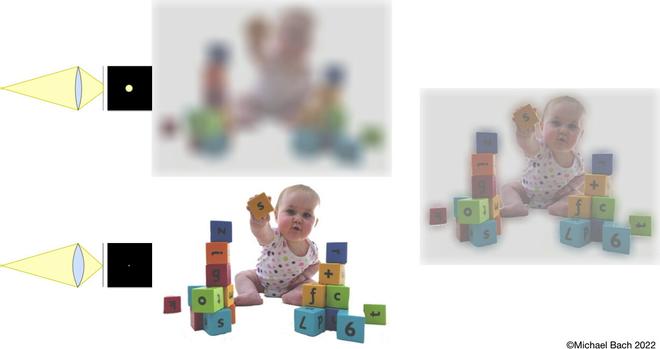
@NicoleCRust The rings "just" cause a superposition of refractive and diffractive imaging. You overlay two images: one sharp, the other defocused (see attached image). The overlay shows a sharp picture with reduced contrast (measured: http://dx.doi.org/10.1007/s00417-014-2565-y). We adapt to the low contrast (https://michaelbach.de/ot/lum-contrastAdapt/) and it "feels" normal. Only snag: absolute contrast threshold remains at ≈½ normal, →more problems in night driving. That's it in a wee nutshell. #vision #visionscience
@michaelbach
Wow - really interesting. To make sure I get it, is this the idea? When I'm looking far away, I get a sharp image of the far away stuff through the sharp rings and a blurry image of the far stuff through the near rings. But my brain adapts to low contrast of the stuff coming through the near rings using contrast adaptation, and that's why it doesn't look like rings of different contrasts when my brain merges them - is that it?
@NicoleCRust Well, that with the near and far rings is wrong anyway: #optics The rings form a #diffractiongrating, designed to collect about 50% of the light in the 1st order and the other 50% in zero order (no deflection). The other side of the lens is convex, creating the focus using the first order of the above. So on the _retina_ you have two images superimposed, just like the one on the right in my formerly attached image. If you're looking close, close focus is sharp, distant blurred.
@NicoleCRust My 400 letters were out… Sorry for poor description, no native English here :): Maybe your multifocal lens is different… However, the #diffractiongrating approach is the standard way to create second focus to my knowledge. #optics is not really my field.
@michaelbach
Hi, I just want to chime in that your English is excellent and your writing very clear.