I don't talk enough about DRUIDE, the language for articulating design uncertainty that @mounadhaouadi designed for her MSc thesis. It's a very good synthesis of concepts for describing the uncertainty that people have during the process of modelling.

Here is the paper, and there is even a 1 minute video of me talking about it: https://www.jot.fm/contents/issue_2021_03/article3.html

#uncertainty #deepUncertainty #MDE #softwareEngineering @seresearchers #SEResearchers

Stakeholders are more than opponents who might throw sand in the gears; they might actually spot considerations you hadn’t thought of. This also raises questions on how we do #costbenefitanalysis under #DeepUncertainty #wickedproblems #postnormalscience (9/9)

8/

#References

[2] Liu, J., Dietz, T., Carpenter, S.R., et al., 2007. Coupled human and natural systems. AMBIO 36, 639–649. https://doi.org/10.1579/0044-7447(2007)36[639:CHANS]2.0.CO;2

[3] Liu, J., Dietz, T., Carpenter, S.R., et al., 2007. Complexity of coupled human and natural systems. Science 317, 1513–1516. https://doi.org/10.1126/science.1144004

(Available free access versions:

https://scholar.google.com/scholar?cluster=9748014925464765351

https://scholar.google.com/scholar?cluster=4395469514804190369 )

#DOI #CoupledHumanAndNaturalSystems #DeepUncertainty #PreciselyIncorrect #complexity #SciencePolicyInterface

4/

On #CoupledHumanAndNaturalSystems (CHANS), the classic overview by Liu et al. (2007) [2][3]

"complexity of organizational, spatial, and temporal couplings"

- "patterns and processes that link human and natural systems"

- "reciprocal interactions and feedbacks—both the effects of humans on the environment and the effects of the environment on humans"

- "how large-scale phenomena emerge from local interactions of multiple agents and in turn influence local system" [2]

#DeepUncertainty

2/

"[...] the impacts of #ClimateChange introduce immeasurable #uncertainty" [1]

Some "policymakers are beginning to grapple with the implications of the #DeepUncertainty in future climate change. They realize that the current “best practice” is risky, because it ignores this new situation and context.

Thus, regulations must be changed to reflect this new level of #complexity and that the university-level training that virtually every practicing professional has been using needs to shift" [1]

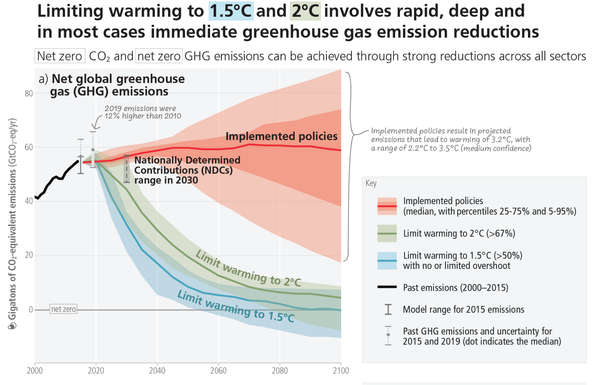
Vast implications of Figure SPM.5 in the #IPCC AR6 summary

A "wise" immediate change of emission patterns (to minimise risk) has become so drastic now that one might wonder if we'll be ever able to achieve it before some #TippingPoint becomes irreversible

Tipping points mean there is #DeepUncertainty: which adds to the urgency of decisions in a policy landscape of disputed values and huge stakes (#PostNormalScience): we may be forced to navigate within effects of unpredictable magnitude

Everyone recognizes that climate risk management is subject to #deepuncertainty, and that it’s valuable to develop plans that aren’t overly sensitive to fragile assumptions.

But how do we quantify performance, trade-offs, and robustness in a world where “all models are wrong”?

Hi! I study water resource systems challenges with focuses on integrated human-natural systems modeling, decision making under #DeepUncertainty, multi-objective optimization.

Lately, I’ve been exploring ML methods for streamflow predictions in ungauged basins.

You can visit my site (which is a bit of a WIP at the moment): https://trevoramestoy.com//

I post frequently on the blog: https://waterprogramming.wordpress.com

Hoping to find some community here!
#introduction #DMDU #hydrology

About me:

About me

Trevor Amestoy