🌄 Watch tea leaves transform through ancient alchemy: plucked at dawn, withered under mountain mist, rolled until edges bruise, oxidized from jade to copper, then fired to halt time itself.

One plant. Five metamorphoses. Infinite expressions.

✍️ Discover the science within tradition: https://TPC8.short.gy/JtayB7Mb

Every cup remembers the mountain. 🍵

#Tea #FoodScience #Botany #Chemistry #CulinaryScience #Agriculture #Science #TPC8

From Garden to Glass: The Five Transformations of Tea 🍃

Discover how one plant becomes green, black, oolong & white tea through 5 transformative stages. From plucking to firing—the science of tea processing

🌄 Watch fresh tea leaves transform through ancient alchemy: withered under mountain mist, rolled by weathered hands until bruised edges release hidden aromatics, oxidized from jade to copper, then fired to halt time itself.

One leaf. Five metamorphoses. Infinite expressions.

✍️ Discover the science within tradition: https://TPC8.short.gy/wiMLRxyg

Every cup remembers the mountain. 🍵

#Tea #FoodScience #Botany #Chemistry #CulinaryScience #Agriculture #Science #TPC8
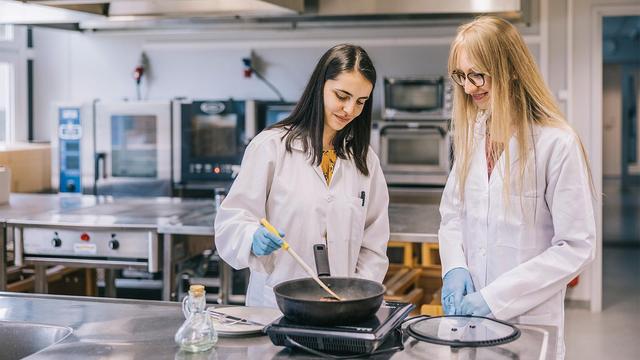
Phase behavior of Cacio e Pepe sauce

``Pasta alla Cacio e pepe'' is a traditional Italian dish made with pasta, pecorino cheese, and pepper. Despite its simple ingredient list, achieving the perfect texture and creaminess of the sauce can be challenging. In this study, we systematically explore the phase behavior of Cacio e pepe sauce, focusing on its stability at increasing temperatures for various proportions of cheese, water, and starch. We identify starch concentration as the key factor influencing sauce stability, with direct implications for practical cooking. Specifically, we delineate a regime where starch concentrations below 1\% (relative to cheese mass) lead to the formation of system-wide clumps, a condition determining what we term the ``Mozzarella Phase'' and corresponding to an unpleasant and separated sauce. Additionally, we examine the impact of cheese concentration relative to water at a fixed starch level, observing a lower critical solution temperature that we theoretically rationalized by means of a minimal effective free-energy model. \tcr{We further analyze the effect of a less traditional stabilizer, trisodium citrate, and observe a sharp transition from the Mozzarella Phase to a completely smooth and stable sauce, in contrast to starch-stabilized mixtures, where the transition is more gradual.} Finally, we present a scientifically optimized recipe based on our findings, enabling a consistently flawless execution of this classic dish.

arXiv.org

🦆 Foie Gras without the duck.

Vow’s cultivated foie gras debuts in select high-end restaurants, turning production challenges into a premium feature.

Vow’s foie gras is 51% quail cells mixed with plant-based ingredients, served at $15 snacks to $186 tasting menus.

https://undark.org/2024/11/26/future-lab-grown-meat-luxury-products/

#labgrownmeat #food #culinaryscience #luxury #culinary #science #future #undark #restaurant #premium #foiegras #plantbased #plantbasedmeat #biology

Is the Future of Lab-Grown Meat in Luxury Products?

A lab-grown alternative to fattened duck liver offers a controversial future for the cultivated meat industry.

Undark Magazine

🌟🔬 Elevate your culinary skills with flavor science! Arielle Johnson, chemist and author of "Flavorama," explains how understanding molecules can enhance your kitchen dexterity. Learn to vary flavor intensity and create innovative dishes! 🧑‍🍳✨

#Foodie #HealthyEating #Nutrition #EatClean #CulinaryScience https://www.sciencenews.org/article/flavorama-science-ingredient-cook-food

‘Flavorama’ guides readers through the complex landscape of flavor

In her new book, Arielle Johnson, former resident scientist at the restaurant Noma, explains how to think like a scientist in the kitchen.

Science News