Marking Progress

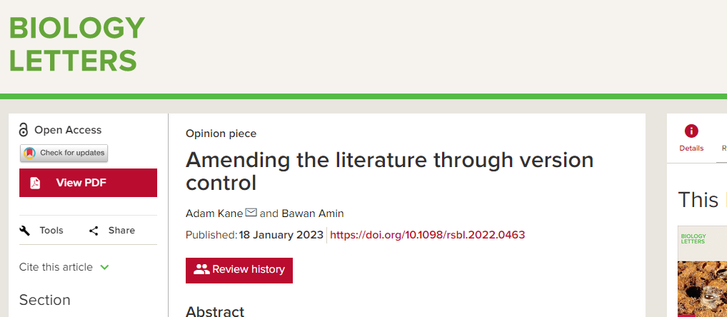
The last day of a week dominated by examination marking found me briefly back on campus to return the batch of scripts I have finished corrrecting and collect the next set (which, happily, is much smaller):

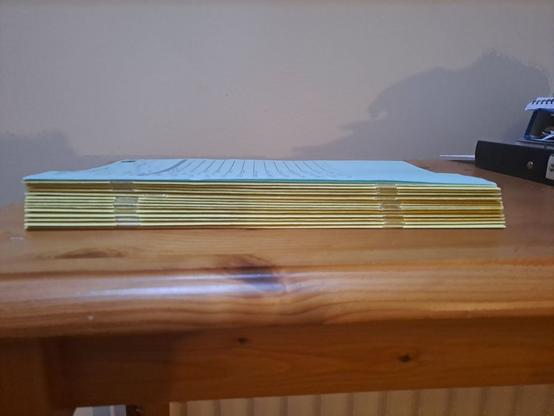
There are 14 scripts in the pile for my second paper, for my 4th year Mathematical Physics module on Differential Equations and Complex Analysis, around one-third of those for my Engineering Mathematics module Differentiaol Equations and Transform Methods. Based on the total number of examinations I have to mark I am therefore now 50% complete, but based on the number of scripts I’m about 75% through. I should be able to finish the latest batch in a day, but there’s no desperate rush so I’ll do them on Monday. I’m not going to start them now as I am off a concert – my first of 2026 – this evening and I prefer not to work at weekends unless I absolutely have to.

I finished the first set of marking yesterday, and spent most of this morning uploading and checking the scores and the conflation of exam marks with coursework scores. Satisfied that all is OK, I returned the scripts to the office for storage until our Examination Board meeting in about 10 days. I wasn’t on campus long, but there was a fire alarm in the Science Building while I was there. As usual, it turned out to be a false alarm.

Anyway, I should be finished with examination matters by Monday evening, which gives me four days next week to get on with other things. I’m looking forward to the change.

#Correcting #DifferentialEquationsAndComplexAnalysis #Examinations #Marking

Marking Time Once More

Lecturers at Maynooth University are supposed to be available on the telephone to deal with queries from students concerning their examinations. And so it came to pass that yesterday I was “on call”. Since I live in Maynooth, I decided to come into campus in case of a query so I could go to the examination venue l to deal with it if required. In the event, however, the examination passed off without incident and nobody called.

I wasn’t twiddling my thumbs all morning though. It seemed a good opportunity to go through the accumulated coursework for this module, applying various exemptions for medical or other reasons, so that when I’ve marked the scripts I can immediately combine the results with the CA component.

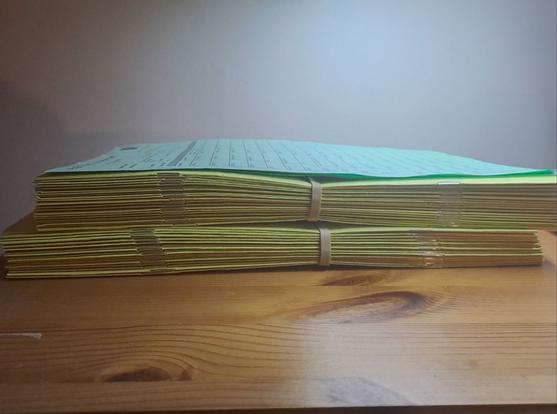
The examination venue, incidentally, was not on campus but in the Glenroyal Hotel in Maynooth. The Sports Hall on campus is usually one of the places for examinations to be sat, but it is not available this year due to refurbishment. The other day I was in one of the shops in the shopping centre next to the hotel and there were some complaints about the lack of available car parking spaces owing to so many students parking there for their exams. Anyway, the exam scripts found their way to my office this morning and here I am again, back home with a stack of an examination scripts to mark. The picture shows about 40 papers from my module on Differential Equations and Transform Methods. I want to get them out of the way as quickly as possible as I have another paper coming up on Thursday and have a lot of other things to do before term starts at the beginning of February. All the usual displacement activities having been exahusted, I’ve already made a start. With a bit of luck I’ll complete this task by Thursday.

I’ve often discussed the process of marking examinations with my colleagues and they all have different techniques. What I do is mark one question at a time rather than one script at a time. What I mean by that is that I go through every script marking all the attempts at Question 1, then I start again and do Question 2, etc. I find that this is much quicker and more efficient than marking all the questions in each script then moving onto the next script. The reason for this is that I can upload into my mind the model answer for Question 1 so that it stays there while I mark dozens of attempts at it so I don’t have to keep referring to the marking scheme. Other advantages are that it’s easier to be consistent in giving partial credit when you’re doing the same question over and over again, and that also you spot what the common mistakes are more easily.

Anyway, I’ve decided to take a break for today. I’ll start again tomorrow.

#Correcting #Examinations #Marking #MaynoothUniversity #Scripts

After making a heated homophobic remark, this NHL coach actually got his apology right - Queerty

Everybody makes mistakes. The growth comes from correcting them.

Queerty

Arıkan's new solution was to create near-perfect channels from ordinary channels by a process he called “#channel #polarization.”

Noise would be transferred from one channel to a copy of the same channel to create a cleaner copy and a dirtier one.

After a recursive series of such steps, two sets of channels emerge, one set being extremely noisy, the other being almost noise-free.

The channels that are scrubbed of noise, in theory, can attain the Shannon limit.

He dubbed his solution #polar #codes.
It's as if the noise was banished to the North Pole, allowing for pristine communications at the South Pole.

After this discovery, Arıkan spent two more years refining the details.
He had read that before Shannon released his famous paper on information theory, his supervisor at Bell Labs would pop by and ask if the researcher had anything new.
“Shannon never mentioned information theory,” says Arıkan with a laugh.
“He kept his work undercover. He didn't disclose it.”

That was also Arıkan's MO. “I had the luxury of knowing that no other person in the world was working on this problem,” Arıkan says, “because it was not a fashionable subject.”

In 2008, three years after his eureka moment, Arıkan finally presented his work.

He had understood its importance all along. Over the years, whenever he traveled, he would leave his unpublished manuscript in two envelopes addressed to “top colleagues whom I trusted,” with the order to mail them “if I don't come back.”

In 2009 he published his definitive paper in the field's top journal, IEEE Transactions on Information Theory.

It didn't exactly make him a household name, but within the small community of information theorists, polar codes were a sensation.

Arıkan traveled to the US to give a series of lectures. (You can see them on YouTube; they are not for the mathematically fainthearted. The students look a bit bored.)

Arıkan was justifiably proud of his accomplishment, but he didn't think of polar codes as something with practical value.

It was a theoretical solution that, even if implemented, seemed unlikely to rival the error-correction codes already in place.

He didn't even bother to get a patent.

#channel #capacity #Shannon #limit #correcting #errors #Bilkent #University #eureka #accurately #redundancy #channel #coding #problem

Arıkan devoted the next year to learning about networks, but he never gave up on his passion for information science.

What gripped him most was solving a challenge that Shannon himself had spelled out in his 1948 paper:
how to transport accurate information at high speed while defeating the inevitable “noise”
—undesirable alterations of the message
—introduced in the process of moving all those bits.

The problem was known as #channel #capacity.

According to Shannon, every communications channel had a kind of speed limit for transmitting information reliably.

This as-yet-unattained theoretical boundary was referred to as the #Shannon #limit.

Gallager had wrestled with the Shannon limit early in his career, and he got close. His much celebrated theoretical approach was something he called low-density parity-check codes, or LDPC, which were, in simplest terms, a high-speed method of #correcting #errors on the fly.

While the mathematics of LDPC were innovative, Gallager understood at the time that it wasn't commercially viable.

“It was just too complicated for the cost of the logical operations that were needed,” Gallager says now.

Gallager and others at MIT figured that they had gotten as close to the Shannon limit as one could get, and he moved on.

At MIT in the 1980s, the excitement about information theory had waned.
But not for Arıkan.

He wanted to solve the problem that stood in the way of reaching the Shannon limit.

Even as he pursued his thesis on the networking problem that Gallager had pointed him to, he seized on a piece that included error correction.

“When you do error-correction coding, you are in Shannon theory,” he says.

Arıkan finished his doctoral thesis in 1986, and after a brief stint at the University of Illinois he returned to Turkey to join the country's first private, nonprofit research institution, #Bilkent #University, located on the outskirts of Ankara.

Arıkan helped establish its engineering school. He taught classes. He published papers.

But Bilkent also allowed him to pursue his potentially fruitless battle with the Shannon limit.

“The best people are in the US, but why aren't they working for 10 years, 20 years on the same problem?” he said.
“Because they wouldn't be able to get tenure; they wouldn't be able to get research funding.”

Rather than advancing his field in tiny increments, he went on a monumental quest. It would be his work for the next 20 years.

In December 2005 he had a kind of #eureka moment.
Spurred by a question posed in a three-page dispatch written in 1965 by a Russian information scientist, Arıkan reframed the problem for himself.

“The key to discoveries is to look at those places where there is still a paradox,” Arıkan says.

“It's like the tip of an iceberg. If there is a point of dissatisfaction, take a closer look at it. You are likely to find a treasure trove underneath.”

Arıkan's goal was to transmit messages accurately over a noisy channel at the fastest possible speed.

The key word is #accurately. If you don't care about accuracy, you can send messages unfettered.

But if you want the recipient to get the same data that you sent, you have to insert some #redundancy into the message.
That gives the recipient a way to cross-check the message to make sure it's what you sent.

Inevitably, that extra cross-checking slows things down.
This is known as the #channel #coding #problem.

The greater the amount of noise, the more added redundancy is needed to protect the message.

And the more redundancy you add, the slower the rate of transmission becomes.

The coding problem tries to defeat that trade-off and find ways to achieve reliable transmission of information at the fastest possible rate.

The optimum rate would be the Shannon limit: channel coding nirvana.
Kansas Moves to Block Trans People From Correcting Their State IDs

Trans residents who have changed their gender marker with the state will have those changes reversed, the Attorney General has said.

Them.

There is a lot that can be improved when it comes to #correcting the #scientific literature. Unfortunately, there are many seen and unseen barriers that prevent researchers from amending their work.

Inspired by #openscience developments, Adam Kane and myself wrote an opinion piece on how authors could transparently and (relatively) easily communicate amendments on their work. Published today #openaccess in #biology letters:

https://royalsocietypublishing.org/doi/10.1098/rsbl.2022.0463

Amending the literature through version control | Biology Letters

The ideal of self-correction in science is not well served by the current culture and system surrounding amendments to published literature. Here we describe our view of how amendments could and should work by drawing on the idea of an author-led version ...

Biology Letters
@vertigo I keep saying that for years and people keep #correcting me 
fedi.xerz.one