We shouldn't be satisfied with open licences to release open resources. With the democratisation and institutionalisation of openness movements, but also because of the contemporary crisis, a copyright reform must be a target in our mind.

Open licenses are a complex system, weapons of the weak.

In 1976, the US copyright Act started to protect software with software industry increasingly closing their code source. In reaction in 80's, Richard Stallman started the free software movement while creating the first open licence (Emacs/GNU General Public License) to guarantee software freedom.

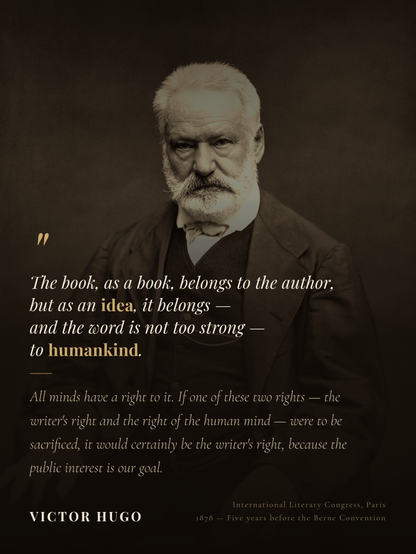
Near 1998, Lawrence Lessig fought at the Supreme Court against the Copyright Term Extension Act to counter this extension of over 70 years after author's death (!) to protect the public domain. They failed, and it led to the creation of the organization @Creative Commons and their licences in 2001.

Open licenses exist because the copyright framework does not provide a way to share outside complex licensing mechanisms. Licenses are bad; it's private law based on tools provided by private organisations.

ยซ CC licenses are a patch, not a fix, for the problems of the copyright system. ยป Creative Commons organization on copyright reform: https://creativecommons.org/about/policy-advocacy-copyright-reform/reform/

A copyright reform would be about integrating a new human right, the right to share.

It's about transforming the public domain which is inconsistent worldwide, where death may be one of the best ways to contribute to it without providing necessarily modification rights.

In fifty years, the landscape changed and open models are becoming mainstream. The EU open source strategy just few days ago, the UNESCO recommendation on open science with a proliferation of national policies on that matter, the UNESCO recommendation on open education with also national policies emerging.

It will be time to flip the table, to change the rules and contribute to the collapse of the open licensing system in order to build the future. We are wasting a tremendous amount of energy because of this inefficient system.

A necessary evil today, but a proper education in licensing should provide a critical framework and not merely explain how it works.

The current copyright system is primarily designed to serve economic interests. In the face of crises, with the need to widely disseminate knowledge and solutions to problems, the entire philosophy behind the copyright system needs to be rethought.

It's a collective battle against powerful forces โ€” this is an ideological conflict for the sake of society.

#openmodels #openscience #openeducation #openhardware #opensoftware #opensource #digitalcommons #creativecommons #copyrightReform
AI training on creative works raises vital questions about fair compensation and legal frameworks. Emerging models like collective licensing, opt-in participation, and micropayments aim to address artist rights in this transformative era. Discover more at https://dev.to/rawveg/ai-trains-on-your-art-mkd
#HumanInTheLoop #AIinCreativity #CopyrightReform #CreativeEconomy
AI Trains on Your Art

When Andrea Bartz, Charles Graeber, and Kirk Wallace Johnson filed their class action lawsuit against...

DEV Community

I'm not sure how this could be actioned, but imagine that copyright and trademark law was reformed to recognise the editorial staff of academic journals as its owners. Not the publisher who distributes them.

That way the editorial staff have decision-making power over whether the articles published in their journal are open access, and what style. If the publisher was unhappy with their decisions, they could move to a different one.

#CopyrightReform

One simple change to copyright law that would make a huge difference is making exclusive licenses unenforceable. Here's an example.

After decades of consolidation, an oligopoly of 3 corporations control licensing for the majority of the world's recorded music (Universal, Sony and Warner). If an artist wants their music distributed by one of them, they have to sign over 100% control of their music licensing rights.

(1/?)

#PolicyNZ #copyright #CopyrightReform

Orphan Works, Living Cultures: What the Copyright Amendment Bill Means for ICIP

17 November 2025Dr Terri JankeOn 5 November 2025, the Australian Government introduced the Copyright Amendment Bill, including a new orphan works scheme designed to update copyright law for the digital age.Under this model, users will be able to rely on a limitation-of-remedies defence when using an orphan work, but only if they meet five strict threshold conditions. Importantly, the Bill and its Explanatory Memorandum also highlight that a higher standard will apply where Indigenous Cultural an

terri-janke
The EU supports open science, but legislative and regulatory frameworks often act as barriers, preventing the full implementation of its principles. We need copyright law to support, not hinder, research. #CopyrightReform
๐Ÿ‘‰Check which legal barriers prevent you from 100% OA. Share your challenges.๐Ÿ‘‡

Like the Right to Repair, we have a Right to Archive. Copyright laws around the world must change, to make it clear that noncommercial archiving of born-digital, published artifacts is Fair Use/ Dealing, and exempt from all copyright claims.

The alternative is to let the powerful run their own versions of the Ministry of Truth, and stuff any digital artifact that's inconvenient to them down the memory hole.

https://mastodon.nzoss.nz/@strypey/114992084802325912

(1/2)

#copyright #CopyrightReform #FairUse #RightToArchive

Strypey (@[email protected])

@[email protected] I mean, are you aware of this? https://www.ted.com/talks/carole_cadwalladr_this_is_what_a_digital_coup_looks_like These people collectively control the archives of most of the world's discussions. As Orwell warned us in 1984; "Who controls the past controls the future: who controls the present controls the past" Independent archiving of public discussions is an essential hedge against global totalitarianism. Orwelll again; "If you want a picture of the future, imagine a boot stamping on a human face - for ever." This is what's at stake.

Mastodon - NZOSS
Mediavine launches petition demanding AI copyright protections: Company urges Copyright Office to reject "wait and see" approach as 17,000 publishers face AI content exploitation. https://ppc.land/mediavine-launches-petition-demanding-ai-copyright-protections/ #AICopyright #CopyrightReform #TechNews #MediaIndustry #ContentCreation
Mediavine launches petition demanding AI copyright protections

Company urges Copyright Office to reject "wait and see" approach as 17,000 publishers face AI content exploitation.

PPC Land
No One Is in Charge at the US Copyright Office

During a wild time for copyright law, the US Copyright Office has no one at the helmโ€”and no one knows when that will change.

WIRED

In a win for fair use and public access to information, a US Federal judge in the Northern District of California has ruled in Bartz v. Anthropic PBC (3:24-cv-05417) that training AI on copyrighted works is protected by fair use.

However, unfortunately, the judge also ruled the Defendant's downloading and storage of pirated books was unlawful.

Reporting: https://www.404media.co/judge-rules-training-ai-on-authors-books-is-legal-but-pirating-them-is-not/ (I think its behind CloudFlare but can't check right now. Is email walled)

Decision: https://storage.courtlistener.com/recap/gov.uscourts.cand.434709/gov.uscourts.cand.434709.231.0_2.pdf

#Copyright #AI #Law #BartzVAnthropic #CopyrightReform #Anthropic #FairUse