 Slow Mover
The Maranatha Empire
There is a prayer so holy that it should burn the tongue of every empire that tries to speak it.
Maranatha.
Come, Lord.
It is the cry of the small church under pressure. The cry of the persecuted and the patient. The cry of those who have no armies to summon, no throne to defend, no voting bloc sufficient to save them, no market share large enough to secure their future. It is the cry of those who wait because they know they are not God.
But in every age, there are those who take this prayer of waiting and turn it into a banner of possession.
They say, “Come, Lord,” but what they mean is, “Give us control.”
They say, “Thy kingdom come,” but what they mean is, “Let our faction rule.”
They say, “Prepare the way of the Lord,” but what they build are prisons, borders, propaganda machines, religious celebrity platforms, and monuments to their own fear.
This is the Maranatha Empire.
It is not one nation only, though nations may become its servants. It is not one denomination only, though denominations may become its chapels. It is not merely Rome, nor Geneva, nor Washington, nor Moscow, nor any other city that has mistaken power for providence. The Maranatha Empire is the recurring temptation of the religious heart: to stop waiting for Christ and begin replacing him.
It begins quietly.
It begins with concern.
The world is dangerous. The children are vulnerable. The church is shrinking. The enemies are multiplying. The culture is changing. The old certainties are crumbling. The people are afraid.
Fear, when baptized, often calls itself faithfulness.
So the frightened church begins to reach for tools Jesus refused.
A throne.
A sword.
A spectacle.
A scapegoat.
A strongman.
A law that can accomplish what love has not yet persuaded.
A state that can enforce what the Spirit has not yet formed.
A leader who promises to defend Christ, as though Christ ever asked Peter to keep swinging after Gethsemane.
This is how the prayer becomes an empire.
The early church cried, “Come, Lord Jesus,” because it knew that Caesar was not Lord. The Maranatha Empire cries, “Come, Lord Jesus,” because it wants Caesar to become useful.
The early church broke bread in homes. The Maranatha Empire builds platforms and calls them altars.
The early church welcomed the stranger. The Maranatha Empire sees the stranger as a threat.
The early church died rather than kill. The Maranatha Empire kills and calls the dead collateral damage in the defense of righteousness.
The early church believed the Lamb had conquered. The Maranatha Empire keeps looking for a beast strong enough to protect the Lamb.
And there is the blasphemy.
Not that empire rejects Christ outright. That would be too honest. The Maranatha Empire does something more dangerous. It uses Christ as decoration for a power that is fundamentally afraid of the cross.
It sings of the Lamb while trusting the dragon.
It preaches resurrection while organizing itself around survival.
It displays the cross while despising weakness.
It quotes Jesus while ignoring the people Jesus told us to notice: the poor, the imprisoned, the hungry, the foreigner, the enemy, the child, the wounded man beside the road.
The Maranatha Empire is not built by atheists. It is built by believers who have lost patience with the way of Jesus.
For the way of Jesus is slow.
It is seed, yeast, salt, light.
It is foot-washing.
It is forgiveness seventy times seven.
It is refusing the shortcut of domination even when domination appears efficient.
It is telling Peter to put away the sword when everything in Peter’s body screams that this is the moment for holy violence.
It is standing before Pilate and saying, “My kingdom is not from this world,” not because the kingdom has nothing to do with the world, but because it does not come by the world’s methods.
The Maranatha Empire cannot tolerate this.
It cannot tolerate a Messiah who will not seize power.
It cannot tolerate a church that would rather be faithful than influential.
It cannot tolerate a people whose politics begin at the basin and towel.
It cannot tolerate enemy-love, because enemy-love ruins the machinery. Empire requires enemies. It needs them. It feeds on them. Without enemies, the crowd might look too closely at the throne.
So, the Maranatha Empire manufactures urgency.
There is no time to love.
No time to listen.
No time to discern.
No time for reconciliation.
No time for peacemaking.
No time to ask whether the means resemble the Christ we claim to serve.
The hour is late, they say. The danger is great. The stakes are too high. We must act now. We must take control now. We must win now.
And somewhere beneath all that urgency is a terrible confession:
They do not actually believe the Lord is coming.
Or, if he is coming, they do not trust him to arrive in the right way.
So they build him an empire to inherit.
But Christ does not inherit empires.
He judges them.
He walks in alleyways, not palaces. He asks whether the churches have kept their first love. He warns those who are rich and comfortable and self-satisfied that they may be poor, blind, and naked. He stands at the door and knocks, not because he has been defeated by secularism, but because religious people have locked him outside while holding meetings in his name.
The Maranatha Empire is always shocked when Jesus is found outside the gate.
Outside the camp.
Outside respectability.
Outside the approved narrative.
Outside the walls with the crucified, the excluded, the unclean, the inconvenient, and the condemned.
The empire expected him in the capital.
But he is with the refugees.
The empire expected him in the cathedral of victory.
But he is with the mother of the disappeared.
The empire expected him on the reviewing stand.
But he is washing feet in the basement.
The empire expected him to bless the troops.
But he is asking why his followers are still carrying swords.
This is why Maranatha must remain a dangerous prayer.
It must never be allowed to become a slogan for conquest. It must never be printed on the banners of those who are unwilling to be converted by the One they summon. To pray “Come, Lord” is not to invite divine endorsement of our projects. It is to invite judgment upon them.
Come, Lord, and judge our churches.
Come, Lord, and judge our flags.
Come, Lord, and judge our markets.
Come, Lord, and judge our weapons.
Come, Lord, and judge our sermons.
Come, Lord, and judge our secret hatreds.
Come, Lord, and judge the ways we have used your name to avoid your way.
This is the prayer empire cannot honestly pray.
Because if the Lord comes, the first thing to fall may not be our enemies.
It may be our idols.
The algorithm.
The nation.
The party.
The brand.
The gun.
The strongman.
The myth of innocence.
The lie that we can harm others for a righteous cause and remain untouched by the harm.
The Maranatha Empire teaches us to fear the collapse of Christian influence.
Jesus teaches us to fear gaining the world and losing our soul.
The Maranatha Empire asks, “How do we take back the culture?”
Jesus asks, “Can you drink the cup that I drink?”
The Maranatha Empire says, “Blessed are the winners.”
Jesus says, “Blessed are the meek.”
The Maranatha Empire says, “Blessed are the forceful, for they shall secure the future.”
Jesus says, “Blessed are the peacemakers, for they shall be called children of God.”
And perhaps this is the word for us now:
The church does not need to become more powerful.
The church needs to become more faithful.
Not passive. Not silent. Not withdrawn into pious irrelevance. But faithful in the particular, cruciform, stubborn way of Jesus. Faithful enough to resist evil without becoming its mirror. Faithful enough to tell the truth without hatred. Faithful enough to protect the vulnerable without worshiping violence. Faithful enough to build communities of economic sharing, hospitality, forgiveness, courage, and joy. Faithful enough to be a people who can live without controlling the outcome.
That is the hard part.
Empire is attractive because it promises control.
Jesus offers communion.
Empire promises security.
Jesus offers peace.
Empire promises victory over enemies.
Jesus offers reconciliation that may begin with our repentance.
Empire promises to make us great.
Jesus invites us to become small enough to enter the kingdom.
So, let the Maranatha Empire fall.
Let it fall first in us.
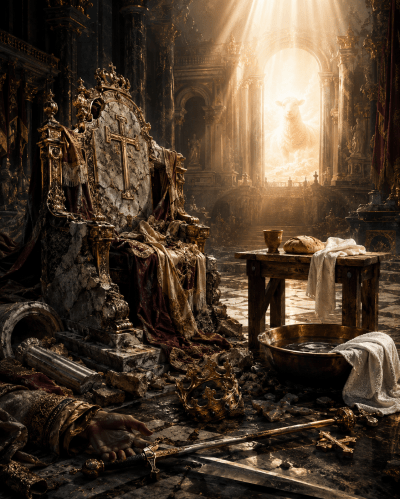
Let it fall in every place where we have confused anxiety with zeal. Let it fall where we have preferred dominance to witness. Let it fall where we have wanted laws to do what discipleship would not. Let it fall where we have used the suffering of others as fuel for our own righteousness. Let it fall where we have asked Jesus to come only after we have arranged the throne to our liking.
And when it falls, may something older and more beautiful remain.
A table.
A basin.
A towel.
A loaf.
A cup.
A people gathered without illusion, without empire, without the need to be impressive, whispering the ancient prayer not as conquerors but as witnesses:
Maranatha.
Come, Lord Jesus.
Come not to crown our domination, but to free us from it.
Come not to baptize our fear, but to cast it out.
Come not to make our empire holy, but to teach us again that your kingdom comes like a seed, like yeast, like mercy, like a Lamb who was slain and yet lives.
And until you come, make us faithful.
Not imperial.
Not triumphant.
Not afraid.
Faithful.
 Intentional Faith
 Greg Johnson
 Atheist Mom


 Anais Rim