The Unknown God

A Sermon about the Idols of Yesterday and Today

Acts 17:16–31

(Note: Sermons can be heard in audio format at https://millersburgmennonite.org/worship/sermon-audio/)

In our scripture this morning, Paul walks into Athens, a city overflowing with religion, beauty, ideas, temples, shrines, altars, arguments, and gods.

Athens is not empty.

Athens is crowded.

And Paul is deeply troubled.

Paul is not troubled because Athens is secular. He is troubled because Athens is religious in all the wrong ways. The city is full of worship, but empty of surrender. Full of gods, but not the living God. Full of altars but still haunted by absence.

For among all those altars, Paul notices one inscription:

To an unknown god.

What a haunting phrase.

In the middle of all the Athenians’ certainty, there is still this admission: we may have missed something. We may not know as much as we think. There may still be a God we have not recognized.

And I wonder if that is not where many people are right now.

Not atheists necessarily. Not even irreligious. But uncertain. Searching. Guarded. Spiritual, yet suspicious of certainty. Curious yet afraid of being closed off or closed in. Open and yet not really able to surrender to truth. Religious and yet still missing God.

La Atenas de Pablo no es solamente historia antigua; también describe nuestro mundo de hoy.

So Athens is not just ancient history.

Athens is now.

Let us pray.

May the words of my mouth and the meditations of our hearts be acceptable in your sight, O God, our Rock and our Redeemer. Amen.

Homily

Like the Athens of Paul’s day, our world today is full of altars too.

Altars to nation. Altars to wealth. Altars to image. Altars to safety. Altars to tribe. Altars to ideology. Altars to the market. Altars to the screen. Altars to the self.

We, like the Athenians, have all kinds of gods.

One reason I think our public discourse feels so fractured is that we are not just arguing about small things. We are bringing completely different belief systems into the room.

In Athens there were Jews who worshiped the one living God; God-fearing Greeks drawn toward that God but not fully committed; Epicureans who sought calm and freedom from fear; Stoics who valued reason, virtue, order, and discipline; and this strange altar to an unknown god, an altar that says, “We do not want to miss the divine. We know there is more than we can name.”

Paul proclaims a God who is not vague, not distant, not merely a principle, not one more option in the marketplace of ideas. Paul proclaims the God who made the world and everything in it, the God who gives life and breath to all, the God who cannot be reduced to shrines or captured in gold or silver or stone or circuitry, the God who is near to all, the God who now calls all people everywhere to repent because God has raised Jesus from the dead.

Pablo anuncia que Dios no es una idea vaga ni un ídolo más, sino el Creador que da vida, aliento y resurrección.

Some may believe truth is revealed and binding. Others are spiritual, but indefinite. Others have been wounded by the church and do not know whether the word “God” is invitation or threat.

And into all of that, Christian witness says: the world belongs to its Creator, and history has turned in the resurrection of Jesus Christ.

When Paul is brought to the Areopagus, we might imagine a cozy invitation. Maybe there is curiosity there, but there is also something more serious. Paul is being examined. Tested. Weighed. Asked to explain himself in public.

Paul is heard, but under suspicion.

And how does he respond?

Not with coercion. Not with panic. Not with silence. Not with flattery. Not with domination.

He responds with witness.

Paul pays attention. He listens. He observes. He starts where the people are.

Pablo no responde con poder o miedo, sino con atención, humildad y testimonio.

Paul does not begin by quoting Moses. He does not begin where he is most comfortable. He begins with what his hearers can recognize: their altar, their poets, their longing, their language of divine nearness.

My friends, that is not compromise. That is faithful witness.

And this matters for us, because our witness cannot always sound exactly the same in every place, in every room, in every forum.

The gospel does not change. “Jesus Christ is Lord” – that doesn’t change either. The call to repentance, reconciliation, mercy, justice, truth, and abundant life this side of the resurrection does not change.

But the way we bear witness may depend on where we are and who is in front of us.

El evangelio no cambia, pero la manera de dar testimonio puede cambiar según el lugar y las personas.

When Paul is in the synagogue, he reasons from the scriptures. But when Paul is in Athens, among philosophers, idolaters, seekers, and skeptics, he begins somewhere else. He begins with creation. He begins with breath. He begins with longing. He begins with the altar they already have. He begins with the poetry they already know.

Paul does not start by asking them to enter his world. He first enters theirs.

That is not watering down the faith. That is speaking the truth in love. That is incarnation-shaped witness.

Pablo entra en el mundo de sus oyentes para poder anunciarles fielmente al Dios vivo.

Paul does not introduce Athens to a God who was absent until Paul arrived. Paul reveals the presence of a God they have already been brushing up against.

The God they called unknown has been waiting to be revealed.

Paul says this God gives to all mortals life and breath and all things. Paul says this God is not far from each one of us. Paul says, “In him we live and move and have our being.”

So maybe the question is not simply, “Will God show up?”

Maybe the deeper question is, “Will we recognize how God is already showing up?”

Which brings us to a question worth asking every day:

God, how are you going to show up today?

Not, “God, are you going to show up?”

But, “God, how are you going to show up?”

La pregunta no es solo si Dios aparecerá, sino si tendremos ojos para reconocer cómo Dios ya está presente.

Because Acts 17 reveals to us that God may already be present before people have the right language. God may already be at work before someone has the right doctrine. God may already be stirring longing before anyone knows how to name that longing.

God may already be there in the question. God may already be there in the difference. God may already be there in the ache. God may already be there in the crack in someone’s certainty.

Paul sees an altar to an unknown god, and he does not only see idolatry. He also sees longing. He sees an opening. He sees a place where witness can begin.

Dios puede estar obrando en la pregunta, en el dolor, en el anhelo, aun antes de que sepamos nombrarlo.

And then Paul does something just as important:

He does not stay there.

He builds a bridge, yes. But he also tells the truth.

He says, in effect, “The God you do not know is the God who made you. The God you have not recognized is the God who gives you breath. The God you have left unnamed is not contained in your temples. The God you seek cannot be reduced to your idols.”

Because idolatry is not just about statues.

Idolatry is whenever we try to bind God to our own systems of power and belief.

Idolatry is when nation becomes ultimate. Idolatry is when wealth becomes sacred. Idolatry is when violence is blessed. Idolatry is when “they” usurps “us.” Idolatry is when “my people” become more important than “humanity.” Idolatry is when our beliefs matter more than relationships. Idolatry is when our politics, grievances, fears, and identities begin to function as gods.

And let us be honest: the church is not exempt.

Athens is not only out there.

Athens is in here.

Athens is in us whenever we want a manageable god. Athens is in us whenever we want a useful god. Athens is in us whenever we want a god who blesses our side, confirms our assumptions, secures our system, and God forbid, never ever, disrupts our loyalties.

But Paul says the living God does not dwell in temples made by human hands.

That means God is not mine, yours, ours to manage.

Dios no pertenece a nuestros sistemas; nosotros pertenecemos al Dios vivo.

Which begs the question:

God, how are you going to show up?

Because we often want God to show up in familiar ways. Predictable ways. Comfortable ways. Worshipful, yes, but also manageable.

But what if the living God shows up in ways that unsettle us?

What if God shows up in the person we dismissed? What if God shows up in the hard conversation? What if God shows up in the exposure of an idol? What if God shows up in a call to repentance? What if God shows up not to decorate our little altars, but to overturn them?

There are some places where our witness begins with Scripture. Some where it begins with service. Some with silence. Some with apology. Some with saying, “Tell me more.”

There are some places where our witness begins not by answering a question no one is asking, but by noticing the altar in the room, the longing in the room, the wound in the room, the fear in the room, the unknown god in the room.

And yet, Christian witness does not end with vague spirituality.

Paul does not say, “Well, you have your gods, and I have mine, and maybe underneath it all we mean the same thing.”

No.

He moves to repentance.

He moves to judgment.

He moves to resurrection.

Because resurrection means God has shown up in Jesus Christ.

The unknown God is unknown no longer.

Not because we figured God out, but because God has acted. Because Christ has been raised.

El Dios desconocido se ha dado a conocer en Jesucristo, crucificado y resucitado.

Because death is not lord. Caesar is not lord. The economy is not lord. Violence is not lord. Fear is not lord. (Fill in the blank) is not lord. Like we say down South, those dogs don’t hunt.

Jesus Christ is Lord. Jesus Christ is Lord. Jesus Christ is Lord!

The Cosmic Christ is more than just our own personal Jesus. And that means resurrection is not just good news for me, or my private soul. Or you and your private soul.  It is the announcement of a new humanity under a new Lord. A new community. A new allegiance. A new public witness.

La resurrección anuncia una nueva humanidad bajo el señorío de Cristo.

That is who the church is meant to be.

Not simply a chaplain to the culture. Not another little religious booth in the marketplace of ideas. Not a baptizer of empire. Not a slave to ideology.

The church is the gathering of a resurrection people.

A people who do not only say, “God, show up.”

But a people who say,

God, help us recognize how you are showing up.

La iglesia existe para reconocer y encarnar la presencia del Cristo resucitado en el mundo.

So ask the question.

Ask it every morning. Ask it before worship. Ask it before the meeting. Ask it before the conversation. Ask it before you enter the room.

God, how are you going to show up?

And then ask the next question:

God, how are you calling me to show up?

To show up in worship, to show up in our community, to show up in the public square, to show up in the hard conversation, to show up in the awkward silence, and to show up in the uncomfortable moment when it would be easier to walk away.

My friends, we are the church of God. We are resurrection people, and resurrection people do not hide behind rose-colored stained-glass windows.

We show up because God first showed up.

We show up not because we are fearless, but because we are faithful. We show up not because every moment is easy, but because love is present. We show up not because we control the outcome, but because Christ is Lord. We show up not to dominate, not to coerce, not to win, but to bear witness.

Nos presentamos no para dominar, sino para dar testimonio con fidelidad, amor, humildad y paz.

And our witness may look different depending on where we are.

In worship, we show up with praise. In the neighborhood, with service. In conflict, with humility. In public life, with truth and peace. Among the wounded, with gentleness. Among the arrogant, with courage. Among the uncertain, with patience. Among the idols, with discernment.

Paul showed up in Athens.

He showed up in a city full of idols, in misunderstanding, under scrutiny, in the awkwardness of difference.

He showed up with a witness shaped by the place he was in.

He did not abandon the gospel.

He embodied it.

He trusted that God was already there ahead of him.

Pablo confió en que Dios ya estaba presente antes de que él hablara.

Maybe that is our calling too.

Not to have every answer. Not to control every room. Not to force belief.

But to show up with courage, humility, truth, and love, because the God who seemed unknown has already come near.

So this week, before you enter the room, begin the conversation, make the assumption, or speak the word, ask:

God, how are you going to show up here, in this moment, today?

And then ask:

Lord Jesus, how are you calling me to show up, here, in this moment, today, with you?

Because the God who was unknown has been made known, and the God who has been made known is still showing up, in us and in the people around us, in our homes and in the homes next door, in our neighborhood and in the communities down the road, in our nation and in all the nations of the world.

May God grant us open eyes and willing hearts to see and serve.

Let us pray.

#Acts17 #anabaptist #Areopagus #biblicalPreaching #ChristianArt #ChristianWitness #ChurchAndSociety #Cross #discernment #faithAndCulture #faithfulWitness #falseGods #GodShowingUp #Idolatry #JesusChristIsLord #modernIdols #PaulInAthens #publicWitness #Repentance #resurrection #SacredImagery #sermonIllustration #spiritualLonging #UnknownGod

Pointing Beyond Ourselves

A Life That Leads Others to Christ
As the Day Ends

As the evening settles in and the pace of the day begins to slow, there is a quiet invitation to reflect not only on what we have done, but on how we have lived before others. The words drawn from John 4:42 echo with clarity: “We no longer believe just because of what you said; now we have heard for ourselves, and we know that this man really is the Savior of the world.” The woman at the well did not become the object of their faith—she became the catalyst for it. That distinction is critical. True love for others does not seek to control, impress, or become indispensable. Instead, it seeks to guide others toward a personal encounter with Christ. The Greek word for “Savior,” sōtēr (σωτήρ), reminds us that salvation is not mediated through personality or influence, but through Jesus Himself. Our role is to point, not replace.

There is a subtle temptation in relationships to take on a role that belongs only to God. We may try to fix, to carry, or to manage the lives of others in ways that exceed our calling. Yet the wisdom of Scripture gently redirects us. Love is most powerful when it fuels another’s faith in God, not dependence on us. When I consider how I have interacted with others today, I am challenged to ask: did my words and actions draw people closer to Christ, or did they draw attention to myself? The apostle Paul captures this balance in 2 Thessalonians 1:4, where he speaks of perseverance and faith in the midst of trials. Our endurance becomes a testimony—not because we are strong, but because God is faithful.

As the day closes, I am reminded that others are always observing, even when I am unaware. Timothy’s faith was shaped by the quiet consistency of his grandmother Lois and his mother Eunice (2 Timothy 1:5). Their legacy was not built in a moment but over time, through lived faith. The Greek word anupokritos (ἀνυπόκριτος), meaning “sincere” or “without hypocrisy,” describes the kind of faith that leaves an imprint on others. This is the kind of life that influences not by force, but by authenticity. As I prepare to rest, I recognize that the most meaningful impact I can have is not in grand gestures, but in steady faithfulness. A life surrendered to God becomes a light that quietly leads others to Him.

Triune Prayer

Father, as I come to the close of this day, I thank You for the opportunities You have given me to reflect Your love. You see the moments where I have been faithful and the moments where I have fallen short. I ask that You refine my heart so that my life consistently points others toward You. Help me to release the desire to control or carry what belongs to You alone. Strengthen my perseverance so that, even in trials, my faith becomes a testimony of Your goodness. Let my influence be shaped not by my own efforts, but by Your presence working through me.

Son, I look to You as the perfect example of what it means to lead others to the Father. You never sought attention for Yourself apart from God’s will, but always directed hearts toward truth. Teach me to walk in that same humility. When I am tempted to rely on my own strength or wisdom, remind me that You alone are the Savior. Let my words carry grace, and let my actions reflect Your love. May those who encounter me be drawn not to me, but to You, discovering for themselves that You are indeed the Savior of the world.

Holy Spirit, dwell within me and shape my life into a living witness of God’s truth. Guide my thoughts as I reflect on this day, and bring to mind the ways I can grow in faithfulness. Cultivate in me a sincere faith—anupokritos—that is genuine and enduring. As I rest tonight, renew my strength for tomorrow, and prepare my heart to serve again. Let Your quiet work within me become a visible testimony to others, so that through my life, they may be encouraged to seek and know God more deeply.

Thought for the Evening:
End your day by asking not how much you accomplished, but how faithfully your life pointed others toward Christ—and rest in the assurance that God will use even the smallest acts of faithfulness.

FEEL FREE TO COMMENT, SUBSCRIBE, AND REPOST, SO OTHERS MAY KNOW


#ChristianWitness #faithInAction #John442 #spiritualInfluence

The Great Commission Starts at Your Front Door — Stop Ignoring It

2,504 words, 13 minutes read time.

The Great Commission is not a suggestion, not a gentle invitation for the spiritually ambitious, and certainly not an optional add-on for Christians who happen to have free time. Matthew 28:18-20 records the risen Christ issuing a direct command to make disciples of all nations, baptizing them and teaching them to observe everything He commanded. This is a marching order from the King of Kings, and it applies to every man who claims the name of Christ. The problem is that most Christian men have conveniently reinterpreted this command to mean “support missionaries financially” or “hope the pastor handles it.” The result is neighborhoods filled with lost souls, communities decaying under the weight of godlessness, and Christian men sitting in comfortable pews congratulating themselves for their attendance record while doing absolutely nothing to bring the gospel to the people within walking distance of their own front doors. The Great Commission begins at home, in the community, among the neighbors and coworkers and strangers encountered daily — and the failure to execute it there is a damning indictment of modern masculine faith.

This article confronts the epidemic of Great Commission neglect among Christian men, exposes the theological bankruptcy of outsourcing evangelism and discipleship, and lays out the non-negotiable biblical mandate to actively make disciples within arm’s reach. There is no escaping this responsibility. The mission field is not some distant land requiring a passport — it is the cul-de-sac, the workplace, the gym, the school pickup line. Every Christian man stands accountable for whether he carried the gospel to the people God placed in his path or whether he buried his talent in the ground like the worthless servant condemned in Matthew 25.

The Great Commission: A Direct Command for Local Evangelism and Disciple-Making

The Great Commission in Matthew 28:18-20 opens with Christ declaring that all authority in heaven and on earth has been given to Him, establishing the foundation upon which the command rests — this is not a request from a peer but a directive from the One who holds absolute sovereignty over every realm of existence. The command itself is structured around one main verb in the original Greek: “mathēteusate,” meaning “make disciples.” The participles “going,” “baptizing,” and “teaching” describe how this disciple-making happens, but the imperative force lands squarely on the creation of disciples. This linguistic reality demolishes the excuse that evangelism is merely about sharing information or planting seeds with no responsibility for the outcome. Christ commandsams the production of disciples — people who follow Him, learn from Him, and obey Him — and He assigns this task to His followers without exception or escape clause. According to research published by the Barna Group, only 52% of churchgoing Christians say they have shared their faith even once in the past six months, and among men, the numbers are often worse due to cultural pressures against religious conversation. This is not a minor shortfall; it is wholesale desertion of the mission.

The phrase “all nations” in the Great Commission does not exclude the local community; it includes it as the starting point. Acts 1:8 clarifies the geographic expansion of the gospel mission: “You will be my witnesses in Jerusalem, and in all Judea and Samaria, and to the ends of the earth.” Jerusalem came first. The apostles did not skip their immediate context to pursue more exotic mission fields. They started where they were, with the people they knew, in the language they spoke, and they built outward from that foundation. Modern Christian men have inverted this pattern, often showing more enthusiasm for supporting distant mission efforts than for speaking a single word of the gospel to the neighbor they have known for a decade. The Pew Research Center’s Religious Landscape Study consistently shows that a significant percentage of Americans claim no religious affiliation, with the “nones” rising to nearly 30% of the adult population in recent surveys. These are not people hiding in remote jungles — they are coworkers, neighbors, family members, and friends living in the same zip code. The mission field is not far away; it is dangerously close, and the failure to engage it is a failure of obedience.

Discipleship as defined by the Great Commission is not a one-time conversation or a gospel presentation delivered and then forgotten. The command includes “teaching them to observe all that I have commanded you,” which implies an ongoing relationship of instruction, correction, and modeling. This is the work of spiritual fatherhood, of investment over time, of pouring truth into another human being until they are equipped to do the same for others. The early church understood this model, as seen in Paul’s relationship with Timothy, Barnabas’s investment in Mark, and the pattern of elder-to-younger transmission described throughout the pastoral epistles. LifeWay Research has found that personal relationships remain the most effective pathway for people coming to faith, with friends and family cited far more often than programs, events, or media as the primary influence. The relational nature of discipleship cannot be outsourced to a church program or a podcast. It demands personal presence, consistent effort, and a willingness to be inconvenienced for the sake of another soul.

Building Disciples in the Neighborhood: The Mechanics of Community-Level Obedience

Executing the Great Commission in a local community requires intentionality, courage, and a willingness to be identified publicly as a follower of Christ. The days of cultural Christianity providing cover are over; the American religious landscape has shifted dramatically, and to speak openly about Jesus Christ is now to invite scrutiny, pushback, and potential social cost. Barna research indicates that practicing Christians often experience hesitation about evangelism due to fear of rejection, lack of confidence in their ability to answer questions, or uncertainty about how to start spiritual conversations. These fears are real, but they are not excuses. The apostles faced imprisonment, beatings, and execution for their witness, and they continued anyway because they understood that the eternal destiny of souls outweighed temporary discomfort. The man who cannot muster the courage to invite a neighbor to church or to explain why he follows Jesus has a faith problem, not a skill problem.

The practical mechanics of community-level discipleship begin with visibility and consistency. Neighbors notice patterns — they see who helps when there is trouble, who shows up when there is need, who lives differently in a world of chaos. The New Testament describes Christians as salt and light, preserving and illuminating their environments through their presence and conduct. This is not a passive process of hoping someone notices; it is an active pursuit of engagement, service, and conversation. Research from the Hartford Institute for Religion Research shows that churches with strong community engagement practices — food pantries, tutoring programs, crisis support — see higher rates of visitor retention and conversion, because people respond to demonstrated love before they respond to proclaimed truth. The man who claims to follow Christ but remains invisible in his community has removed his lamp from the stand and hidden it under a basket, directly violating the command of Matthew 5:14-16.

Disciple-making also requires verbal proclamation of the gospel, not merely good deeds performed in silence. Romans 10:14-17 establishes the necessity of preaching for faith to arise: “How then will they call on him in whom they have not believed? And how are they to believe in him of whom they have never heard? And how are they to hear without someone preaching?” The modern tendency to substitute “lifestyle evangelism” for actual gospel proclamation is a cowardly retreat from the full biblical mandate. Good works open doors and build credibility, but they do not save anyone. The gospel must be spoken — the reality of sin, the justice of God, the substitutionary death and resurrection of Christ, the call to repentance and faith. According to the Lausanne Movement’s Cape Town Commitment, integral mission includes both social action and gospel proclamation, and neither can replace the other. The man who serves his neighbor but never speaks the name of Jesus has given a cup of water while withholding the living water.

Reproducing disciples means identifying and investing in specific individuals who show spiritual hunger or openness. The pattern of Jesus choosing twelve from among many followers, and then investing most deeply in three within that twelve, demonstrates selective focus in discipleship. Not every contact will become a disciple, but every community contains people whom God has prepared for the message. Second Timothy 2:2 describes a multi-generational transmission model: “What you have heard from me in the presence of many witnesses entrust to faithful men, who will be able to teach others also.” This is the exponential multiplication strategy that built the early church, and it remains the blueprint today. The Center for the Study of Global Christianity estimates that Christianity has grown from a handful of disciples to over 2.5 billion adherents through this person-to-person transmission across two millennia. Every man who makes one disciple who makes another disciple participates in this unbroken chain, and every man who neglects the task breaks the chain in his section of the world.

The Cost of Commission Neglect: Spiritual Consequences and Community Decay

The failure to live out the Great Commission carries consequences that extend beyond personal disobedience to systemic community decay. When Christian men retreat from evangelism and discipleship, they cede the moral and spiritual territory of their communities to competing worldviews and ideologies. The Pew Research Center has documented the rapid rise of secularism, the decline of religious affiliation, and the erosion of traditional moral frameworks in American society over the past several decades. This shift did not happen in a vacuum; it happened in part because those who knew the truth chose silence over proclamation, comfort over mission, and reputation over obedience. The neighborhood without active Christian witness becomes a neighborhood shaped entirely by secular values, media narratives, and the appetites of fallen humanity. Children grow up without ever hearing the gospel from a credible adult who lives it out. Marriages collapse without anyone offering the biblical framework for covenant love. Men spiral into addiction, despair, and purposelessness because no one told them about the Christ who transforms lives.

The spiritual consequences for the disobedient believer are equally severe. The parable of the talents in Matthew 25:14-30 describes a servant who buried his master’s money rather than putting it to work; the master’s judgment is devastating: “You wicked and slothful servant… cast the worthless servant into the outer darkness.” The talent given was not merely for personal safekeeping but for active investment that produced a return. The gospel entrusted to every believer is meant to be deployed, not buried under layers of fear, comfort, and distraction. James 4:17 states plainly: “So whoever knows the right thing to do and fails to do it, for him it is sin.” The man who knows his neighbor is lost and does nothing, who understands the commission and ignores it, who possesses the truth and hoards it — that man is in sin, and no amount of church attendance, theological knowledge, or religious activity erases that failure.

The corporate witness of the church also suffers when individual men abdicate their responsibility. The Barna Group’s research on church perception shows that non-Christians often view the church as judgmental, hypocritical, and irrelevant — perceptions formed not primarily by official church statements but by personal encounters (or lack thereof) with individual Christians. When Christian men in a community are known only for what they oppose and never for the love and truth they extend to their neighbors, the gospel itself becomes associated with negativity rather than hope. Conversely, research from Alpha International and other evangelistic ministries consistently shows that personal invitation remains the most effective way to bring people into contact with the gospel, with most participants in evangelistic courses arriving because a friend, family member, or colleague invited them. The man who invites, who shares, who speaks truth in love becomes the doorway through which others enter the kingdom. The man who remains silent becomes a locked gate.

The Great Commission is not merely about saving souls in the abstract; it is about the concrete transformation of communities as the gospel takes root and produces fruit. The early church described in Acts did not exist in isolation from its surrounding culture; it impacted that culture through generosity, mutual care, and bold proclamation, such that “the Lord added to their number day by day those who were being saved” (Acts 2:47). Historical research on the spread of Christianity, including sociologist Rodney Stark’s work on the rise of Christianity in the Roman Empire, demonstrates that the faith grew through personal networks, community care during plagues, and the remarkable willingness of believers to risk themselves for others. These were not professional clergy operating programs; they were ordinary believers living out the commission in their neighborhoods, workplaces, and households. The same pattern applies today, and the same choice confronts every Christian man: participate in the mission or watch the community decay.

The Great Commission stands as the defining mission of every follower of Jesus Christ, and there is no exemption for comfort, fear, or cultural resistance. The command to make disciples applies locally and immediately, starting with the people God has placed within reach. Evangelism and discipleship are not optional programs for the especially gifted or called; they are baseline obedience for anyone who names Christ as Lord. The cost of neglect is measured in lost souls, decaying communities, personal spiritual rot, and a worthless-servant judgment that no man should want to face. The mission field is not across the ocean — it is across the street, across the office, across the dinner table. Every man who claims to follow Christ will either take up this commission or stand accountable for abandoning it.

Call to Action

If this study encouraged you, don’t just scroll on. Subscribe for more bible studies, share a comment about what God is teaching you, or reach out and tell me what you’re reflecting on today. Let’s grow in faith together.

D. Bryan King

Sources

Disclaimer:

The views and opinions expressed in this post are solely those of the author. The information provided is based on personal research, experience, and understanding of the subject matter at the time of writing. Readers should consult relevant experts or authorities for specific guidance related to their unique situations.

#Acts18 #biblicalManhood #ChristianAccountability #ChristianCommunity #ChristianCourage #ChristianLeadership #ChristianLiving #ChristianMen #ChristianMission #ChristianObedience #ChristianResponsibility #ChristianService #ChristianWitness #Christianity #churchGrowth #churchPlanting #communityEvangelism #communityImpact #communityOutreach #communityTransformation #discipleMaking #discipleMakingMovement #discipleMakingProcess #discipleship #evangelism #evangelismCourage #evangelismTraining #faithSharing #gospelProclamation #GreatCommission #GreatCommissionObedience #localChurch #localMissionField #makeDisciples #Matthew28 #menSBibleStudy #menSChristianGrowth #menSChristianity #menSDiscipleshipProgram #menSSpiritualHealth #menSSpiritualLeadership #menSDiscipleship #menSFaith #menSMinistry #menSSpiritualDiscipline #menSSpiritualJourney #mentorship #neighborhoodEvangelism #neighborhoodMinistry #neighborhoodWitness #personalEvangelism #spiritualFatherhood #SpiritualGrowth #spiritualWarfare
YouTube

Enjoy the videos and music you love, upload original content, and share it all with friends, family, and the world on YouTube.

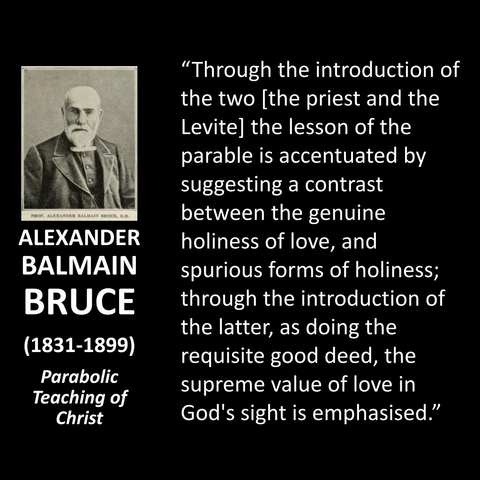
Alexander Balmain Bruce, Free Church of Scotland minister, on the Good Samaritan from Luke 10. Genuine holiness of love differs from that shown by the priest and the Levite, who did not offer any aid to the injured traveler. God values love supremely.

Would we object to someone using the word “holiness” to refer to getting one’s hands dirty with physical aid to the afflicted?

How can you aid a fallen person today?

#christian #datpostmilltho #christianwitness #economics #faithjourney