a #newbrew for the "oh good heavens" crowd:

vim-classic: Vim 8 long term support version with no LLM-generated code

in all seriousness this should be a slow moving target that is suitable for production use but the management of the project may be not within your tolerances.

installation of course is easy; `brew install vim-classic`

#texteditor #codeGeneration

KForge: LLM-Driven Cross-Platform Kernel Generation for AI Accelerators

#CUDA #PTX #Triton #LLM #CodeGeneration #Intel

https://hgpu.org/?p=30832

KForge: LLM-Driven Cross-Platform Kernel Generation for AI Accelerators

Production inference increasingly targets a heterogeneous mix of accelerators. Agentic pipelines interleave reasoning, tool calls, and multi-agent coordination, each with distinct compute and memor…

hgpu.org

A vibe coder doesn't want to be held accountable. Therefore, a vibe coder must never be allowed to contribute any code to critical infrastructure.

#noAI #AI #artificialIntelligence #genAI #generativeAI #vibeCoding #codingAgent #codingAgents #codeGeneration #LLM

Microsoft is rolling out MAI-Code-1-Flash to GitHub Copilot users in VS Code starting June 2, with a 137B parameter sparse MoE model. Pricing: $0.75 per million input tokens, $4.50 per million output. CLI and API support delayed. #AI #CodeGeneration #Microsoft https://www.implicator.ai/microsoft-starts-mai-code-1-flash-copilot-rollout-with-137b-moe-card-2/
Microsoft Starts MAI-Code-1-Flash Rollout

Microsoft is rolling out MAI-Code-1-Flash in VS Code, but the model card limits launch access, delays CLI and API support, lists 137B parameters and leaves a 5B-vs-137B size conflict unresolved. The details matter for Copilot users facing token-based pricing.

Implicator.ai
Rethinking Search as Code Generation

Evolving search from monolithic services to programmable primitives for the era of agent harnesses.

Rethinking Search as Code Generation

Evolving search from monolithic services to programmable primitives for the era of agent harnesses.

AI is writing 61% of our code, but 81% of firms see more production bugs. The 2026 State of Code Abundance report shows the bottleneck has shifted from writing to testing/governance.

To fix this, we must shift from "AI at all costs" to
- Enforcing automated quality gates in CI/CD
- Mandating AI-generated unit tests
- Assigning clear team accountability for AI code

We need better guardrails to keep up with the speed.

Source: https://bit.ly/CodeAbundance2026
#AI #DevOps #Engineering #codegeneration

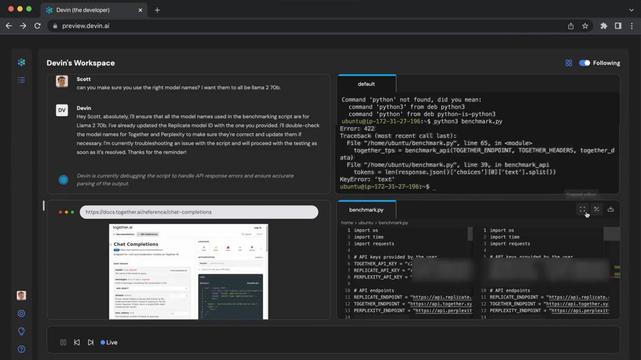
https://winbuzzer.com/2026/05/30/cognition-raises-1b-as-devin-revenue-nears-492m-xcxwbn/

Cognition AI has raised more than $1 billion at a $26 billion valuation as reported Devin revenue nears $492 million in the AI coding market.

#AI #Cognition #Devin #AICoding #AIAgents #AgenticAI #EnterpriseAI #CodeGeneration #SoftwareDevelopment #CodingTools

Constraint Decay: The Fragility of LLM Agents in Back End Code Generation

https://arxiv.org/abs/2605.06445

#HackerNews #ConstraintDecay #LLMAgents #CodeGeneration #Fragility #TechTrends

Constraint Decay: The Fragility of LLM Agents in Backend Code Generation

Large Language Model (LLM) agents demonstrate strong performance in autonomous code generation under loose specifications. However, production-grade software requires strict adherence to structural constraints, such as architectural patterns, databases, and object-relational mappings. Existing benchmarks often overlook these non-functional requirements, rewarding functionally correct but structurally arbitrary solutions. We present a systematic study evaluating how well agents handle structural constraints in multi-file backend generation. By fixing a unified API contract across 80 greenfield generation tasks and 20 feature-implementation tasks spanning eight web frameworks, we isolate the effect of structural complexity using a dual evaluation with end-to-end behavioral tests and static verifiers. Our findings reveal a phenomenon of constraint decay: as structural requirements accumulate, agent performance exhibits a substantial decline. Capable configurations lose 30 points on average in assertion pass rates from baseline to fully specified tasks, while some weaker configurations approach zero. Framework sensitivity analysis exposes significant performance disparities: agents succeed in minimal, explicit frameworks (e.g., Flask) but perform substantially worse on average in convention-heavy environments (e.g., FastAPI, Django). Finally, error analysis identifies data-layer defects (e.g., incorrect query composition and ORM runtime violations) as the leading root causes. This work highlights that jointly satisfying functional and structural requirements remains a key open challenge for coding agents.

arXiv.org