2/
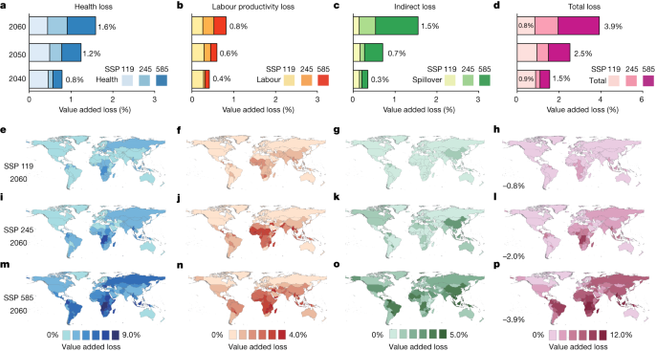
Suspicious because it sounds so much like Nordhaus: their outdoor focus on agriculture and mining.
These were also the only 2 sectors where Nordhaus saw harm to "the economy" from climate change.

Also Nordhaus-like suspicious: for them, heat stress only makes humans suffer.
No word of crop losses or loss of insect life due to heat stress.
Change in soil microbe composition and changed soil capillaries makes access to water ever more difficult for plants.

High temperature also drives drought via evaporation, so heat stress also causes drought-related damages in crops, soils, insects,
hinders electricity generation with water, nuclear and fossil fuels,
and disrupts water-dependent industry.

Heat stress and its drought-related stress cause built infrastructure to crumble, damages roads, rail tracks, and buildings.

All this has no impact on "the economy". Because economists don't know it, they still merely juggle with Nordhaus' DICE.
https://www.nature.com/articles/s41586-024-07147-z

#climateEconomics #ClimateChange #Heatwave #heatstress #ExtremeWeather

Global supply chains amplify economic costs of future extreme heat risk - Nature

A global high-resolution disaster footprint analytical model is developed to show substantial socioeconomic impacts from climatic change-driven heat stress through the global supply chain by 2060 due to direct and indirect effects on health and labour productivity.

Nature

https://www.theguardian.com/environment/2026/mar/25/us-climate-damage-research
"US has caused $10tn worth of climate damage since 1990, research finds"

From the paper "Quantifying climate loss and damage consistent with a social cost of carbon" https://www.nature.com/articles/s41586-026-10272-6#author-information

So eCONomists are strutting around again, "consistently" gunning down rational thinking with their loaded dice.
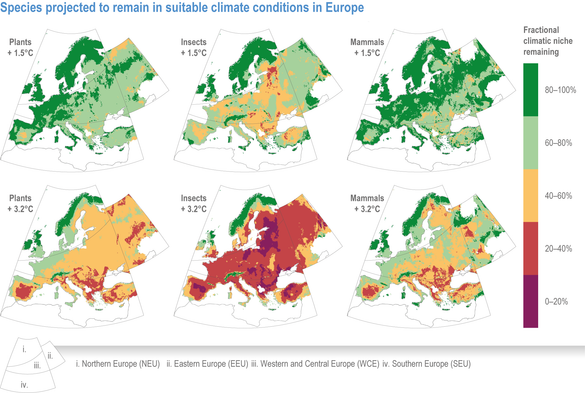
Let's demand their price tag for this loss in European mammals, insects and plants – as early as by 2030. Let alone on the way to 3C.
From real scientists, IPCC AR6-WG2👇
eCONomists just don't know, and do not want to know, what they're playing with.
Their peer-review process is broken, or such fiction wouldn't make it through. Economics is not a science.

#ClimateEconomics #SCC #SocialCostOfCarbon

@tom_andraszek @CelloMomOnCars

It's good that the 2 geologists and the philosopher focussed the long-term damage.
But the one-dimensionality of wanting to express the world in €€€ figures is a big part of the underlying problems that caused our econ system pervert into the EconObscene.

The one-dimensional concept is so strong that these three non-eConomists forgot to factor in: to cause economic € damage there has to be a society which trades goods for money, and the future damaged society's complexity level has to be comparable to ours, ie not like one from the 1400s.

That's not going to happen. I wish, good thinkers like those 3 non-economists would start to figure out regional collapse thresholds: how big can climate stress like, eg, food insecurity become before, just as an example, the nation of India becomes ungovernable and hence, unproductive? How big can the pressure on India from already deteriorating neighbors Pakistan and Bangladesh get before India crumbles too?
Because an unproductive India is certainly one of the breaking points for our complex global tech civilisation.
So.
When this civilisation ends, and let's say, only 10% of the global population survive the turmoil, the damage function becomes meaningless.
Climate then changes too, by the way. Which might even reduce the cost of the then-obsolet damage function. But ther will be no one left to care.

#RCPcollapse #ClimateEconomics

RE: https://fedifreu.de/@anlomedad/116210194578628656

Aaaaaarrrghhhhhh the neoliberal myopic definition of efficiency=cheap again:

"Achieving the EU’s 2040 and 2050 climate targets in a cost‑effective manner requires meaningful emission reductions across the entire economy."
Says Otmar Edenhofer, PIK Director and chair of the European Scientific Advisory Board on Climate Change.

So the cost-effective manner is the main focus, The Goal, in that sentence, right?
Right.
Not the remaining carbon budget, no. Cost-effectiveness. Right.
And clinging to target policy years that were insufficient from the get-go.
Right again. Some advisory board on climate change they are...

Just like the British CCC, a bunch of lazy climate-impact deniers – for the sole purpose of not having to change their silly econ gospel. That would be over-taxing their intellectual capacity, it seems.
Welllll, okay. Right.

Advisory report title: "Climate adaptation and mitigation in the agri-food system; Recommendations for coherent EU policies"
https://climate-advisory-board.europa.eu/news/eus-agri-food-system-must-prepare-for-rising-climate-risks-and-accelerate-emission-reductions

#ClimateChange #ClimatePolicy #ClimateAdaptation #Agriculture #ClimateEconomics

Wow. This is really harsh criticism👍 of integrated assessment modelers and engineers who hide everything that challenges their lifestyle in fairy tales about CCS and H2. Allwood shows how #paper, #steel, #cement, #aluminum, #plastic, and #glass can only become climate-neutral through degrowth.
https://www.nature.com/articles/s44286-025-00344-1

The best thing is his harsh language. He takes no prisoners, but shoots liars on sight.
No wonder. After all, it was their lies that always prevented greenhouse gas reductions from being implemented quickly enough to match the risk. Academia bears a huge share of the blame.
#CCS #ClimateChange #IAM #SharedEconomicPathways #Degrowth #EconObscene #Economics #ClimateEconomics

Too late for CCS and hydrogen - Nature Chemical Engineering

Fifty years after it was commercialized, global carbon capture and storage (CCS) capacity is equal to 0.09% of global emissions. Meanwhile, global emission-free electricity generation grows at a steady, linear rate. This Perspective argues that it is now too late for CCS or hydrogen to make a substantial contribution by 2050, so other solutions are required to decarbonize industry.

Nature

"Climate change must be treated as a potentially existential threat to the economy, rather than an issue which is suitably addressed by economic cost-benefit analysis."

"papers on the economics of climate damages were refereed by economists alone. Properly refereeing these papers required knowledge of the science of global warming that economists typically did not have. Consequently, economic referees approved the publication of papers that made claims about global warming that are seriously at odds with the scientific literature."

From 2023:
https://carbontracker.org/reports/loading-the-dice-against-pensions/

"Economists have claimed, in refereed economics papers, that 6°C of global warming will reduce future global GDP by less than 10%, compared to what GDP would have been in the complete absence of climate change.

In contrast, scientists have claimed, in refereed science papers, that 5°C of global warming implies damages that are “beyond catastrophic, including existential threats,” while even 1°C of warming—which we have already passed—could trigger dangerous climate tipping points.
This results in a huge disconnect between what scientists expect from global warming, and what pensioners/investors/financial systems are prepared for.

Consequently, a wealth-damaging correction or “#MinskyMoment” cannot be ruled out, and is virtually inevitable. (=sudden collapse of asset values)

Pension funds have a fiduciary duty to correct the erroneous predictions they have given their members.
Similarly, financial regulators, who have used the same erroneous and misleading economic damage predictions to stress test the exposure of financial institutions to climate change, must drastically revise their stress test studies.
This report calls on all stakeholders, from governments, regulators, investment professionals, all the way to civil society groups and individuals, to ensure that climate change policy is based upon the work of scientists.
Climate change must be treated as a potentially existential threat to the economy, rather than an issue which is suitably addressed by economic cost-benefit analysis."

#climateEconomics #ClimateChange #EconObscene #collapse

Great report. They polled 500 climate (!) scientists on aspects of the #EconObscene, 60 responded.
Some useful things to learn from the in-depth discussion of polled Q and answers, and their proposals for improvement of damage functions and other assumptions in economic models.
Report: https://greenfuturessolutions.com/news/recalibrating-climate-risk/
Guardian article (not recommended bc of platitudes) https://www.theguardian.com/environment/2026/feb/05/flawed-economic-models-mean-climate-crisis-could-crash-global-economy-experts-warn

But. They attempt to formulate a "economy collapse function" and set an ill-informed threshold at 3-4°C based on the gut feeling of the 60 polled CliSci.

But I think, the network of complex global supply chains breaks far earlier bc factories within ±35 latitude lose their workforce in turmoil 💡

I noticed that the false idea dominates among clisci too that our economies in G-North continue to function despite losing manufacturing capacity in the (Sub-)Topics to climate-induced societal breakdown.

But we in G-North don't have the manpower to replace all the output of mio of workers and their supporting population 💡

How much do they produce?
Example German export and import from tropics and subtropics – in metric tons! :
1/4 of German imports come from countries in climate zones pummelled by weather extremes and ill-equipped to repair or adapt.
1/5 of German exports go to these countries. (data from 2019, the HS96 dataset here: https://www.cepii.fr/CEPII/fr/bdd_modele/bdd_modele_item.asp?id=37 )
Gradually or shock-wise eliminating this input and output from the German economy pulls the rug from beneath our feet. It's too much and in, I assume, a too short time span.

Even if we'd manage to replace some of their material output by building and manning new factories in our region,
our societal organisation is so disrupted from the loss of the rest that our economic activity eventually shrinks to bartering for food and water, like theirs.

Once supply chains are cut by Tropical turmoil, spare parts for energy, comms & transport are unavailable. That ends tech-civilisation.

Even if we'd manage to move "important" production to our region, our societies collapse from the job loss, price hikes & from the logic in our finance system; all caused by the Sub&Tropics in climate upheaval disrupting complex supply chains.

Note how my scenario ends our tech-civilisation without factoring in tipping points, war or mass migration to 🇪🇺🇺🇸

Simply by relentlessly pummelling the Sub-/Tropics ±35°N with climate extremes, we annihilate the global web for making things 🏭 = the foundation of our economic activity, our tax revenue, our jobs, our everything.

#climateChange #ClimateEconomics #RCPcollapse

Recalibrating Climate Risk: New report urges governments and investors to fix 'faulty radar' in climate damage models | Green Futures Solutions

The Recalibrating Climate Risk report explains why economic models are increasingly understating climate risks as the world moves towards 2°C.

Green Futures Solutions

Economists are desperately trying to put a €-number on climate disasters to inform policy makers.
Here, it's the ECB, EU Central Bank, funding a paper from a Mannheim Univ economist.
https://www.sciencedirect.com/science/article/abs/pii/S001429212500131X
"Going NUTS: The regional impact of extreme climate events over the medium term" by Sehrish Usman et al 2025.
or https://www.ecb.europa.eu//pub/pdf/scpwps/ecb.wp3002~a77b495fa8.en.pdf

Some thoughts.

"In high-income regions, [flood] is followed by more
investment...suggesting a reconstruction boom." But that boom is stolen from other activities that then don't occur – and non-occurrence isn't measured by economists:

*The 2021 flood damaged 600🇩🇪 railroad bridges. The repair raised GDP👏🏽 but stole resources like raw material, workforce and funds
from much needed maintenance (needed due to decade-long neglect in favour of car dependency)
and rail network extension.
(Book Flixbus-eq, guys!)

They then suggest
"build back better" as potential positive outcome of a destructive climate disaster [a factor economists also can't put a number on].

Dream on...
*Insurers involved in the 2021 flood demanded that home owners replace damaged gas boilers 1:1 and wouldn't pay for climate-friendly heatpumps.

*Rebuilding at risky site got permitted in all but 1 case.

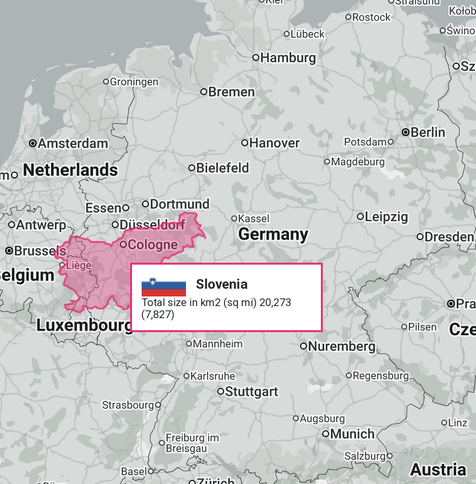
In 2023, two thirds of Slovenia were flooded. That area in square km could have been the same as in the 2021 flood.
Below is the country of Slovenia overlaid over the 2021 flood area which also included east Belgium. https://thetruesize.com/#?borders=1~!MTQ0NzQ1MzM.MTMxMjM4NzA*MjEwMTAxNDE(MTc1NjA0MzQ~!CONTIGUOUS_US*MTAwMjQwNzU.MjUwMjM1MTc(MTc1)MQ~!IN*NTI2NDA1MQ.Nzg2MzQyMQ)Mg~!CN*OTkyMTY5Nw.NzMxNDcwNQ(MjI1)Mw~!SI*NzY2NzQ0.MTMzOTgwNzI)NA

Road and rail network in Slovenia might not have been as dense as in the 2021 area, so maybe only 200 rail bridges got damaged?
But what does this damage entail for the nation state of Slovenia?
How does the state budget cope with the unexpected expenses and what are the "costs" of delayed development projects?

The country also lies in the normal flight path of the summer jetstream that regularly hauls hot Mediterranean water and dumps it over cooler, elevated land.
Switzerland, Austria, Bavaria, Bulgaria, Romania, Croatia to name but a few EU states, all lie in that flight path.
Inundation of 2/3 of its infrastructure will become, or already is, who knows, a regular occurrence in Slovenia.
How long until the state is broke?
When will the young generation give up and [try to] flee to larger nation states?
How will policies change in those larger states due to influx of desperate climate refugees from EU countries?

#ExtremeWeather #flood #drought #heatwave #Economics #EconObscene #ClimateChange #ClimateEconomics

Job Alert

Research Professor in Economics of Adaptation and Resilience  
Deadline: 2025-09-29 (16:00) 

Location: Finland, Helsinki, Joensuu, Oulu

https://www.academiceurope.com/ads/research-professor-in-economics-of-adaptation-and-resilience/

#hiring #Economics #environmentalscience #professor #ClimateEconomics #Sustainability #geopolitics #stochastics