 This Is My Glasgow
One of the Briggait's Winged Sea Horses or Hippocampi, dating from 1873, with the Merchants Steeple, dating from 1665, as seen from Clyde Street in central Glasgow.
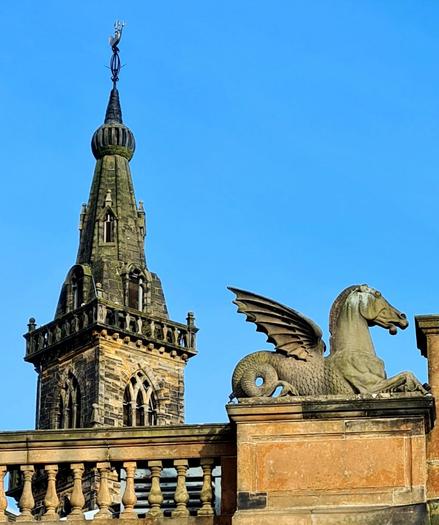
One of the Briggait's Winged Sea Horses or Hippocampi, dating from 1873, with the Merchants Steeple, dating from 1665, as seen from Clyde Street in central Glasgow.
Red sandstone tenement on Briggait in Glasgow. Built in 1905, it was designed by A.B. McDonald of the Office of Public Works, one of the city's most important architects of the late Victorian and Edwardian periods.
#glasgow #architecture #architecturephotography #tenement #glasgowtenements #briggait
One of the Clyde Street entrances to the Briggait in Glasgow. Designed by Clarke and Bell, it was oginally built in 1873 as a fish market. The hippocampi on either side of the central parapet are amongst the most distinctive architectural sculptures in the city.
#glasgow #architecture #hippocampus #briggait #architecturephotography #sculpture #glasgowbuildings
The Clyde Street facade of the Briggait former fish market in central Glasgow. Built in 1873, it was designed by Clarke and Bell.
#glasgow #architecture #glasgowbuildings #briggait #clydestreet

The Briggait in cental Glasgow. Designed by Clarke and Bell as a fish market, it was built in 1873 on the site of the Merchants'Guild Hall. The only part of this earlier structure which is left is the 1665 Merchants' Steeple that is now enclosed by the newer building.
One of four Winged Sea Horses on the parapet of Clyde Street Facade of the Briggait in Glasgow. The building was designed by Clarke and Bell and was constructed in 1875. However, the sculptor of these fantastic beasts is unknown.
#glasgow #architecture #sculpture #seahorse #glasgowbuildings #briggait

Scattered across the streets lying south and west of Glasgow Cross, there are five steeples bearing distinctive blue-faced clocks: the Tolbooth, the Tron, the Briggait, St Andrew’s in the Square, and Hutchesons’ Hall. Occasionally a tour guide will point at one of them and explain that it’s painted blue because of an edict of Henry VIII. This is not, as far as I know, true. Nevertheless, the city’s blue clocks have a story to tell. It’s a story about Glasgow’s growth from the Reformation to the Industrial Revolution, from a market town in the shadow of the Church to a confident manufacturing giant.
The steeples of the Tolbooth (lower right) and St Andrew’s in the Square (left).In the late sixteenth century, Glasgow had just two public clocks. One occupied the old Tolbooth at the Cross, a building that probably dated to the early fifteenth century; the other was in one of the now-demolished west towers of the Cathedral.
The Tolbooth clock first enters the records in September 1573, when one Dauid Lioun was paid three shillings “for ane pece of trie to þe knok”. Three years later, the Council employed David Kaye, of Craill,
to ſett wp and repair or mend þe two knokks, þe ane maid be himſelf, and þe wþer auld knok mendit be him, how oft he beis requyrit þairto, be þame or ony in thayr name, and þat wpone þe tounes raonable expenſs fo be payit and done be him thairfor.
Kaye, who had already built a clock for St Mary’s Church in Dundee, was probably as close as Scotland had to a professional clockmaker. The Tolbooth clock was an elaborate piece of work, with not only an “orlage” (face) but a “moyne”, i.e. a display showing the phases of the moon. Unfortunately, like most clocks of the period it could not be trusted to keep good time if left to its own devices, and by 1578 the position of “rewler of the knok” had been established. The first incumbent was a chaplain, Archibald Dickie, who was paid a small salary
for rowlling and gyding of the knok and for lying nychtlie in the tolbuth to rewll and keip the samyne.
Dickie, lying every night alone in the Tolbooth with a watchful eye on the rickety machinery, must have felt the cold, and his remuneration included a separate allowance “for helping and support of him to his bed clais”.
It’s possible that the first clock in the High Kirk was in fact the old Tolbooth clock replaced by Kaye. It first appears in 1587, when a smith from Blantyre was called in to repair it. The records of the Kirk Session from 1591 suggest that this clock was under the supervision of the beadles, who were charged
to allow none to enter the Steeple to trouble the Knock and Bell there, but to keep the Knock going at all times.
By 1610, responsibility for the two clocks had been combined, and
George Smyth, rewler of the Tolbuith knok, hes bund him to the town to rewll the said knok for all the dayis of his lyfetyme for the sowme of tuentie pundis money yeirlie… and siklike, oblissis him to rewll the Hie Kirk knok and keip the same in gangand grath, and visie hir twa seuerall dayis in the wik, the sessioun payand him ten merkis yeirlie.
Although Smyth’s salary of twenty pounds a year was not colossal, this solemn contract suggests that the clocks were important to the town, and it’s worth asking why.
One reason was undoubtedly prestige. For a couple of centuries, increasingly complex astronomical clocks, such as the Pražský orloj of 1410, had been used to signal status and sophistication. Typically such clocks carried gilded numerals and astronomical symbols on a blue background. In 1540, Henry VIII of England had a particularly splendid example installed at Hampton Court, and it seems likely that this set the fashion across the British Isles. Though we have no information about the decoration of the Tolbooth or High Kirk clocks, it’s reasonable to guess they were in the same tradition.
The astronomical clock (1540) at Hampton Court. [Wikimedia Commons]A second reason the clocks mattered was more practical: a town clock set a definitive standard of time. This was important to a mercantile centre because trade, including trading hours, was strongly regulated. Glasgow’s Letter of Guildry in 1605 specified that
It shall not be leasome to any unfreeman to hold stands upon the Highstreet, to sell anything pertaining to the crafts or handy work, but betwixt eight of the morning and two of the clock in the afternoon, under the penalty of forty shilling; providing that tappers of linen and woollen cloth be suffered from morning to evening, at their pleasure, to sell. All kind of vivers to be sold from morning to evening; but unfreemen, who shall sell white bread, to keep the hours appointed.
This system which defended the rights of the established merchants and other burgesses against “unfreemen” could be enforced only if the “hours appointed” could be defined. (The legal importance of the town clock is echoed in a tale a century later, when the burghers of Banff put their clock forward a quarter of an hour to hang the outlaw James MacPherson before his pardon could arrive.)
In 1626 the increasingly prosperous burgh demolished the old Tolbooth and erected a new one on splendid lines. A combination of city hall, prison, and bell-tower topped with vanes and a gilded weathercock, it required a clock to match. One John Neill was paid six hundred merks “to mak ane new knok and haill furnitour of irne work, als sufficient, fyne, and worthie as the great knok in the laich stipill of the Metrapolitane Kirk”. It came with “horolog brodie, mones, bunkis and roweris”, i.e. a clock face, a moon, rollers, and mysterious accessories that appear nowhere else in Early Modern Scots.
The project ran somewhat over budget. Neill had to be paid a further three hundred merks in 1628, while a subcontractor received another fifty “becaus it was lang in working, and sindrie pairtis thairof wrocht over agane”. Finally “Vallentyn Ginking, paintour” was called in to make the whole ensemble glorious by “gilting of the horologe brodis, palmes, mones, the Kingis armes and all paintrie and cullouring thairof”. It was pure bling, and a powerful statement that Glasgow had arrived.
Glasgow showing off its gilded cock.Neill’s struggles with the mechanism reflected the fact that clockmaking locally was in its early days. It was in 1630 that the first clockmaker was recommended to the Incorporation of Hammermen, and only in 1649 that he was formally admitted, although the Hammermen had been asserting their right to regulate clockmaking since 1622.
The Tolbooth clock would not rule alone for long over the lower part of Glasgow. The next to join it was the clock in the steeple of Hutchesons’ Hospital, on the north side of the Trongate, which was installed in 1649 at a cost of £408 14s Scots. This clock must have had a rough time of it, as the lead that protected the steeple was stripped off in 1651 to save it from Cromwell’s troops; stashed under the floor of the Hospital, it was not restored until 1654.
Artist’s impression of the old Hutchesons’ Hospital on Trongate. [The Glasgow Story]In the late 1650s the University under Principal Patrick Gillespie also embarked on a building project, and a tower duly rose between the courts, containing a clock apparently made by a local blacksmith.
The University in the 1660s, from Slezer’s Theatrum Scotiae (1693), showing the bell/clock tower. [The Glasgow Story]Not to be left behind, in 1663 the Merchants’ House erected their new steeple in Briggait, with its own clock and peal of bells. This triggered one of the periodic rows between Council and contractors.
Artist’s impression of the Merchants’ Hall in Briggait, with its steeple. [The Glasgow Story]Andrew Purdoune had succeded John Neill in 1657 as “rewler of the knocks”, a task which increased in complexity with every new clock that had to be synchronised with the others. Meanwhile James Colquhoune, a general factotum to the Council, picked up a deal of work colouring and gilding the horologes. The job of making and rewling the new Briggait clock went to John Brodbridge, who briefly ousted Purdoune, but by 1665 the Council were accusing him of “not performing his ingadgment in relatioune to the perfecting the knock in Briggait”. Brodbridge was held to his contract to produce chimes for this clock, but they were instead to be installed in the Tolbooth. This took a couple more years to achieve, and finally in 1668,
The provest having relaited in counsell that there was ane generall complent throw the whoill toune anent the misgoverning of the knockis, in consideratioune quherof it was concludit, be pluraltie of votis, that the keyes should be takin from Johne Brodbridge and delyvered againe to Andrew Purdoune; and the said Johne, being sent for, come and did lay doune the said keyes wpon the counsell table.
Despite this discord the Tolbooth now had a musical clock, or at least a clock equipped to make loud noises at specified intervals. Musicality took longer. In 1673, fifty pounds sterling were “deburst to Mr. Kervie for tuning the bellis”, and in 1677, a further five pounds sterling were paid to “Walter Corbett, lait prenteis to Androw Purdoume, for chynging the note of the chyme of bellis in the tolbuith quhen his maister was at Holland”. By 1693, at least, John Slezer could remark on “the Tolbooth, magnificently built of hewn stone, with a very high tower, and bells which sound melodiously at every hour’s end”.
Competition continued for the role of clock-keeper, which suggests that it was either profitable in itself or a good opportunity to pick up lucrative jobs. In a small community with close links between the Trades and the Council, work was often awarded on the basis of estimates which were understood to be elastic. In 1720, the keeper William Telfer did find his “extravagant” bill of £136/11/6 sterling for work on the Tolbooth and Briggait clocks firmly reduced to 2000 Scots merks (roughly £100 sterling), but this didn’t stop him keeping the role until 1736, when he was cut out by John Dunlop, who’d been petitioning for it since 1729. The Telfer dynasty, in the person of John Telfer, recovered the contract in 1739 and retained it at least until 1758; from 1752 onward it was held by John’s widow (whose first name is sadly not recorded). Another widow, Katherine Hannington, would be keeper of the clocks from 1812 to 1813 in succession to her husband William.
By modern standards, the maintenance the keepers carried out was probably fairly crude. We know the mechanisms were lubricated, as one of Walter Corbet’s duties in 1688 was “to furnishe the haill clocks with oyll”. This oil was, in all probability, derived from tallow produced by the local fleshers, which would explain the occasional references to violent cleansing procedures: “putting [the Tolbooth clock] throw the fyre” in 1702 and “boyling” the clocks in 1738 and 1744. In turn, this handling probably explains why Glasgow’s clocks needed regular replacement or repair.
The eighteenth century brought a new technology: the pendulum. A mechanical clock needs two main elements: a drive to supply the force to keep the parts moving, and an escapement which measures out that motion in regular amounts. Glasgow’s early clocks were driven, like most steeple clocks, by slowly descending weights. We don’t have direct evidence about their escapements, but we can assume that they used the standard system of the day: a verge and foliot. This consisted of a toothed wheel which engaged a vertical rod, the verge, turning it alternately in one direction and the other; the verge in turn rotated a weighted horizontal rod, the foliot, and it was the foliot’s moment of inertia that controlled the rate of the rotation.
Early verge and foliot escapement [Wikimedia Commons].Verge and foliot escapements seem to have been about as fiddly as this description suggests: modern estimates suggest that if carefully tended — and presumably not boiled too often — they might be accurate to within fifteen minutes per day. Pendulum escapements, invented by Christiaan Huygens in 1756 and gradually improved, were a huge advance, reducing daily errors to as little as tens of seconds. Pendulums had reached eastern Scotland by the 1690s, and took a further decade to spread west. The Tolbooth clock was converted in 1702, with a minute hand added at the same time; an idea of the scale of the operation is given by the charge for “twelve stone and twelve pound of iron… for wheels to the said clock”. The Hutchesons clock was similarly upgraded in 1703, and the High Kirk in 1707.
The High Kirk clock was replaced entirely in 1724, and that decade saw various bling-enhancement works on the others: when the Briggait steeple was redded up in 1728, it used 119 books of gold leaf, exhausting the local book-binder’s supplies so that more had to be ordered from Edinburgh.
The next major upgrade came in 1736, when the Council revived their interest in music. A Stirling watchmaker, Andrew Dickie, was contracted to make a completely new chime of bells, along with “a new sett of wheels and pinions, a wooden barrell, a new sett of keys and comb barr, a sett of clappers with hammers and hammer springs and other tackling”. These chimes weren’t just a gigantic music box: they could also be played by hand. A local music teacher, Rodger Rodburn, was sent through to Edinburgh to learn the art, and equipped with a small set of practice bells at the town’s expense. He was then paid an annual salary of £15 sterling “for playing on the bells from half one to half two in the afternoon each day, Sabbath days excepted, and for extraordinary playing on Hallow days. These live performances were in addition to the mechanical sounding of the “curious set of chymes and tuneable bells, which plays every two hours”.
“Curious” was probably the right word. The original set of eighteen bells ordered to be cast in London turned out to be one short, and a B-flat bell was hurriedly added to the order — which came to £311 1s. 9d. sterling. Whether from deficiencies in casting or in installation, the chime was not in tune, and after two excruciating years the Council employed John Fife, “player on the musick bells at Edinburgh” to sort it out. The process took four months of chiselling and the casting of fourteen new bells, while one of the old bells sent to Edinburgh proved irredeemable and was melted down for scrap. (It weighed 620 pounds; transporting it in pre-canal days must have been a major operation.)
Even with approximately tuneful bells, the performances can’t have been subtle. “Senex” recalled watching the musician in action around 1790, and recorded that the keys were “sturdily beaten with the whole force of the clenched fists, and these fists carefully guarded from danger by being enclosed in well-stuffed coverings of stout leather”. Nevertheless, the performances became a treasured part of Glasgow life.
As the city expanded, new churches were required, and these naturally came with clocks. The first was the North-West Kirk (also known as the Ramshorn) in 1722. St Andrew’s followed in 1756, St Enoch’s in 1780, and St George’s in 1809. In 1757, the Tolbooth clock was replaced again, with “a new four-day clock, carricing eight hands, with a quarter piece”; this may also have been when this clock acquired “day o’ the month brodds” in addition to its other paraphernalia. After some repair work, the old Tolbooth clock was put up in the steeple of the Laigh Kirk on Trongate; the Tron steeple remains today after the rest of the kirk was lost to accidental arson by the City Guard.
The Trongate in 1770, from a drawing by Robert Paul. The old Tolbooth clock can be seen in the Tron Steeple to the left, and the new Tolbooth clock in the Tolbooth steeple to the right. [The Glasgow Story]We get occasional glimpses of the University clock and its tower. By 1730, one Henry Drew, hammerman, was being given an allowance for keeping this clock in order. (Drew also worked for Robert Dick, Professor of Natural Philosophy, becoming the first recorded lab assistant in the University’s history.) This clock was replaced in about 1750. In 1771 Dick’s successor John Anderson entertained a kite-flying crony from America, one Benjamin Franklin, on a visit to Scotland; the following year saw Glasgow’s first lightning conductor fitted to that tower.
The University clock tower, in a George Washington Wilson photo from the mid-C19th. [Aberdeen University]In 1802-5, as part of the city’s redevelopment and expansion westward, the old Hutchesons’ Hospital was demolished and Hutcheson Street opened through the site. A new building, Hutchesons’ Hall, was erected where Hutcheson Street met Ingram Street. The original plan may have been to recycle the old clock, now a century or more old, but in the end a replacement was supplied by William Hannington for £168 11s. Hannington, in fact, was only a middleman, and the clock itself was made by John Thwaites & Co, the leading clockmakers of London. Rising on manufacture and the Atlantic trade, Glasgow could finally afford the best that dubiously gained wealth could buy.
The arrival of the new Hutchesons clock, and the other Thwaites clock that graced the steeple of St George’s, set the Council fretting. By now there were nine public clocks: some were effectively worn out, and there was not much consensus on the time. A Committee on Clocks was formed, and as well as recommending a change of contractor it set out an expensive programme of repairs and replacements.
Public clocks marked on Fleming’s 1808 plan of Glasgow: from north to south, the High Kirk, the University, the North-West Kirk, St George’s, Hutchesons, the Tolbooth, the Tron Steeple, St Andrew’s, St Enoch’s and the Briggait. [National Library of Scotland]This work took place in fits and starts over the next twelve years. The Tron clock was the first to be replaced, with another Thwaites piece; the old Tron clock made its way to the High Kirk. The Tolbooth clock was recommended for replacement in 1809, but the Council baulked first at the price tag and then at the countersuggestion that “it should not in future be burdened with the additional machinery for playing tunes every two hours”. A solemn warning was recorded that “[t]he public would be sensible of the want and might complain”, and the Council bravely resolved to take no action.
Instead, the Tolbooth clock limped on with successive repairs until 1815, when the new contractors Mitchell & Russell reported that “on taking it to pieces we find it so completely worn out that to repair it… would be throwing away the sum voted for that purpose”. Mitchell & Russell provided a detailed proposal, which was accepted, and which constitutes the most detailed description of any of the Glasgow civic clocks:
… the machine to be what is termed an eight day clock, with the exception of the musical part which is to go 24 hours as at present, the quarters are to strike on two bells instead of one as is the case at present, copper hands gilt are to be placed on each of the four dials so as to show the hours and minutes, the great wheels are to be as follows, vizt., striking 16 inches, watch 15 inches, quarter 16 inches, and chime 24 inches diameter, all of which are to be fixed in strong iron frames; the barrel for the music is to be new, and fitted for the tunes at present in use, vizt., for Sunday—the Easter hymn, Monday—Gilderoy, Tuesday—Nancy’s to the greenwood gane, Wednesday—Tweedside, Thursday—Lass o’ Patie’s mill, Friday—The last time I came o’er the moor, and Saturday—Roslin Castle. Conformable to the above description we hereby offer to make and put up the whole machinery, &c., and to find the weights, pulleys, ropes, and carpenter work, and do every other necessary thing in a sufficient manner to your satisfaction, the work to be fitted into its place and clock going by the 1st of January next, for the sum of £325, at 6 months’ credit or 5 per cent. for cash.
(Apart from the Easter Hymn — probably Jesus Christ is Risen Today from Lyra Davidica — these tunes were traditional Scots airs, dating to early in the previous century. The chimes were still going forty years later, when the antiquarian Gilbert Neil noted that “Though said even yet not to be sufficiently perfect in the musical scale, the chime must be allowed as of a respectable order, and possessing such variety of tones as to render the harmony always cheering and agreeable.”)
The five remaining blue-faced clocks: Hutchesons’ Hall (centre); St Andrew’s in the Square (top left); the Tolbooth (top right); the Tron steeple (bottom right); the Briggait (bottom left). Note the close family resemblance, which may be the result of the rapid burst of replacement in the early nineteenth century.The High Kirk clock, which had started out a century earlier in the Tolbooth, was finally scrapped and replaced in 1817, as was the North-West Kirk clock. (It may be one of these that had recently nearly killed “a valuable and respectable clergyman” when one of its weights fell and ricocheted off the floor.) Haggling over the clock in the Briggait steeple ended only in 1821 with a deal to split the costs between the Council and the Merchants’ House. This seems to have been the last clock to be set up in the old blue-faced style: when the North-West Kirk was replaced entirely in 1825-6, it carried, like St George’s before it, a more modern design.
The clock on the Ramshorn Kirk (possibly a modern replica, but consistent with contemporary images).Maintenance costs were still a worry to the Council, with a perpetually lingering suspicion that clock-keepers were making work for themselves. The proposal to roll the costs of repairs into the keeper’s salary was first made in 1823, and finally agreed in 1829: after a round of maintenance the keeper, Mr Halbert, was contracted to wind and maintain the clocks, posting a £100 bond as surety that no extra expense would be laid on the town for fifteen years. After several centuries, the Council had finally learned to manage risk when awarding public contracts.
By this point the clock in the Tron steeple had acquired something genuinely new: gas light. The lighting was set up in October 1821, and consisted of an argand burner mounted above the dial and enclosed in a parabolic reflector. James Cleland boasted that “this is the only steeple in the kingdom where the hour can be seen after dark, at a distance of nearly a quarter of a mile”; being Cleland, it is almost certain that he had measured this.
Cleland made a point of naming the designers of the Tron’s lighting scheme: John and Robert Hart, a pair of pastry bakers from Bo’ness who had moved to Glasgow, taken classes at Anderson’s Institution, become pals with James Watt, and set themselves up as inventors. To Cleland and others, their career paths epitomised the rising industrial city, finally shaking off its provincial past and emerging as a centre of innovation.
After perhaps three centuries of chasing the technological curve, Glasgow had at last caught up. The brilliantly lit Tron clock, like all its predecessors, was more than a timepiece: it was quite consciously a sign of the times.
Main sources
Many of the details come from the Extracts from the Burgh Records of Glasgow published by the Scottish Burgh Records Society. (If anyone ever finds a copy of the 1760-1809 volume(s), please let me know.) Other key sources:
I’m also grateful to Rebekah Higgitt and Thony Christie for responding to the hist-tech bat-signal when I had questions about astronomical clocks. Full details of everything available on request; corrections welcome, and all mistakes my own.
https://newcleckitdominie.wordpress.com/2023/10/09/blue-in-the-face/


 New-cleckit dominie