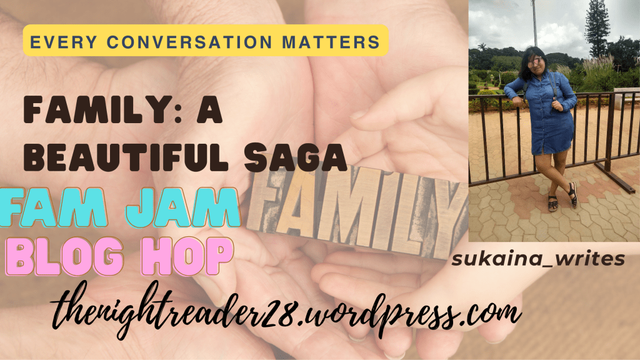
Every Conversation Matters-The Unconventional drama!

We belong to a generation shaped by the early years of pop culture — Tommy Hilfiger shirts, chains with snakes or the word cool, and Bollywood families that looked perfect on screen. We grew up watching films like Hum Saath-Saath Hain and Hum Aapke Hain Koun..!, believing in the idea of the “happy family.” At the same time, we became the first generation to openly talk about toxic family dynamics, emotional guilt, and the damage hidden beneath those smiling photographs.

Families have always been complicated, but those films sold us an illusion — one big joint family where love conquered everything. And we swallowed it completely.

Now, twenty-five years later, we continue to recreate the same image online. Families pose together for reels, photos, and celebrations. Everyone smiles until the camera cuts. Then the masks fall off, and people return to keeping emotional distance from one another. We have learned to recognise who harms us, who drains us, and who truly cares once the performance ends.

Still, families are pushed together for appearances. We are expected to sit in the same rooms and pretend everything is fine so the world can see a “happy family.” In the process, we ignore discomfort. We ignore the aunt who body-shamed us throughout childhood. We ignore the uncle whose stare made us uneasy. We ignore the brother-in-law who borrowed money and never returned it. We ignore the teenage cousin making inappropriate gestures toward young girls.

We ignore all of it because family, apparently, must stay together.

I remember my own parents encouraging me, the elder daughter, to “hang out” with my cousins. I almost laughed. Part of me wanted to ask, “Did you check whether they even want to spend time with me?” I never said it out loud, and that hangout never happened.

Even now, whenever I see cousins online acting inseparable, I scoff a little. Sometimes I laugh. Sometimes I feel sorry for them. Perhaps some of them are genuine, but the internet has taught us how easy it is to perform closeness.

Words like family, bond, and connection are used so casually today that they are beginning to sound like corporate slogans. “We are one big happy family”, the popular slogan.

Everything feels transactional now. Every post, every story, every carefully edited video carries a price tag.

Reading this, people will probably ask, Who hurt you?

And my answer is simple: Who do you think?

Then comes the next question: Who is your family, then?

Perhaps my sister. Perhaps my mother.

That is my reality.

I have seen too many performative families — including my own — to believe completely in the fantasy sold by films like Kabhi Khushi Kabhie Gham… or even Kal Ho Naa Ho. Still, I appreciate stories that dare to look beyond the illusion.

Every day, I wake up hoping my mother and sister are safe, healthy, and alive.

Perhaps that is my version of family.

Sordid, maybe. But real. Absolutely real.

This post is a part of ‘Fam Jam Blog Hop’ hosted by Manali Desai and Sukaina Majeed under #EveryConversationMatters blog hop series

#blog #blog2026 #blogPosting #blogWriter #blogger #bloggerLife #bloggerOfIndia #bloggersOfIndia #blogging #bloggingChallenges #bloggingCommunity #everyConversationMatters #faith #FamJamBlogHop #family #life #love #May2026 #mayBlogPost #sukainaWrites #theUnconventionalDrama #writing

I wrote a think to write better blog postings:

check-markdown-files: pre-commit checks for blog postings written in Markdown

https://andreas.scherbaum.la/post/2025-07-28_check-markdown-files-pre-commit-checks-for-blog-postings-written-in-markdown/

#Blog #Blogging #goHugo #Hugo #BlogPosting #Python #Markdown

check-markdown-files: pre-commit checks for blog postings written in Markdown

After switching my blogs to a static blogging engine, I found a number of preventable issues. Certain syntax errors, forgot tags, or forgot a description, or forgot a preview picture, or forgot an image. This kind of things. So I wrote check-markdown-files.py, which now scans all my blog postings before committing the posting to git. Any known error is raised, and aborts the commit. Each problem has an override switch in case it is a false positive.

ads' corner

Operation Vijay and the Significance of Kargil Diwas: A Call to Understand the Kargil War #EveryConversationMatters #TricolourTalesBlogHop

Nobody craves war, yet geopolitical tensions often leave governments with no choice but to engage. The hunger for power, whether through war or genocide, has led to countless deaths, with soldiers bearing the brunt. When war is declared, every individual faces danger, regardless of their position. This makes Kargil Vijay Diwas, observed on July 26, profoundly significant. It honors the soldiers who prioritized the nation’s safety during the Kargil War of 1999.

Yet, how many of us have truly delved into a book or account to grasp what the Kargil War was about?

Operation Vijay, as the conflict is known, was a swift and resolute response by the Indian Army, in coordination with the Indian Air Force, to safeguard India’s borders.

In 1999, as a nine-year-old, I saw the nation rally around this cause, sparking my curiosity about its origins. “Why Kargil?” As a pre-teen, I repeatedly questioned why the Kargil War happened.

I sought to understand the politics of governance and the battlefield, but answers like “Pakistan needed to be attacked” felt inadequate. Today, through discussions with my co-host Manali and research for our theme, I’ve gained clarity.

The Kargil War wasn’t a random event but a calculated move by Pakistani forces to disrupt the Srinagar-Leh highway, a vital link to Ladakh. Their covert infiltration into Indian territory aimed to control strategic heights along the Line of Control (LoC). For the first time in independent India’s history, the Indian Air Force joined the Army in a high-altitude conflict, marking a historic escalation.

Conspiracy theories about the war’s motives abound, but they dilute the truth. Only those who served at the border—soldiers, officers, and their families—truly know the reality.

This is why we chose Non-Fiction, Memoirs, and Biographies for our winning prizes: to amplify authentic voices from those who witnessed the conflict firsthand.

A Special Hero: Gunjan Saxena

Commemorating Kargil Diwas in 2025 feels incomplete without honoring Gunjan Saxena, one of the few women pilots involved in Operation Vijay. She flew in the perilous high-altitude war zone, showcasing extraordinary courage and breaking barriers for women in combat roles. Her contribution symbolizes the evolving role of women in India’s defense forces.

What Should Not Be Missed

Operation Vijay marked a historic collaboration between the Indian Army and Air Force. Despite the intense ground and air operations, India upheld international diplomacy by not crossing the LoC, a decision that earned global respect. This restraint, paired with military success, underscored India’s commitment to peace while defending its sovereignty.

The Legacy of Operation Vijay

The Kargil War demonstrated India’s prowess in high-altitude warfare, with the Army and Air Force working in unison to reclaim occupied territories. It highlighted the sacrifices of heroes like Captain Vikram Batra, whose bravery remains etched in history, and introduced pioneers like Gunjan Saxena, one of India’s first women pilots in a war zone.

The victory restored the LoC and reinforced India’s resolve to protect its borders.

On this 25th Kargil Diwas, let’s go beyond social media tributes or fleeting homages. Pick up a book, read an article, or speak with a retired officer who stood at the border.

As writers and readers, we have a responsibility to make informed choices. We must understand the sacrifices that shaped our nation’s history. Let’s honor Kargil Vijay Diwas by seeking the truth and celebrating the courage of those who put India first.

This post is a part of ‘Tricolour Tales Blog Hop’ hosted by Manali Desai and Sukaina Majeed under #EveryConversationMatters

#blog2025 #blogHopHost #blogPosting #blogger #bloggerOfIndia #bloggersOfIndia #bloggingCommunity #blogpost #bookBlogger #delhiBlogger #EveryConversationMatters #history #india #kargilDiwas #kashmir #operationVijay #pakistan #politics #soldiers #sukainawrites #tricolourtalesbloghop

The Roar: The Chuckle Chronicles Blog Hop

My laughter, my roar, defines the joy of my existence. It’s not just a sound—it’s a declaration of my spirit. Growing up, I was fortunate to live in a home free from rigid rules about how a girl should sit, walk, or even where her bra strap should rest. My mother never handed me a manifesto dictating how to be a “proper” woman. But the world outside was different. Society, with its relentless judgments, waited until I was old enough to feel the weight of its insecurities—taunts about my parents’ upbringing, snide remarks about my behavior, and criticism of how I, as a woman, dared to exist.

The loudest critiques targeted my laughter—my roar. Relatives and cousins grimaced at its sound, as if it were an offense. When I was  21, a 40-year-old man mocked it, mimicking me with disdain, as if to say, “How dare she?” 

Society succeeded where my mother never intended: it pressed my vocal cords so tightly that I felt guilty for laughing. Imagine that—feeling shame for joy. At  family gatherings, aunts and uncles with their thick UP accents would point and scold, “Yeh kaise hass rahi ho? Theek se hasso.” (What laugh is this? Laugh properly.) 

The “proper” laugh, a subdued, acceptable giggle, became a constant reminder of how my roar was nearly silenced forever.

But one day, I broke free from that chokehold. I refused to let “people” dim my voice any longer.

My roar is not just mine—it’s a rebellion against a world that will only identify those women as women if they have a laugh which is small, soundless and doesn’t attract attention. 

This World Laughter Day, I urge every woman to reclaim her roar.

I see it in my sisters, friends, and countless others who’ve muted their laughter or adjusted it to fit what’s deemed “proper.” Let’s reject that. Let’s laugh loud, unapologetically, and fiercely.

My journey wasn’t about learning to laugh—it was about unlearning the guilt society imposed. It was about embracing the raw, untamed joy that makes me, me. So, to every woman reading this: let your laughter echo. Let it shake the walls of expectation. Your roar is your power, your freedom, and your truth. Don’t let anyone silence it.

This post is a part of ‘The Chuckle Chronicles Blog Hop’ hosted by Manali Desai and Sukaina Majeed under #EveryConversationMatters

#Thechucklechroniclesbloghop #blog #blog2025 #blogPosting #bloggerLife #bloggersOfIndia #blogging #bloggingCommunity #bookBlogger #delhiBloggers #everyConversationMatters #EveryConversationMatters #humor #laughter #life #ManaliDesai #may2025 #mentalHealth #roar #sukainaMajeed #sukainaWrites #thenightreader #worldLaughterDay

Habe gerade ein neues Blogposting veröffentlicht, welches sich damit befasst, wie Google Gemini auf die Frage meines vorherigen Blogpostings (Warum die beiden größten Legenden der Luftfahrt immer seltener werden) reagiert hat.

#luftfahrt #aviation #lufthansa #airbus #boeing #blogposting #blog #a380 #747 #jumbo #jumbojet

https://pascal.scherbaum.la/post/2024-09-22_warum-die-beiden-groessten-legenden-der-luftfahrt-immer-seltener-werden-laut-google-gemini-ai/

Warum die beiden größten Legenden der Luftfahrt immer seltener werden - laut Google Gemini AI

Nachdem ich mein letztes Blogposting über die Boeing 747 und den Airbus A380 geschrieben hatte, kam ich auf die Idee auch einmal Google's KI Tool Gemini zu dem Thema zu befragen: 'Warum werden die beiden größten Legenden der Luftfahrt immer seltener?' Die Antwort war ... interessant.

Unterwegs mit Pascal