Being able to use modern technology without being an addict is starting to sound like a superpower!

#Privacy #Security #FreeSoftware #Freedom #BehavioralAddiction #Addiction

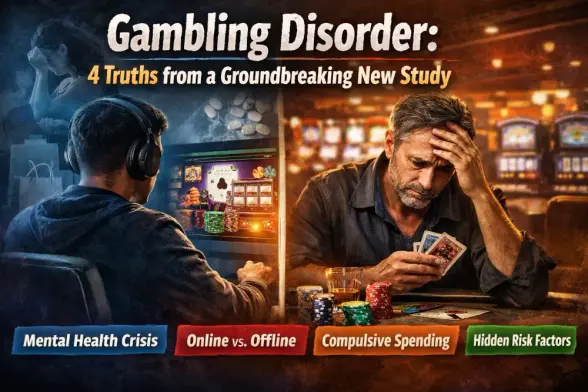
Gambling Disorder: 4 Truths from a Groundbreaking New Study

When you picture someone with a gambling disorder, a specific image might come to mind. But what if that stereotype is outdated and dangerously incomplete?

A groundbreaking new study from an innovative program in Madrid called ‘Adcom’ reveals that the digital age is forging a new, more complex, and more hidden type of gambling addict. This research, based on hundreds of individuals who sought help voluntarily. And it challenges our most common assumptions about who is affected and why. 

This article shares the most impactful and counter-intuitive findings from this research.

Prepare to see what gambling addiction really looks like today.

1. It’s Rarely Just About Gambling: The Hidden Mental Health Crisis

One of the study’s most critical findings is the extremely high rate at which Gambling Disorder co-occurs with other serious mental health conditions.

This situation, known as “Gambling Dual Disorder (GDD),” suggests that gambling is not an isolated issue. It’s a symptom of a much larger mental health struggle. 

Among the participants who self-referred for a gambling problem, the numbers were stark: 

  • 57.4% showed evidence of other psychopathological symptoms. 
  • 64.9% experienced significant symptoms of depression.
  • 51.3% were at risk for an anxiety disorder.
  • 37.4% screened positive for ADHD.

This reframes gambling not as a simple lack of willpower, but as a complex disorder deeply intertwined with a person’s overall mental well-being. To be effective, treatment cannot just focus on the gambling; it must address these co-occurring conditions as well. 

Gambling Disorder can be defined as “persistent and recurrent problematic gambling that leads to significant impairment or distress”.

Are you a professional looking to stay up-to-date with the latest information on, sex addiction, trauma, and mental health news and research? Or maybe you’re looking for continuing education courses?

Stay up-to-date with all of Dr. Jen’s work through her practice’s newsletter!

2. The Digital Divide: Online and Offline People with Gambling Disorder Are Strikingly Different People

This complex mental health picture becomes even more fragmented when we look at where the gambling happens. A divide that is creating two entirely different profiles of addiction.

The study revealed significant and clear differences between online gambling versus those who struggled with offline gambling. The most compelling demographic contrasts paint a clear picture: 

  • Age: The average online gambler was 30.6 years old, a full generation younger than the average offline gambler at 43.4 years old.
  • Gender: While men were the majority in both groups, the disparity was much greater online. Only 5.3% of online gamblers were female, compared to 20.5% of offline gamblers.
  • Prior Treatment: Individuals with offline gambling problems were far more likely to have previously sought help for a mental health issue (62.1%) than those with online problems (42.9%). 

These differences are profound.

Technology has fractured the landscape of addiction. It’s created a younger, more isolated cohort that is harder to reach.

The fact that this online group has had significantly less prior contact with mental health services suggests a new, underserved population. A population that may not be captured by traditional outreach and may be less aware of their own underlying conditions.

More About Gambling Disorder

3. A Shocking Connection: Gambling Disorder and Compulsive Buying Go Hand-in-Hand

Perhaps the single most surprising finding was the powerful link between Gambling Disorder and another behavioral addiction: compulsive buying.

The study found that compulsive buying was a potential problem in an astonishing 85.2% of participants. 

Breaking this down even further, for 57.7% of the entire group, the existence of a compulsive buying problem was considered “very probable/sure.” 

This is highly counter-intuitive.

While both behaviors involve money, they are often viewed as completely separate issues. This powerful correlation is not just a quirky finding. It’s evidence that Gambling Disorder may be part of a broader spectrum of impulse-control disorders rooted in similar neurological pathways. It highlights a shared underlying mechanism related to the brain’s reward system and the cycle of financial distress and emotional coping.

4. Your Background and Other Vices Can Predict How You Gamble

The study went beyond simple descriptions to identify factors that could predict whether a person was more likely to struggle with online versus offline gambling. This analysis revealed a complex interplay of cultural factors, lifestyle, and co-occurring disorders that shape a person’s specific addictive behaviors. 

The research identified several key predictors: 

  • Being born in Spain increased the odds of having an online gambling problem by more than five times.
  • Excessive Internet use nearly tripled the odds of having an online gambling problem.
  • Conversely, having a co-occurring alcohol addiction or an eating disorder significantly reduced the odds of having an online problem, making it far more likely the gambling problem was offline.

These points reveal that the specific form an addiction takes is not random. It is shaped by a combination of a person’s environment, other behaviors, and personal history.

Conclusion: A New Call for Awareness of Gambling Disorder

The message from this research is clear: the digital age has forged a new profile of gambling addiction that is younger, more hidden, and more complex. The old stereotypes simply don’t fit the modern reality. 

Innovative programs like Adcom, which lower the barriers to seeking help, are not only crucial for providing treatment but also for gathering the vital data needed to truly understand the problem. This new knowledge allows for better prevention, more targeted interventions, and a more compassionate public understanding of a deeply challenging disorder. 

Knowing that online addiction strikes a younger group with less mental health history, how must we radically change our outreach to find and help this hidden population before it’s too late?

How do you view gambling disorder after reading this article? Let us know in the comments!

Have you found yourself in legal trouble due to your sexual behavior? Seek assistance before the court mandates it, with Sexual Addiction Treatment Services.

Do you feel your sexual behavior, or that of someone you love, is out of control? Then you should consult with a professional.

Are you looking for more reputable data-backed information on sexual addiction? The Mitigation Aide Research Archive is an excellent source for executive summaries of research studies.

#addictionRecovery #ADHD #anxiety #behavioralAddiction #casinoGambling #comorbidity #compulsiveBuying #depression #digitalAddiction #dualDiagnosis #gamblingAddiction #gamblingDisorder #impulseControl #mentalHealth #mentalHealthTreatment #onlineGambling #problemGambling #publicHealth #researchStudy #sportsBetting

Gambling Is an Addiction — Even Without a Substance

Gambling is the only behavioral addiction formally recognized alongside substance use disorders.

In this episode, Dr. Kasra Ghaharian explains why gambling is classified this way, how the internet and AI are transforming the gambling landscape, and how these developments reflect wider changes driven by artificial intelligence.

🎧 Full episode: https://youtu.be/asb99lQdnnA

#GamblingAwareness #BehavioralAddiction #AI #Podcast #mentalhealth

5 Hidden Ways the Gambling Industry Engineers Harm

Introduction: The Illusion of Choice

For many, gambling is seen as a form of entertainment, a voluntary activity where personal responsibility is paramount. We’re told to gamble responsibly. But, if things go wrong, the blame is often placed on the individual’s lack of self-control. 

But what if that entire narrative is a dangerous fiction?

A new public health study reveals gambling harm is not an unfortunate side effect of a few people’s poor choices. Instead, it is the calculated outcome of a powerful and deliberate “gambling ecosystem” designed to maximize profit at a severe human cost.

This system operates using tactics that public health experts call the “commercial determinants of health.” The same strategies used by the tobacco and fossil fuel to drive profit by undermining public wellbeing. 

This post will reveal five of the most impactful insights from the study, exposing the hidden truths of an industry that has mastered the art of engineering harm.

1. The “Responsible Gambling” Slogan is Designed to Blame YOU

The familiar phrase “gamble responsibly” is not a genuine public health message but a strategic discourse meticulously promoted by the industry. The primary function of this narrative is to shift the focus, and the blame, onto the individual consumer.

By framing harm as a personal failing, it deflects attention. It deflects it from:

  • Predatory industry practices
  • Unsafe products
  • A system that profits from addiction

This blame-shifting has severe consequences, creating a culture of shame that prevents people from seeking help and isolates them when they are most vulnerable. As the study’s authors note: 

This emphasis on individual responsibility diverts attention from the practices of the industry. It generates stigma and shame for those harmed. It downplays serious harms caused by gambling. Worst of all: it contributes to the suicide toll. 

This psychological framing is so damaging because it convinces individuals that their suffering is their own fault, making it harder to recognize the external forces at play and seek the support they need. 

Are you a professional looking to stay up-to-date with the latest information on, sex addiction, trauma, and mental health news and research? Or maybe you’re looking for continuing education courses?

Stay up-to-date with all of Dr. Jen’s work through her practice’s newsletter!

2. The Gambling Industry’s Goal is For You to “Play to Extinction”

Behind the glamorous advertising and messages of entertainment lies a stark and chilling internal objective. The study highlights a term used by gambling industry representatives to describe their core aim: “playing to extinction.” 

This isn’t an exaggeration; it’s the industry’s own vocabulary for its business model:

“
gambling industry representatives describe their aim is to maximise revenue per available customer (revpac), and encourage ‘playing to extinction’, the point at which a customer has exhausted all available funds.”

The phrase has a chilling double meaning.

It refers to the financial extinction of a customer’s funds, but in the context of gambling-related suicide, it acquires a much darker significance.

The industry’s profit model depends on pushing customers into the exact states of financial ruin and profound despair that are known precursors to suicide. It is a business model that treats human crisis as a key performance indicator. Rather than a tragic crisis.

3. Products are Engineered to Undermine Your Control

Modern gambling products, especially digital ones, are not simple games of chance. They have been intentionally intensified with features like:

  • Increased speed
  • High complexity
  • “Frictionless” transactions

All designed to encourage extended use and bypass a person’s executive function. 

The industry also employs digital tactics like sludging. Deliberately designing interactions to make it difficult for customers to act in their own best interest. Such as withdrawing funds or closing an account. This tactic also manifests physically. For 15 years, the Australian industry has resisted modern, universal pre-commitment systems that allow users to set binding loss limits. Instead, it has relied on a form of physical sludging: “manual, paper-based self-exclusion” that requires a person to fill out separate forms for every single venue they wish to avoid. 

Product design also deploys psychological tricks to encourage overspending.

The study points out that a single ticket in the Australian “Powerball” lottery can be priced as high as AUD$46,249.65. This serves as a psychological anchor. While few would buy it, its existence makes spending smaller—yet still exorbitant—amounts like hundreds or thousands of dollars seem reasonable by comparison.

Need support and not local to the Lehigh Valley? Check out the LGBT National Help Center.

4. “Good Causes” are Used as a Smokescreen

A common defense of the gambling industry is that it funds worthy causes, from sports teams to community charities. The research argues this is a calculated strategy to create an “‘alibi’ to legitimise gambling operations” and procure a “social license” to operate. 

This linkage creates a “symbiotic, reflexive relationship” where community groups become financially captured. Reliant on gambling revenue, these beneficiaries become powerful allies in resisting reforms that could threaten their funding, even if those reforms would reduce harm. This insidious dependency creates a powerful barrier to reform. 

As one researcher observed, the dynamic is inescapable: 


 at first the lottery was primarily dependent on the good cause and then, gradually, the good cause became increasingly dependent on the lottery. 

5. The Gambling Industry Distorts Science and Influences Policy

Like the tobacco and fossil fuel industries before it, the gambling ecosystem actively works to control and distort the scientific evidence base to protect its interests. The study identifies two key tactics: 

  • Funding “safe” research: The industry funds and promotes research focused on the individual, such as the influential “pathways model.” This model frames gambling harm as an artifact of pre-existing conditions like “antisocial personality disorder,” thereby shifting blame from the addictive product to the flawed consumer. 
  • Discrediting effective solutions: The ecosystem publicly casts doubt on proven harm-prevention tools. The paper cites an industry-linked researcher who claimed that universal pre-commitment systems might have a “detrimental effect and may aggravate the problem.” Crucially, the study notes that a subsequent review of the evidence cited for this claim found “no support for this conclusion,” noting the studies had significant “methodological limitations.” This reveals a pattern of distorting weak evidence to undermine effective public health measures. 

This distortion of science is coupled with political donations and the “revolving door”—where politicians and staff take industry jobs after leaving office—to block or delay meaningful reforms that could save lives.

Conclusion: Shifting from Individual Blame to Systemic Accountability

The evidence is clear: gambling harm is not a simple story of poor individual choices. It is the predictable and profitable result of a commercial system meticulously designed to addict users, shift blame, and protect its revenue streams at all costs. From manipulative product design to the distortion of science, the gambling ecosystem functions as a commercial determinant of health, actively generating and sustaining harm. 

This reframing moves the problem from one of personal responsibility to one of systemic accountability. Seeing the deliberate system that drives these harms, what does real responsibility—from our governments, communities, and the industry itself—truly look like?

Are you looking for more reputable data-backed information on sexual addiction? The Mitigation Aide Research Archive is an excellent source for executive summaries of research studies.

Do you feel your sexual behavior, or that of someone you love, is out of control? Then you should consult with a professional.

Have you found yourself in legal trouble due to your sexual behavior? Seek assistance before the court mandates it, with Sexual Addiction Treatment Services.

#behavioralAddiction #commercialDeterminantsOfHealth #darkPatterns #gambling #gamblingAddiction #gamblingHarm #gamblingIndustry #gamblingPolicy #harmReduction #onlineGambling #preCommitmentLimits #predatoryDesign #problemGambling #publicHealth #responsibleGambling #selfExclusion #sludging #sportsBetting #stigmaAndShame #suicidePrevention

Holiday Gambling: Why You Bet Matters More Than How Much

The Surprising Psychology of Sports Gambling 

Are you thinking about placing a little wager on a football game this holiday season? With the rapid growth and normalization of sports gambling across the United States and Canada, betting on a game is more common than ever. But what are the real reasons people gamble?

Most would assume it’s simply for fun, to make a game more exciting, or for the chance to win money. But what if the most important metric for gambling risk isn’t on a bank statement, but in the unseen emotions driving the bet? 

A recent study of over 900 sports bettors reveals a more complex picture, uncovering deeper psychological motivations that separate casual fun from problematic behavior. The findings challenge our basic assumptions about gambling risk. This article will break down the five most impactful takeaways from this research, revealing that the “why” behind a bet is far more important than the “how much.” 

1. Your Reason for Betting Matters More Than How Much You Spend 

One of the study’s most unexpected findings was the relationship between mental health, betting habits, and gambling problems. The research showed that greater anxiety and depression were strongly linked to the severity of a person’s gambling problems. However, these emotional states were not significantly related to the total amount of money a person spent or the total number of bets they made. 

This insight reframes how we should think about risk. It’s not just about the financial footprint of betting, but the emotional impetus behind it. 

According to the study, the true indicator of risk isn’t found in a bettor’s bank statement, but in the emotional state that drives them to bet in the first place. 

This is a critical distinction. It shifts the focus from a purely financial view of problem gambling to a psychological one, suggesting that the “why” you bet is a more telling sign of risk than the “how much” you spend.

Are you exploring your trauma? Do you feel your childhood experiences were detrimental to your current mental or physical health? Utilize this free, validated, self-report questionnaire to find out.

Take the Adverse Childhood Experience (ACE) Questionnaire

2. The Crucial Difference: Gambling for Fun vs. Betting to Escape

The study identified two key motivations that drive people to bet, each with vastly different outcomes: 

  • Enhancement Motives: Betting to increase positive emotions. This is the classic reason—placing a wager to add to the thrill and enjoyment of watching a game. 
  • Coping Motives: Betting to reduce or escape from negative feelings, such as anxiety, stress, or depression. 

The results linked to each motive were counter-intuitive.

This revealed a fascinating paradox: while betting to enhance the fun of a game was linked to placing bets more often, it was simultaneously associated with fewer gambling problems. This suggests a clear psychological dividing line between frequent, low-risk engagement and problematic, high-risk behavior. 

In stark contrast, betting to cope was the single strongest pathway linking pre-existing anxiety and depression to serious gambling problems.

Crucially, this connection held true even when the researchers accounted for other potential drivers like betting for social or financial reasons, isolating ‘coping’ as the most dangerous motivation. This finding strongly supports the “emotionally vulnerable pathway” model of problem gambling, where individuals use gambling as a maladaptive strategy to manage emotional distress. 

3. “In-Play” Gambling Is a Different Beast Entirely

“In-play” sports betting, defined as making wagers during a live game, has exploded in popularity. The study’s findings on this specific group were stark. Compared to bettors who only place wagers before a game starts (single-event or traditional bettors), in-play bettors reported: 

  • Significantly higher levels of problem gambling.
  • Significantly higher scores for both anxiety and depression.
  • A higher frequency of betting.

This raises a critical question for researchers: does the high-speed, constant-feedback nature of in-play betting actively create psychological distress, or does it primarily attract individuals already struggling with anxiety and depression who are seeking a powerful distraction? 

As professionals, our time is valuable. Dr. Weeks created the Mitigation Aide Research Archive because there isn’t enough focused, data-backed research available in easily digestible formats.

4. For Sports Bettors, Anxiety and Depression Are Often Intertwined 

The research observed that in this sample of sports bettors, depression and anxiety were “highly correlated.” In simple terms, participants who scored high on one tended to score high on the other. 

The researchers noted that this suggests these conditions are more likely to be comorbid—or occur together—in people who bet on sports. The connection was so strong that the effects of anxiety and depression on gambling behaviors often overlapped. This reinforces the concept of a combined “emotional vulnerability” that can fuel problematic gambling, rather than a single, isolated mental health issue.

5. The Psychological Blueprint Is Surprisingly Consistent Across Genders

The study also examined differences between men and women, revealing a nuanced picture. On the surface, there were clear differences in behavior and emotional states: 

  • Men engaged in sports betting on significantly more days than women.
  • Women reported significantly higher levels of anxiety, depression, and betting for social and coping reasons.

Despite these differences in emotional states and motivations, men and women reported statistically similar levels of overall gambling problems. 

The more profound finding was that despite these surface-level differences, the underlying psychological model was the same for both groups.

The core pathways showing how anxiety, depression, and motives lead to gambling problems did not differ between men and women. This suggests that when it comes to the fundamental emotional drivers of problem gambling, gender may not change the blueprint. Interventions, therefore, can likely focus on these consistent psychological drivers for everyone. 

Conclusion

This research cuts through the noise of wins, losses, and dollar amounts to deliver a clear message:

Understanding the motivation behind gambling is the key to understanding the risk of it becoming a problem.

While many people bet to enhance their enjoyment of a sport with few negative consequences, the data points to a clear red flag:

The strongest pathway to serious gambling problems isn’t rooted in how much money is spent, but in whether the bettor is motivated by a need to cope with or escape from negative emotions. 

Before placing your next bet, it might be worth asking: am I doing this to enhance my fun, or to escape my feelings?

Drop a comment and let us know if you were able to identify any motivations you may have for acting out this holiday season.

Are you a professional looking to stay up-to-date with the latest information on, sex addiction, trauma, and mental health news and research? Or maybe you’re looking for continuing education courses? Then you should stay up-to-date with all of Dr. Jen’s work through her practice’s newsletter!

Do you feel your sexual behavior, or that of someone you love, is out of control? Then you should consult with a professional.

Have you found yourself in legal trouble due to your sexual behavior? Seek assistance before the court mandates it, with Sexual Addiction Treatment Services.

#addictionRecovery #anxietyAndGambling #behavioralAddiction #bettingBehavior #bettingMotives #copingMotives #depressionAndGambling #emotionalVulnerability #enhancementMotives #footballBetting #gamblingDisorder #gamblingEducation #gamblingPsychology #gamblingRiskFactors #harmReduction #holidayFootball #inPlayBetting #liveBetting #mentalHealth #problemGambling #responsibleGambling #selfReflection #sportsBetting #sportsGambling

“I became disabled—and the internet became my world.”
In this week’s clip, Professor Mark Griffiths shares how going online became essential to staying part of society after becoming disabled.
🎧 We also explore the blurry line between digital addiction and intense internet use.
🔗 Listen here: https://youtu.be/hJ62AERmZjM

#DisabilityTech #DigitalSociety #InternetAddiction #BehavioralAddiction #TheInternetIsCrack #PodcastClip

Positive reinforcement is one of the most powerful drivers of behavior - so what happens when that’s weaponized in our feeds and games?

In this clip from our conversation with Dr. Mark Griffiths, he explains how getting rewarded (likes, wins, praise) can train the brain into addictive loops.

Full episode: We explore what really separates compulsive internet use from true behavioral addiction.

🎧 https://youtu.be/hJ62AERmZjM

#BehavioralAddiction #SocialMediaDesign #DigitalWellbeing #Podcast

Are we addicted to the internet—or just the stuff on it?
Dr. Mark Griffiths unpacks behavioral addiction in the digital age. Not the network, but the nudges.
🎧 https://youtu.be/hJ62AERmZjM

#BehavioralAddiction #DigitalHealth #InternetCulture #TheInternetIsCrack #MastodonTech #FediScience

“When anything is free on the internet it means you are the product.”
🎧 Listen now: https://youtu.be/hJ62AERmZjM

#BehavioralAddiction #DigitalCompulsion #TheInternetIsCrack #InternetAddiction #TechCulture