“What’s in a name?”

Antidepressant use is on the rise in the U.S.– and with it, the proliferation of new mood-management drug names. At the same time, the Tech Right’s fascination with The Lord of the Rings, has occasioned a flood of company and product names drawn from that fantasy series. It can be very confusing, as a new game from the folks at Vercel demonstrates. Can you tell if a name is an antidressant drug or a Tolkien character?

Find out here.

* Shakespeare, Romeo and Juliet (Act II, Scene II)

###

As we navigate nomenclature, we might recall that it was on this date in 1941 that first injection of penicillin into a patient was administered by physician Charles Fletcher at Radcliffe Infirmary in Oxford, England.

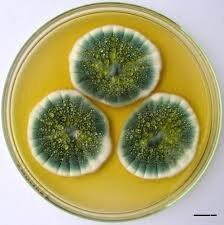
In 1928, Alexander Fleming had discovered the anitbacterial properties of the Penicillium mold. But he had little luck convincing his medical colleagues of its value: penicillin was so difficult to isolate that its development as a drug seemed impossible. After Fletcher’s experiment and others– all of which showed promise, but “failed” when the doctors ran out of penicillin– Fleming used the hospital’s entire supply of penicillin to cure a patient of an infection of the nervous system (streptococcal meningitis) which would otherwise have been fatal. Having established medical efficacy, the doctors were able to convince labs in the U.K and the U.S. to pursue large-scale fermentation of the mold and refinments in its medical form. By June 1942, just enough US penicillin was available to treat ten patients. But with the U.S. entry into World War II, the War Production Board undertook to make penicillin available to fighting forces across the conflict. By June, 1945, over 646 billion units per year were being produced.

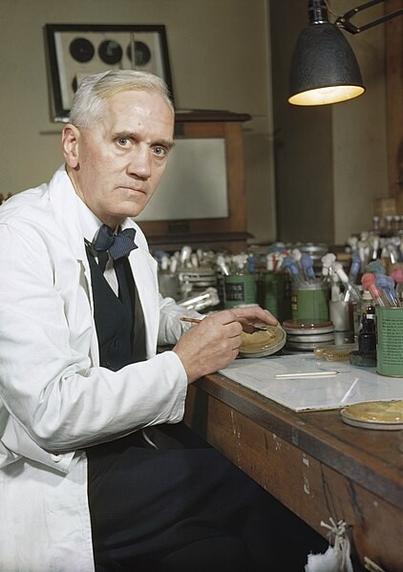
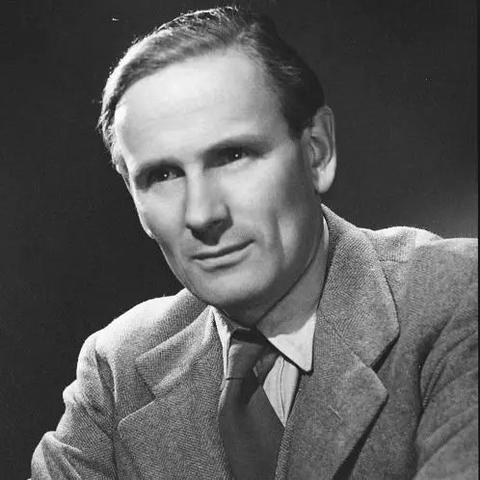
Charles Fletcher (source) #AlexanderFleming #antidepressants #CharlesFletcher #culture #Drugs #history #LordOfTheRings #medicine #penicillin #Science #Tolkien

El descubrimiento de la penicilina G (bencilpenicilina) en 1928 por el bacteriólogo escocés Alexander Fleming marcó el inicio de la era de los antibióticos. Este hallazgo, ocurrido en el Hospital St. Mary de Londres, fue el resultado de la observación directa de un hongo contaminante del género Penicillium que inhibía el crecimiento de la bacteria Staphylococcus aureus.

La sustancia es producida de forma natural por el moho Penicillium rubens (identificado inicialmente como P. notatum). Es un antibiótico betalactámico que actúa inhibiendo la síntesis de la pared celular bacteriana, provocando la lisis del microorganismo.

Aunque Fleming identificó la sustancia, no pudo aislarla de forma estable. Fue hasta 1939 que Howard Florey, Ernst Boris Chain y su equipo en la Universidad de Oxford lograron purificarla. La producción masiva se trasladó a Estados Unidos durante la Segunda Guerra Mundial, utilizando la técnica de fermentación sumergida.

Su primera aplicación clínica exitosa en humanos ocurrió en 1941. Para 1945, la disponibilidad de la penicilina redujo drásticamente la tasa de mortalidad por neumonía y sepsis entre las tropas aliadas. Por estos trabajos, Fleming, Florey y Chain compartieron el Premio Nobel de Fisiología o Medicina en 1945.

Ya en su discurso de aceptación del Nobel, Fleming advirtió sobre el peligro de la resistencia: el uso indiscriminado de dosis bajas de penicilina permitiría que las bacterias desarrollaran mecanismos de defensa, un problema de salud pública vigente en la actualidad.

#Penicilina #Medicina #Ciencia #Historia #AlexanderFleming #Antibioticos #Salud #Biologia #Investigación
Public Domain Day: Diese Werke sind ab heute gemeinfrei

https://netzpolitik.org/2026/public-domain-day-diese-werke-sind-ab-heute-gemeinfrei/

Mit Beginn des Jahres 2026 gehen viele Kunstwerke, Schriften und Musikstücke in die Public Domain über. In Europa sind das die Werke von Urheber*innen, die im Jahr 1955 gestorben sind. Mit dabei sind Thomas Mann, Fernand Léger und Clemence Housman.

#agathachristie #alberteinstein #alexanderfleming #arthurhonegger #francescobalillapratella #gemeinfrei #gemeinfreiewerke #hermannweyl #joséortegaygasset #josefvonsternberg #karlhofer #léonwerth #marlenedietrich #publicdomainday #thomasmann #urheberrecht #netzpolitik

Credits: Public Domain Ferdinand Léger
In questi giorni si fa un gran parlare (giustamente) del rischio di antibiotico-resistenza, tanto che l'AIFA ha rilasciato un'app specifica per monitorarne l'uso. “Un giorno i batteri saranno più forti dei farmaci” scriveva quasi un secolo fa #AlexanderFleming, papà della penicillina. Dalla muffa alla lacrima, fino all’antibiotico, la vita dello scienziato che ha cambiato il mondo, morto l'11 marzo 1955 - Famiglia Cristiana https://www.famigliacristiana.it/articolo/alexander-fleming-papa-della-penicillina-dalla-muffa-alla-lacrima-fino-allantibiotico-la-vita-dello-scienziato-che-ha-cambiato-il-mondo.aspx
Alexander Fleming, papà della penicillina: dalla muffa alla lacrima, fino all’antibiotico. La vita dello scienziato che ha cambiato il mondo

70 anni fa moriva il premio Nobel per la Medicina: un genio che ha trasformato la casualità in scoperte che hanno salvato milioni di persone. La previsione dell’antibiotico-resistenza: “Un giorno i batteri saranno più forti dei farmaci”

Famiglia Cristiana
The Nobel Prize on LinkedIn: In 1929, Alexander Fleming published his paper outlining the antibacterial… | 15 comments

In 1929, Alexander Fleming published his paper outlining the antibacterial properties of penicillin, and began the era of antibiotics. Read the Nobel Prize… | 15 comments on LinkedIn

The age of antibiotics began in September 1928, with the discovery of penicillin by Alexander Fleming (1881-1955), then a professor of bacteriology at St. #History #AlexanderFleming #Medicine #Penicillin #HistoryFacts https://www.worldhistory.org/article/2490/discovery-of-penicillin/
Discovery of Penicillin

The age of antibiotics began in September 1928, with the discovery of penicillin by Alexander Fleming (1881-1955), then a professor of bacteriology at St. Mary's Hospital in London. Previously there...

World History Encyclopedia
I sometimes hold it half a sin
To put in words the grief I feel;
For words, like Nature, half reveal
And half conceal the Soul within.
In Memoriam L.M.R.
#Tennyson 🥂
#LisaRome 🥂
#AlexanderFleming 🥂
#LucilleBall 🥂
#RichardHofstadter 🥂

#Datreveno #AlexanderFleming #Kuracilo #Penicilino

Je ĉi dato en 1881 naskiĝis Alexander Fleming, bakteriologo, kiu pro sia malordigita laborejo malkovris hazarde la unuan antibiotikon penicilino, kiam unu el lia eksperimentoj fungo malpurigis, kvankam li ne povis izoli la gravan substancon el la fungo. https://eo.wikipedia.org/wiki/Alexander_Fleming
Bildo: https://en.wikipedia.org/wiki/File:Synthetic_Production_of_Penicillin_TR1468.jpg

Alexander Fleming - Vikipedio

.> Yet wrapped up in penicillin’s serendipitous beginnings were hints of challenges to come. “It is not difficult to make microbes resistant to penicillin in the laboratory by exposing them to concentrations not sufficient to kill them,” Fleming warned in 1945 when he received the Nobel Prize in medicine or physiology, together with Florey and Chain, “and the same thing has occasionally happened in the body.”.> His remarks proved ominously prescient: penicillin-resistant strains of S. aureus began appearing in hospitals just years after the drug was introduced.
...
.> But even Fleming did not anticipate the magnitude of the resistance problem to come. In the 1950s, amid postwar outbreaks of dysentery, Japanese researchers led by Tsutomu Watanabe began to encounter bacteria simultaneously resistant to multiple drugs—impossibly unlikely for pathogens acquiring random mutations. By 1955, researchers were reporting several strains of Shigella dysenteriae resistant to the same four antibiotics at once. Even worse, the resistance itself was contagious. Related species, when mixed with multidrug-resistant S. dysenteriae, also became resistant to multiple antibiotics.
.> “Resistance works differently in the bacterium,” explains Stuart Levy - https://www.harvardmagazine.com/2014/05/superbug
#AlexanderFleming #Penicillin #TsutomuWatanabe #WatanabeTsutomu #StuartLevy #Antibiotics #AntibioticResistnace #HGT #HorizontalGeneTransfer

Superbug: An Epidemic Begins

As antibiotic resistance spreads, scientists and doctors race time.

Harvard Magazine

#AlexanderFleming (6 de agosto de 1881 - 11 de marzo de 1955)

"No son los vestíbulos de mármol los que proporcionan la grandeza intelectual, sino el alma y el cerebro del investigador"