 Alan Lewis
: #cancer #democrats #donaldthehoaxtrump #donaldtramp #eightysix47 #health #healthcare #presidenttramp #trumpstein #trumpsteincoverup #uspol #uspolitics #waroncancer :
DONALD TRAMP'S WAR ON THE WAR ON CANCER
Mastodon Post

: #cancer #democrats #donaldthehoaxtrump #donaldtramp #eightysix47 #health #healthcare #presidenttramp #trumpstein #trumpsteincoverup #uspol #uspolitics #waroncancer :
DONALD TRAMP'S WAR ON THE WAR ON CANCER
Mastodon Post
@JoePajak
Just science, without the involvement of public health, big business, high finance politicians and federal elections, was unable to deal effectively with cross contamination of research cell lines by #HeLa cells back during Nixon's #WarOnCancer (see #MichaelGold's #AConspiracyOfCells 1986.
The systems in place now aren't up to the task of containing Covid-19 IMO.
Which strongly suggests they'll fail on #ClimateChange too.
Though like East Germany showed, things can change quickly.
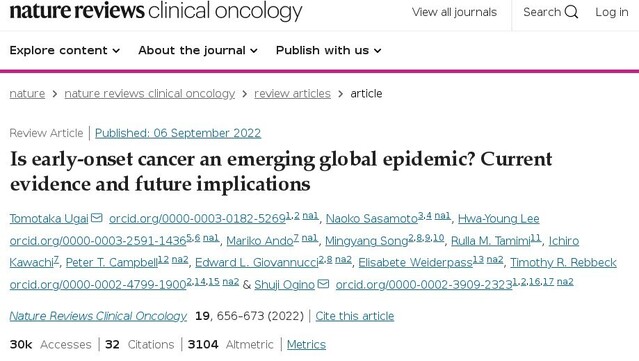
Over the past several decades, the incidence of early-onset cancers, often defined as cancers diagnosed in adults <50 years of age, in the breast, colorectum, endometrium, oesophagus, extrahepatic bile duct, gallbladder, head and neck, kidney, liver, bone marrow, pancreas, prostate, stomach and thyroid has increased in multiple countries. Increased use of screening programmes has contributed to this phenomenon to a certain extent, although a genuine increase in the incidence of early-onset forms of several cancer types also seems to have emerged. Evidence suggests an aetiological role of risk factor exposures in early life and young adulthood. Since the mid-20th century, substantial multigenerational changes in the exposome have occurred (including changes in diet, lifestyle, obesity, environment and the microbiome, all of which might interact with genomic and/or genetic susceptibilities). However, the effects of individual exposures remain largely unknown. To study early-life exposures and their implications for multiple cancer types will require prospective cohort studies with dedicated biobanking and data collection technologies. Raising awareness among both the public and health-care professionals will also be critical. In this Review, we describe changes in the incidence of early-onset cancers globally and suggest measures that are likely to reduce the burden of cancers and other chronic non-communicable diseases. The incidence of early-onset forms of many cancers (defined as cancers diagnosed in individuals <50 years of age) has increased in a number of countries over the past several decades. The underlying reasons for this apparent increase probably include greater use of screening programmes, but also changing patterns in early-life exposures. In this Review, the authors describe the emerging global increase in the incidence of early-onset cancers and suggest changes that might address this situation.
 skua
skua El Club De Los Físicos Muertos