 Oliver Kennedy
 Spirituality & Religious Studies
Ma’at
She comprised the ancient Egyptian concepts of truth, balance, order, harmony, law, morality, & justice. Ma’at was also the goddess who personified these concepts, & regulated the stars, seasons, & the actions of mortals & the deities who had brought order from chaos at the moment of creation. Her ideological opposite is Isfet (Egyptian: jzft), meaning injustice, chaos, violence, or to do evil.
The earliest surviving records indicating that Ma’at is the norm for nature & society in this world & the next, were recorded during the Old Kingdom of Egypt. The earliest significant surviving examples being found in the Pyramid Texts of Unas (circa 2375 BCE-2345 BCE).
Most Egyptian goddesses were paired with a male counterpart. Her masculine equivalent was Thoth. This is because their traits are similar. In other accounts, Thoth was paired off with Seshat, the goddess of writing & measure, who’s a lesser-known deity.
After her role in creation & continuously preventing the universe from returning from & returning to chaos, her primary role in ancient Egyptian religion dealt with the Weighing of the Heart that took place in the Duat.
Her feather was the measure that determined whether the souls (considered to reside in the heart) of the departed would reach the paradise other afterlife successfully. In other versions, Ma’at was the feather as the personifications of truth, justice, & harmony.
Pharaohs are often shown with the emblems of Ma’at to emphasize their roles in upholding the laws & righteousness. From the 18th Dynasty (circa 1550-1295 BC), Ma’at was shown as the daughter of Ra, suggesting that Pharaohs were believed to rule through her authority.
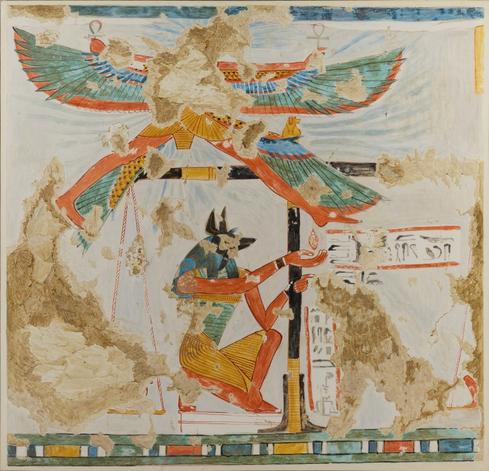
As the goddess of harmony, justice, & truth, Ma’at was shown as a young woman. She’s sometimes shown with wings on each arm or as a woman with an ostrich feather on her head.
The sun-god Ra came from the primaeval mound of creation only after he set his daughter Ma’at in place of isfet (chaos). Kings inherited the duty to ensure Ma’at remained in place. They with Ra are said to “live on Ma’at,” with Akhenaten in particular emphasizing the concept to a degree that the king’s contemporaries are seen as intolerance & fanaticism. Some kings combined Ma’at into their names, being referred to as Lords of Ma’at or Meri-Ma’at (Beloved of Ma’at). Ma’at had a central role in the ceremony of the Weighing of the Heart.
Ma’at represented the ethical & moral principle that all Egyptian citizens were expected to follow throughout their daily lives. They were to act with honor & truth in matters that involve family, the community, the nation, the environment, & the gods.
Ma’at was the spirit in which justice was applied rather than the detailed legalistic account of rules. She represented the normal & basic values that formed the setting for the application of justice that had to be carried out in the spirit & fairness.
From the 5th Dynasty (circa 2510-2370 BC) onward, the vizier (Jafar’s job in Disney’s Aladdin, the 1st one.) was responsible for justice and was called the Priest of Ma’at. In later periods, judges wore images of Ma’at.
The goddess Ma’at was the daughter of the Egyptian sun-god Ra. She was/is the wife of Thoth, who’s the god of wisdom who invented writing. She’s associated with the judgment of the dead & whether a person has done what’s right in their life. To do Ma’at was to act in a manner unreproachable or innocent.
So revered was the concept of Ma’at that Egyptian kings would often pay tribute to gods, offering small statues of Ma’at. This indicated that they were successfully upholding the universal order.
The earliest evidence for a dedicated temple is in the New Kingdom (circa 1569-1081 BC) era. Amenhotep III commissioned a temple in the Karnek complex. While textual evidence indicates that other temples of Ma’at were located in Memphis & at Deir el-Medina. The Ma’at temple at Karnak was also used by courts to meet regarding the robberies of the royal tombs during the rule of Ramesses IX.
In the Duat, the Egyptian underworld, the hearts of the dead were said to be weighed against Ma’at’s single “Feather of Ma’at.” This symbolically represented the concept of Ma’at in the Hall of 2 Truths.
This is why hearts were left in the Egyptian mummies while other organs were removed, as the heart (called “ib”) was seen as part of the Egyptian soul. If the heart was found to be lighter or equal to the feather of Ma’at, the deceased had led a virtuous life & would go to Aaru. A heart that’s unworthy was devoured by the goddess Ammit & its owner condemned to remain to the Duat.
The Weighing of the Heart, as usually shown on papyrus in the Book of the Dead (or in tomb scenes) shows Anubis overseeing the weighing & Ammit seated awaiting the results to eat those who failed. The image contains a balancing scale with an upright heart standing on 1 side & the Shu-feather standing on the other.
Other traditions God that Anubis brought the soul before the posthumous Osiris who performed weighing while the heart was weighed the deceased recited the 42 Negative Confessions as the Assessors of Ma’at looked on.
The Assessors of Ma’at are the 42 deities listed in the Papyrus of Nebseni, to whom the deceased make the Negative Confession in the Papyrus of Ani. They represent the 42 united nomes of Egypt. They’re called “the hidden Ma’ati gods, who feed upon Ma’at during the years of their lives.”
One-Time Monthly YearlyMake a one-time donation
Make a monthly donation
Make a yearly donation
Choose an amount
$1.00 $5.00 $10.00 $1.00 $5.00 $10.00 $5.00 $10.00 $15.00Or enter a custom amount
$Your contribution is appreciated.
Your contribution is appreciated.
Your contribution is appreciated.
DonateDonate monthlyDonate yearly
#1081BC #1550BC #1569BC #18thDynasty #2345BCE #2370BC #2375BCE #2510BC #42NegativeConfessions #5thDynasty #Akhenaten #Aladdin #AmenhotepIII #Ammit #Anubis #AssessorsOfMaAt #BelovedOfMaAt #BookOfTheDead #Chaos #DeirElMedina #Disney #Duat #Egypt #EgyptianBookOfTheDead #Feather #FeatherOfMaAt #Goddess #HallOfTwoTruths #Ib #Isfet #Jzft #Karnek #LordsOfMaAt #MaAt #Memphis #MeriMaAt #Mummies #NewKingdom #OldKingdomOfEgypt #Osiris #OstrichFeather #PapyrusOfAni #PapyrusOfNebseni #Pharaoh #PriestOfMaAt #PyramidTextsOfUnas #Ra #RamesesIX #Seshat #ShuFeather #SunGod #Thoth #Vizier #WeighingOfTheHeart
 Dwight Williams (💉 x9)+😷🇨🇦
 Oliver Kennedy
 Astronomical data center
 DoomsdaysCW

 Oliver Kennedy
