 mosspiglet
"I write speculative fiction sometimes, which can get weird. It's OK with me. I like weird.
Let's try a speculative scenario, something super weird.
Let's imagine that in a society just like ours, some foundational aspect of the streets was found to be harmful in a way that threatened everyone. Let's say for example that they had been built for individual personal vehicular transportation rather than highly scalable public transportation, and that this configuration created congestion and isolation and hazard, and made life increasingly difficult and dangerous for increasing numbers of people, and made ownership of individualized private vehicles a prerequisite for participating in society, which made cities far less livable and more difficult and dangerous to walk around in—and beyond that, the strain on non-renewable resources and the impacts on the environment that attended the consumption of those resources by these vehicles created effects that endangered the stability of all societies and the lives of everyone in those societies.
I warned you, I do sometimes come up with very weird fictional premises. Maybe that one is too far out there, too speculative. What if we made it something simpler, then: what if some part of all the streets, some chemical in their composition, were radioactive and deadly?
What then?
Well…if we valued the lives of people in our system, we'd need to replace those streets.
How many? All of them.
How far? To the furthest extent of the problem. To the very boundaries of the city. To the very foundations that create the hazard. In other words, the solution would require active, persistent, determined, informed, and transformative action.
At what cost? At whatever cost it took.
Otherwise, we'd have to accept that the streets would kill us, because we valued the money we would save by neglecting the streets rather than paying the cost to repair and enhance them more than we valued the lives of the human beings harmed by our harmful streets.
Right?
Like I said: obvious.
But hey, listen to this: What if we only fixed some of the streets? What if we only fixed the streets where most of the residents were deemed to be "white?" Or what if we—"unable to see color," but having inherited a system whereby those deemed "white" were more likely to own generational wealth, homes, and other property—only fixed the streets lined by houses of greater value?
That would work out, I suppose, provided you are someone wealthy enough to afford a valuable house, and provided the thought of your neighbors dying while you live is acceptable to your conscience.
But suppose human intentions are like streets. Suppose human intentions have a direction, too, and that living in a murderous system that is designed to see human life as disposable to financial convenience may become a problem for you tomorrow, if you are a human. Remember, every street has a destination. And no street ever reached its destination by accident. And a system that eats people will eat people.
But hey, listen to this wrinkle: Imagine in our scenario that most of the people want to fix the streets, but the city still refuses. What then?
I think we'd have to conclude that some portion of us are no longer what is meant when we say "the city decides." I think we'd have to conclude that the controls over our natural human system have been unnaturally stolen. We'd have to conclude that the problem of our radioactive streets is only the immediate problem, and that the larger undergirding problem is this: The way that our city makes decisions has been unnaturally misalligned, intentionally stolen.
We might call this theft "injustice."
Before we could reconfigure the streets, we'd have to reconfigure the means of configuration itself—the way the city decides. How far? To the furthest extent of the problem, to the very boundaries of the injustice, at whatever cost necessary. The solution would require active, persistent, determined, informed, and transformative action, aligned to a compass that views as its true North a justice founded in love—that is, a justice that ensures the inherent dignity, legal equality, and provision for basic human need, of all human beings, even those aligned against that compass setting. Or we'd have to accept that our unnaturally corrupted human system, designed to kill people for financial convenience, would kill us, if it ever became financially convenient for it to do so.
Right?
If the way the city decides has become as broken or useless or harmful as our hypothetically fatal streets, then our natural human system becomes potentially unable to solve problems—any problems. Our natural human system might even start to configure itself around a principle such as "government is the problem"—the idea that solving the problems of people isn't a suitable matter for cities to engage in. If our city is organized in such a way that it is unwilling to save people from death unless they are deemed worthy of life, then we are all vulnerable, not only to the problem of the streets, but to any danger that makes us unprofitable. This suggests that if we are people who wish to live, we will have to be willing to perform radical transformative structural reconfiguration, not only on our city, not only on the ways in which the city decides, but on our spirit itself—our foundational beliefs and assumptions—and not just in any direction, but in a direction that leads us toward inclusiveness, completeness, plurality, and equality. This suggests that, should I discover that the natural value delivery system in which I exist has been unnaturally stolen and corrupted, the greater danger is not in radical structural reconfiguration, but in refusing to pursue radical structural reconfiguration.
Remember, cancer and virus require only your silence. They'll do the rest.
What happens when a system that eats unvaluable people runs out of unvaluable people to eat? What happens when something changes dramatically, and you are suddenly less valuable?
If human intention is like a street, it will eventually reach its destination.
Eventually it will find you and me.
Let's try another speculative scenario.
Imagine a city dependent on precipitation, where a few people decided to capture all the rain. Imagine they built a series of gutters and downspouts and barrels and cisterns, so that when the rain fell on all the houses, they could divert most of it away from some of the people and bestow it to a select few others. Imagine a city comprised of islands of perfect lush green, swimming in a vast sea of blasted and parched and unnatural desert. Imagine a city that manufactured drought during a rainy season, and horded water in times of manufactured drought.
Imagine a city that recognized the intrinsic value that a collection of people naturally generates—inextricable, automatic, inherited, shared, invisible—where a few people decided to configure it to capture all that value for themselves, and then expected to be praised as the givers of water when they allowed a bit of it to trickle down. Imagine, if you can, a society founded on a series of unjust lies—an unnatural human configuration of our natural human system.
Suppose the founders of some hypothetical society had learned that they could maximize for themselves the foundational, generative value that is the natural output of human society, by stealing it away from millions of other humans, and giving it all to themselves. Suppose they did this by utilizing the idea that it was not only possible but desirable, not only desirable but righteous, for human beings to own other human beings as possessions; that ownership of property was the only valid channel for determining who should provide value to society, and who should receive it. Suppose they founded their society on the proposition that the Owners should be the only people within the society allowed to partake in the collective will of the human system the Owned had built, and to control all the value delivered, and to parcel value out to the Owned only to the exact extent to which such an allowance would profit the Owner.
I would suppose that such a society, founded on human enslavement, would always turn themselves, whatever their stated intentions, back toward slavery. I would suppose that people in such a society would believe, at the bedrock level of their assumptions, that some people have more value and others have less, or even none, or even a negative value. I would suppose that such a society would behave as if a person's value is a matter of power and wealth, and to lack power and wealth is to lack any value. I would suppose that such a society would conclude that for a valueless person to receive some value that diminished the profit they could provide an Owner would be considered a grotesque and offensive theft; and would eventually conclude that person who could not be used for profit had not earned life, represented theft, and had therefore earned death. I would suppose that such a society would believe the violence of neglect or the violence of brutality to be an acceptable way to redeem such a debt against such a valueless thief.
And then that society would configure itself to control and harm valueless people. You'd know this was the configuration of this society, no matter what individuals within that society said their individual intentions were, because this society would control and harm people, and justify it on a metric of cost and profit. And those with access to the power to change this configuration would not do the work of reconfiguration, which would reveal their deepest intentions.
And they might even configure their streets and roads so that the value of transportation was maximally available to those who could afford increasingly expensive personal vehicles, and almost non-existent for those who couldn't. And they might defend and expand this configuration, even when it became clear that this configuration made cities and towns far more inhospitable and dangerous to people, even once it became clear that the operation of these personal vehicles was a major factor in a global threat to all of their lives.
Oh man. I'm back to the same extremely unbelievable scenario as before. My friends will tell you I do that sometimes. Maybe this all seems too far-fetched to you. As I said, I write speculative fiction, which often requires a real stretch of the imagination."
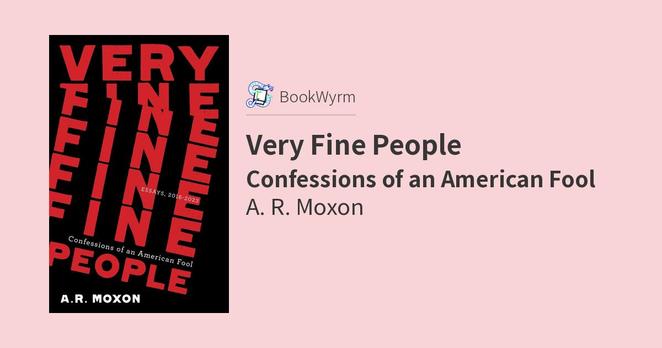
— A. R. Moxon: Very Fine People, pp. 143-149
#Books #Quotes #ARMoxon #VeryFinePeople #Streets #Cities #Societies #SpeculativeFiction
 ghost with books 👻📚
 br00t4c
 DoomsdaysCW
 *|FNAME|* 🇨🇦
 SLCW💥
SLCW💥
 Levka
Levka
 Aaron Lord

 troy_friz_zell