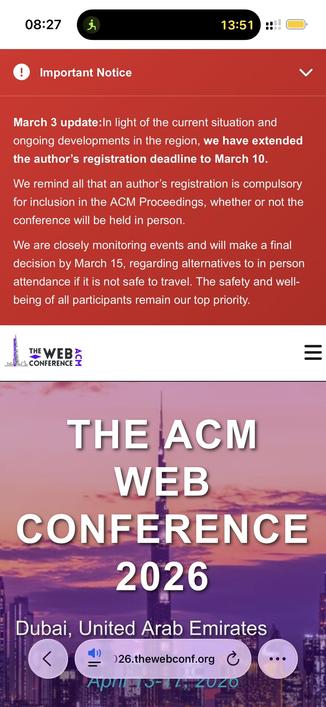
The Web Conference 2026 (Dubai, April 13-17): Registration deadline is March 10, but organizers won't decide if it's in-person or virtual until March 15.

How do you plan travel, pick a registration tier, or get institutional approval without knowing the format?

#TheWebConf #AcademicLife

Couldn't attend #TheWebConf? No problem!
You can now catch up on every session at your convenience on our YouTube channel: https://youtube.com/@ACMSIGWEB
Plan your binge-watch parties now and spread the word!
Bevor Sie zu YouTube weitergehen

Following my recent trip to attend #TheWebConf in Singapore 🇸🇬, I wrote a trip report 🧳 for my colleagues (and you) to share some of the things that I learned: https://blog.tomayac.com/2024/05/22/the-web-conf-2024-singapore-trip-report/. Surprise: this edition was dominated heavily by #LLMs, #AI, and how all this affects the #Web, but also #accessibility and #security. I co-organized the Resource track 🧑‍🎓 and had a paper in the History of the Web track.
The Web Conf 2024, Singapore: Trip report

The personal blog of Thomas Steiner

Our paper in the ACM Web Conference, on Inequality and Concentration of Power in Online Governance

We built and studied a census of the #DAOs ecosystem: 30K blockchain communities, 200K proposals, 22M votes
https://doi.org/10.1145/3589335.3651481

The paper is open access and open licensed, same as the dataset at
https://zenodo.org/records/10794916

The work was led by PhD student Andrea Peña, with Javier Arroyo, Andrew Schwartz, and me.

Starting a thread with the main highlights
#web3 #TheWebConf
1/4

Concentration of Power and Participation in Online Governance: the Ecosystem of Decentralized Autonomous Organizations | Companion Proceedings of the ACM on Web Conference 2024

ACM Conferences

Just finished the presentation of my #TheWebConf History of the Web track paper on "Toward Making Opaque Web Content More Accessible: Accessibility From Adobe Flash to Canvas-Rendered Apps":

📄 Paper: https://goo.gle/opaque-web-content-paper
🖼️ Slides: https://goo.gle/opaque-web-content-slides

Starting my trip to #TheWebConf in Singapore 🇸🇬. I'm co-chair of the Resource track (https://www2024.thewebconf.org/calls/resource) and will present a paper in the History of the Web track (https://www2024.thewebconf.org/calls/history-web) on "Toward Making Opaque Web Content More Accessible: Accessibility From Adobe Flash to Canvas-Rendered Apps". Anyone else from my timeline at the conference?
International World Wide Web Conference 2024 ( WWW2024 | The Web Conf 2024 ) | Resource Papers

Congratulations to Lukas Blübaum and Stefan Heindorf for the acceptance of your paper "Causal Question Answering with Reinforcement Learning" at The Web Conference #TheWebConf 👏🥳

➡️Take a look at the paper here: https://arxiv.org/abs/2311.02760

#ReinforcementLearning #DICEreadme

Causal Question Answering with Reinforcement Learning

Causal questions inquire about causal relationships between different events or phenomena. They are important for a variety of use cases, including virtual assistants and search engines. However, many current approaches to causal question answering cannot provide explanations or evidence for their answers. Hence, in this paper, we aim to answer causal questions with a causality graph, a large-scale dataset of causal relations between noun phrases along with the relations' provenance data. Inspired by recent, successful applications of reinforcement learning to knowledge graph tasks, such as link prediction and fact-checking, we explore the application of reinforcement learning on a causality graph for causal question answering. We introduce an Actor-Critic-based agent which learns to search through the graph to answer causal questions. We bootstrap the agent with a supervised learning procedure to deal with large action spaces and sparse rewards. Our evaluation shows that the agent successfully prunes the search space to answer binary causal questions by visiting less than 30 nodes per question compared to over 3,000 nodes by a naive breadth-first search. Our ablation study indicates that our supervised learning strategy provides a strong foundation upon which our reinforcement learning agent improves. The paths returned by our agent explain the mechanisms by which a cause produces an effect. Moreover, for each edge on a path, our causality graph provides its original source allowing for easy verification of paths.

arXiv.org
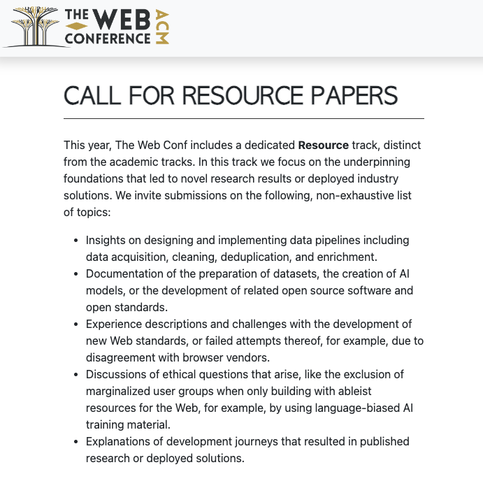
📢 At the upcoming #TheWebConf 2024, Michael Hausenblas and I are responsible for the Resource track: https://www2024.thewebconf.org/calls/resource/. The Resource track is distinct from the academic tracks. In this track, we focus on the underpinning foundations that led to novel research results or deployed industry solutions.
#CfP #WWW2024
International World Wide Web Conference 2024 ( WWW2024 | The Web Conf 2024 ) | Resource Papers

#TheWebConf
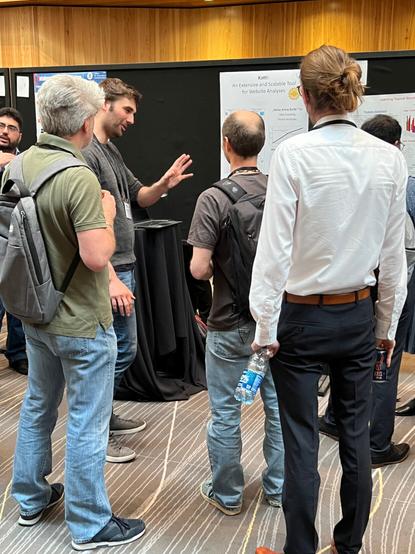
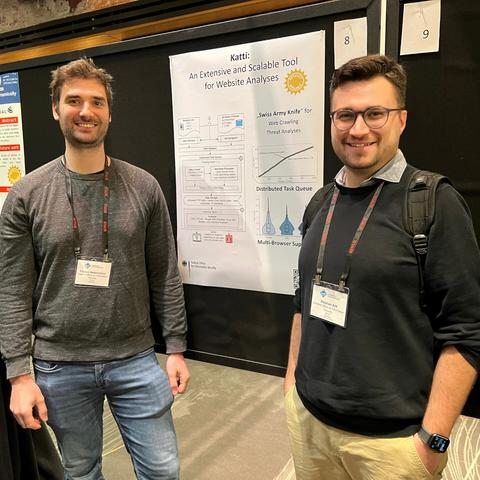
ist die Flagship-Konferenz der WWW-Community. Unsere BSI-Kollegen präsentieren dieses Jahr in Austin (Texas, USA) ein Tool, mit dem zukünftig u.a. Ad-Malware-Kampagnen detektiert werden könnten: ➡https://dl.acm.org/doi/10.1145/3543873.3587351

#TheWebConf2023 #DeutschlandDigitalSicherBSI

Katti: An Extensive and Scalable Tool for Website Analyses | Companion Proceedings of the ACM Web Conference 2023

ACM Conferences

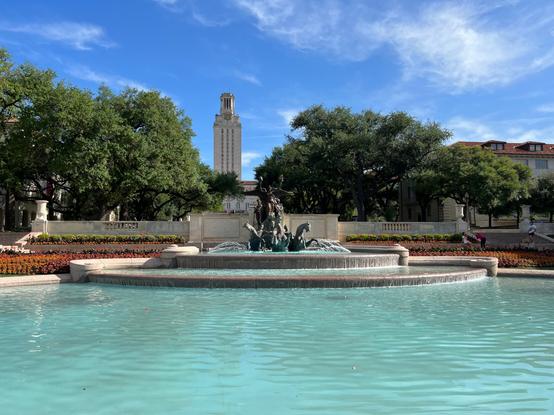
Happy to have presented our research work "Show me your NFT and I tell you how it will perform: Multimodal representation learning for NFT selling price prediction" ( ✍ w/ @starquake and @andreatagarelli) at TheWebConf 2023 in Austin, Texas 🤠

Full paper 👉 https://dl.acm.org/doi/abs/10.1145/3543507.3583520

#TheWebConf #NFT #NonFungibleTokens #Blockchain #Web3 #Metaverse #Transformers #AI #ComputerVision #NLP #DeepLearning #Research #Finance

Show me your NFT and I tell you how it will perform: Multimodal representation learning for NFT selling price prediction | Proceedings of the ACM Web Conference 2023

ACM Conferences