Alexander Loth

@xlth
24 Followers
23 Following
114 Posts
Researcher exploring how generative AI reshapes disinformation & public trust. Building JudgeGPT · Author of books on data visualization & AI · iOS developer (Trackless Links, Mindful Coffee) · Views my own.
🌐 Websitehttps://alexloth.com
🎓 Google Scholarhttps://scholar.google.com/citations?user=ofZZ8LgAAAAJ
📚 Bookshttps://alexloth.com/books
🔗 Linkshttps://linktr.ee/xlth

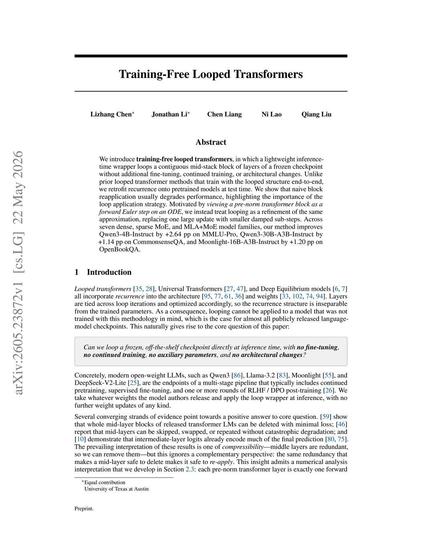
Can we steer visual representations like we prompt LLMs? This paper shows how to inject text into vision encoders via early fusion, creating steerable features that stay strong for core vision tasks while focusing on any concept you ask for.

Read the full paper: http://arxiv.org/abs/2604.02327v1

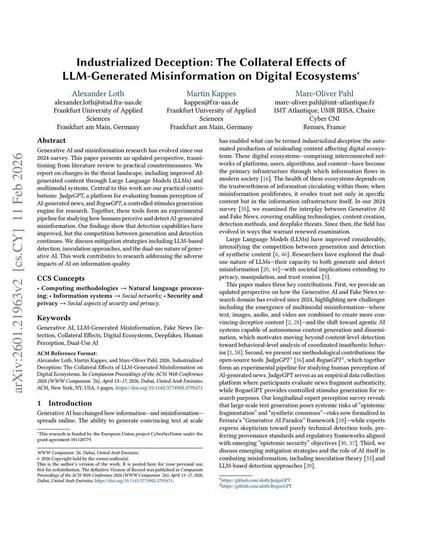
Most fake news generators still spit out text you can’t reproduce or compare.
RogueGPT ships a controlled pipeline - multi-model, multilingual, style-locked news with full provenance - beyond what GROVER or FACTGEN allowed.
If we can generate disinfo this precisely, how should evaluation tools change?

Full paper here: https://github.com/aloth/RogueGPT

#introduction

I'm Alexander Loth -- researcher & author in Frankfurt.

PhD: how generative AI reshapes disinformation & trust.

Tools I build:
🔬 JudgeGPT -- humans detect AI news at 52% (coin flip)
🤖 RogueGPT -- controlled misinfo stimuli
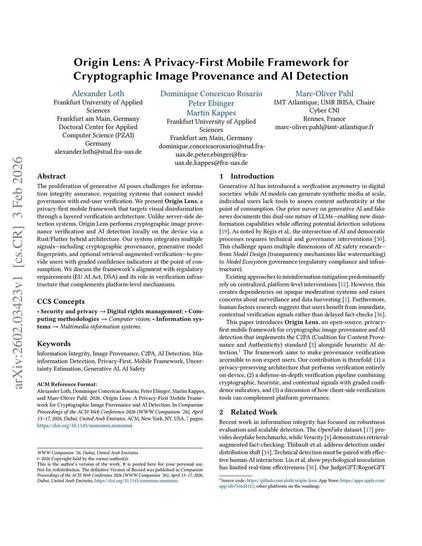
🔍 Origin Lens -- on-device C2PA verification
📊 CRED-1 -- domain credibility dataset

Also: books on data viz & AI, iOS apps.

https://scholar.google.com/citations?user=ofZZ8LgAAAAJ
https://github.com/aloth

#AcademicMastodon #GenAI #Disinformation #C2PA #WebScience #AIethics

Alexander Loth

Microsoft AI for Good Research Lab - 171-mal zitiert - Generative AI - Information Integrity - Computational Social Science - Human-AI Interaction - AI Ethics

People think they can spot AI-written news. Turns out they mostly can’t.
In a large human study, GPT-4 news was judged about as authentic as real journalism, with accuracy hovering near chance.
If readers can’t tell, what happens to trust when anyone can publish at scale?

Full paper here: https://github.com/aloth/JudgeGPT

We still verify images by squinting at pixels and vibes.
Origin Lens does on-device cryptographic C2PA verification, showing who signed an image and if it was altered.
When trust is math instead of guesswork, which would you rely on?

Try it out on iOS: https://apps.apple.com/us/app/origin-lens/id6756628121

PsyPost: New research suggests truth has a natural competitive edge over misinformation. “Truthful messages are more persuasive and more likely to be shared than false ones, according to new research published in the Journal of Personality and Social Psychology. The findings, drawn from four large experiments, challenge the widespread belief that misinformation naturally spreads more […]

https://rbfirehose.com/2026/04/02/psypost-new-research-suggests-truth-has-a-natural-competitive-edge-over-misinformation/
PsyPost: New research suggests truth has a natural competitive edge over misinformation

PsyPost: New research suggests truth has a natural competitive edge over misinformation. “Truthful messages are more persuasive and more likely to be shared than false ones, according to new …

ResearchBuzz: Firehose

It's International Fact-Checking Day.

Since 2015, EUvsDisinfo has documented nearly 20,000 cases exposing the Kremlin’s lies and information manipulation.

The world’s largest publicly available.database of pro-Kremlin disinformation: https://euvsdisinfo.eu/disinformation-cases/

#EUvsDisinfo #EU #Russia #Europe #Kremlin #Ukraine #factchecking

Database - EUvsDisinfo

EUvsDisinfo database – the only searchable, open-source repository of its kind, updated weekly with most recent samples of pro-Kremlin disinformation.

EUvsDisinfo

After 2 years researching AI-generated misinformation (4 papers at WWW '26), I'm expanding into agentic AI.

Same core question, harder version: how do we maintain trust when AI acts autonomously? When an agent sends emails or books meetings on your behalf, how do you verify it did what you intended?

Open questions: verification at action time, trust calibration, safe agent-tool interface design.

https://alexloth.com/from-misinformation-to-agentic-ai-research-direction-2/

#AgenticAI #AIResearch #Trust

From Misinformation to Agentic AI: Where My Research Is Heading

After two years researching how AI generates misinformation, I am expanding into agentic AI systems. The trust questions are similar but harder: when agents act autonomously, how do we verify intent, calibrate trust, and maintain oversight?

alexloth.com

March update for CRED-1 🗓️

4 weekly releases this month with 2,629 domain rescores — the largest batch yet, reflecting a comprehensive recalibration against updated fact-checker assessments. The dataset now tracks 2,673 sources, with rt.com among the notable new additions.

Credibility scores are derived from 9 independent fact-checking organizations and updated weekly.

Dataset: https://github.com/aloth/cred-1/releases/tag/v2026-03-24

#OpenData #Misinformation #FactChecking #MediaLiteracy

Release CRED-1 2026-03-24 · aloth/cred-1

2026-03-24 Total domains: 2673 Score updates: 5 domains rescored

GitHub

"For more than a decade, the Reuters Institute Digital News Report has documented fundamental shifts in how young people (defined in this report as those aged 18–24) interact with and think about news during a period of significant technological, media, and political transformation. As ‘social natives’, this demographic is moving away from traditional news media like television, print, and even news websites, gravitating instead towards a social-first and audiovisual-heavy media diet, where news is one type of content consumed among many.

While much has been said about the perceived lack of news engagement among younger people, our research also documents a greater sense of alienation among this segment of the public, some of whom find traditional news irrelevant, difficult to understand, or unfairly biased against their demographic. Mismatches between journalistic output and the expectations of young audiences highlight the need for newsrooms to examine both the question of how to reach young people where they are and, equally important, how to do so with news they find relevant, engaging, and ultimately worth their attention. Meeting the needs of this segment is crucial, not just for the current stability of the journalism industry, but also for the future of democratic societies as young individuals transition through adulthood (Røsok-Dahl and Ihlebæk 2024).

In this report we bring together evidence from over a decade of Reuters Institute research to shed light on young audiences today. Understanding generational shifts is vital for the financial sustainability of the news industry, which depends on a pipeline of younger consumers who will keep coming back to news. It also matters for the democratic health of our societies, which requires individual citizens, including young people, to be informed and collectively share a basic understanding of the world."

https://reutersinstitute.politics.ox.ac.uk/understanding-young-news-audiences-time-rapid-change

#Media #News #YoungAudiences #Journalism #MediaLiteracy

Understanding young news audiences at a time of rapid change

Reuters Institute for the Study of Journalism