Session 3.1 Partnerships of the Sea: Forms, Functions and Prospects of Marine Symbioses hosted by Daniela Da Silva and Thilo Appeldorn
#ICYMARE2026Bremen #symbioses #marinesymbioses #symbioticrelationships #ecology #marineecology #earlycareerconference #oceandecade

✍🏼📋 "Pas si smart, nos phones"
Quels matériaux et quels enjeux complexes se cachent derrière l’écran lisse de nos smartphones ? Et comment prolonger leur durée de vie ? Immersion dans une animation de Repair Together Asbl, à l’Athénée royal Jean Absil à Etterbeek.

Un article et reportage réalisé par Sophie Lebrun 🙏🏼 publié dans le numéro 143 du magazine #Symbioses du Réseau IDée (pages 20 & 21)

👉🏼 Télécharger Symbioses: https://www.reseau-idee.be/fr/symbioses-magazine?numero=143

Symbioses - Magazine

Mycorrhizal networks

"Fungi form well-documented and functionally relevant symbioses with the majority of plants and the fungi grow inside the roots, forming symbiotic exchange interfaces."

"Reasons underpinning this focus on common mycorrhizal networks (CMNs) are quite evident: these fungi form well-documented and functionally relevant symbioses with the majority of plants and the fungi grow inside the roots, forming symbiotic exchange interfaces (Smith & Read, 2008)."
>>
Rillig, M.C., Lehmann, A., Mounts, I.R. and Bock, B.M. (2025), Concurrent common fungal networks formed by different guilds of fungi. New Phytol. https://doi.org/10.1111/nph.20418
#FungalNetworks #fungi #flora #networks #roots #symbioses #PlantFungalInteractions #CMNs #entanglement #forests

Researchers propose mechanistic framework to explain complex #microbe-host #symbioses.

https://phys.org/news/2024-09-mechanistic-framework-complex-microbe-host.html

Researchers propose mechanistic framework to explain complex microbe-host symbioses

Virtually all multicellular organisms on Earth live in symbiotic associations with very large and complex microbial communities known as microbiomes. New research has just been published aimed at offering a complete understanding how those relationships form.

Phys.org

Hello there!

I'm a new PhD student freshly arrived in #Toulouse to work on plant-microbe interactions. My thesis will focus on the study of mycorrhizal and rhizobial #symbioses at the root #endodermis level.

On the side, I like to do #photography, discover new music (often #postrock) and play with computers and electronics (mostly #Linux and #Arduino).

Looking forward to exploring the Fediverse :)

#introduction

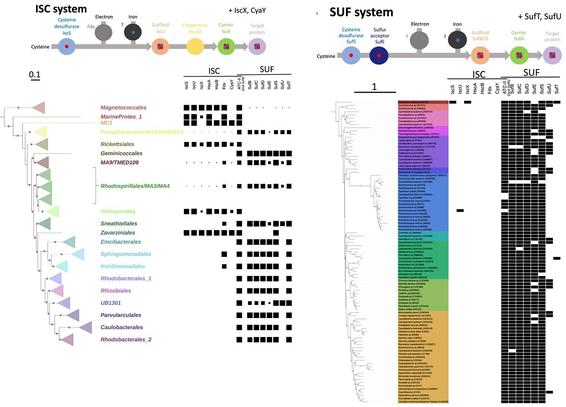
The #symbioses that gave rise to primary #organelles are key events in the origin of #Eukaryotes. @PierreSGarcia @FredBarras & @SGribaldo use markers from 2 conserved machineries for [Fe-S] cluster biogenesis to support an early emergence of #mitochondria & #plastids within #Alphaproteobacteria & #Cyanobacteria #PLOSBiology https://plos.io/3FNP5E5
Components of iron–Sulfur cluster assembly machineries are robust phylogenetic markers to trace the origin of mitochondria and plastids

The symbioses that gave rise to primary organelles are key events in the origin of Eukaryotes. This study uses a dataset of markers belonging to two conserved machineries responsible for [Fe-S] cluster biogenesis to support an early emergence of mitochondria and plastids within Alphaproteobacteria and Cyanobacteria, respectively.

Partie de #Symbioses hier soir, la deuxième que je fais en présence et je me suis encore senti embarrassé de la présence des autres, comme si ce jeu où les personnages vivent en des lieux, des cultures, voir des temps différents était fait pour le virtuel. En tous cas il y a une convergence en virtuel qu'il n'y a pas autour d'une table.

Et sinon, meilleurs #JdR pour faire des monologues mystiques.

Reminder: The 2023 GRS on Animal-Microbe #symbioses is officially open for abstract submissions. This 2-day meeting will happen right before the sister GRC. All applicants are encouraged to apply for both! 1/5

https://grc.org/animal-microbe-symbioses-grs-conference/2023/

#GRCSymbioses
@GordonConf @MicrObeng @Kaltenpoth_Lab

2023 Animal-Microbe Symbioses (GRS) Seminar GRC

The 2023 Gordon Research Seminar on Animal-Microbe Symbioses (GRS) will be held in Lucca (Barga), LU Italy. Apply today to reserve your spot.

The Sediment Below https://storymaps.arcgis.com/collections/cad9443adff1429f94cd212aee672123?item=6&fbclid=IwAR2CKnDNtDZA5XAqhEmPiEcETzxV1F0_S34flRKatmz7ZSnUI8QNQlpZFqQ

#Ciliates are interesting because they form #symbioses with other #microbes really easily. Even though they are common in oxygen-depleted environments where there is not a lot of energy available, they are large and very active. Some get large enough that you can even see them with your eyes.”

The Current - Fall 2022

RI NSF EPSCoR’s annual magazine, highlighting the scientific and engineering research of faculty and students at institutions across Rhode Island

Esri

The 2023 GRS on Animal-Microbe #symbioses is officially open for abstract submissions. This 2-day meeting will happen right before the sister GRC. All applicants are encouraged to apply for both! 1/5

https://grc.org/animal-microbe-symbioses-grs-conference/2023/

#GRCSymbioses @GordonConf
@MicrObeng
@Kaltenpoth_Lab

2023 Animal-Microbe Symbioses (GRS) Seminar GRC

The 2023 Gordon Research Seminar on Animal-Microbe Symbioses (GRS) will be held in Lucca (Barga), LU Italy. Apply today to reserve your spot.