This photo of India Street in 1931 doesn’t look exciting, but it turns out to be linked to technical education, cryptozoology, a pioneering woman in technology, and a piece of my own family history. Let’s take a dive.
24 India Street in 1931.
[Virtual Mitchell]
Interior of 24 India Street in 1931. [
Virtual Mitchell]
24 India Street was the Glasgow branch of the Caledonian Wireless College Ltd, which had been founded in 1925, principally to train wireless operators for ships. (Note the headsets on the wall, and the Morse keys on the tables.) The Wireless College weren’t the first place to offer such training — the nearby School of Navigation had started doing so as early as 1913 — but the College seized the chance to detach wireless from the general cadet course, and they advertised brashly.
Adverts in the
Glasgow Observer and Catholic Herald (3 October 1925) and the
Hawick Express (23 August 1929).
Crucially, the Wireless College had a deal with the Marconi Company which allowed them to guarantee positions to successful students. Although the “call of the sea” was an important marketing tool, shore-based jobs were opening up, and the College plugged these opportunities too:
For the benefit of those to whom a life at sea does not appeal, it should be added that there are many remunerative shore appointments for which the colleges provide courses. Among these are:— Government wireless inspector, operator, or engineer; land station engineer or operator; inspector of telegraphs (Colonial or foreign); B.B.C. maintenance engineer; and newspaper telephotography or telegraphy operator.
Hamilton Advertiser, 26 April 1930.
The Colleges also made a point of boosting their successes. In 1929, newspapers reported that William McIlwraith Gray of Dennistoun had become the first in Britain to obtain the Postmaster General’s new First-Class Certificate, while one of his contemporaries was now a wireless operator in another new tech sector, joining Imperial Airlines.
In 1928, Dorothy “Dot” Burns of Carluke had achieved another milestone, as the first woman in Britain to qualify as a first-class operator.
The Bioscope, 24 October 1928.
Burns’s father was a cinema operator, and that may not have been pure coincidence. Wireless telegraphers weren’t only Morse code signallers; they also had to be able to maintain and repair their complicated equipment, and there were skills overlaps with other technologies. When sound films arrived in the late 1920s and cinemas frantically converted, the Wireless College promptly offered courses for talkie operators.
Dorothy Burns herself would go on to run her own wireless transmitter and the Regal cinema in Duns, to be a member of the Scottish Flying Club, and to represent Duns as a local councillor; her daughter Michaelle Burns-Greig would become a racing driver. Whoever wrote that advertisement to “ambitious young men” didn’t know the half of it.
It probably is a coincidence that the Wireless College’s neighbours, at number 26, were Scottish Films Productions (1928) Ltd.; their sign is just visible in the photo at the top of this post.
24 and 26 India Street on Goad’s 1929 fire insurance map. [National Library of Scotland]
Run by the entrepreneurial auteur and arc welder Malcolm Irvine, Scottish Films experimented with their own synchronised sound system, Albion Truphonic.
Malcolm Irvine (left) and a colleague allegedly filming monsters. [NLS Moving Image Archive]
Truphonic failed to catch on, but Scottish Films became established as makers of imaginative documentaries on local subjects. In 1936, they released the first footage of the Loch Ness Monster as the final segment of their news magazine programme Things That Happen. (Other segments featured borzois and shoe manufacture in Kilmarnock.)
But back to the Wireless College…
In the mid-1930s the Wireless College moved from India Street: first round the corner to Elmbank Crescent and later to Woodside Crescent. They continued to diversify, offering sales and technical support for home wireless sets, and survived into the 1940s. They were not, as they took pains to point out, merely Wireless Jobbers.
Edinburgh Evening News (26 November 1932).
In January 1930 a nineteen-year-old boy, who’d left school at fifteen, quit his job in a fruit and flower shop in Glasgow Bazaar to train as a wireless telegrapher. He earned his second-class certificate in 1931 and his first-class certificate in 1932, and with them a job as a radio engineer. The Second World War took him and his skills to the Air Ministry, and to Lancashire, where he met my grandmother.
We’ve no record of my grandfather’s education, but all in all the Caledonian Wireless College is by far the most likely place.
And…
This photo turned up, as such things do, on a maritime nostalgia site. It’s hard to be sure — as hard, perhaps, as to distinguish a lurking plesiosaur from a ripple on the surface of a loch — but one row back is a face that might just be the one that stares into the camera on my grandfather’s wireless certificate.
India Street was flattened in the 1970s and is now an access lane for the Scottish Power building.
Nessie might or might not exist.
But there are still faint signals from that past, almost lost in the static, but just audible if you tune in.
Sources. Most of this is based on newspaper articles (details on request) and on the NLS Moving Image Archive. Caroline Merz’s PhD thesis “Why Not a Scots Hollywood? Fiction film production in Scotland, 1911-1928” (University of Edinburgh, 2016) is fascinating on the early years of Scottish film. Many thanks to Dr Nina Baker for helping me pursue the career of the redoubtable Dorothy Burns.
https://newcleckitdominie.wordpress.com/2024/05/27/we-are-not-wireless-jobbers/
#caledonianWirelessCollege #dorothyBurns #indiaStreet #scottishFilms #wireless
 TheEdinburghBookshop
 New-cleckit dominie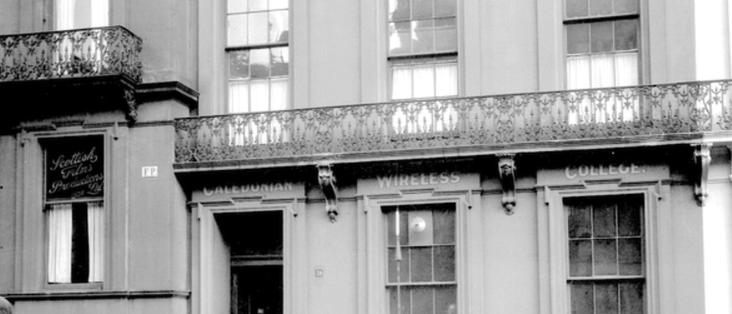
 Vivienne Dunstan


 From a Shed in Scotland