“Mangoes will make you forget anything but mangoes”*…

… Or not. As Christin Bohnke explains, sometimes a mango is more than just a mango…

What happens when ideologies are destroyed? When beliefs that shaped generations dissolve overnight? In the wreckage of old traditions, new symbols are created, and meaning is projected onto what was previously trivial. But not all of these new symbols are coherent or easily legible. Some are outright weird. Few events in history demonstrate the absurdity of political symbolism as clearly as the Mao Mango Mania that swept China during the infancy of the Cultural Revolution.

In 1966, Mao Zedong, Chairman of the Communist Party and China’s supreme leader, set in motion the Great Proletarian Cultural Revolution, a campaign to realign China with his revolutionary vision. His goal was to transform society, both economically and ideologically, by purging everything deemed traditional or capitalist. Over the next ten years, the Cultural Revolution changed the country in profound and painful ways, leading to more than a million estimated deaths as well as to immense human suffering.

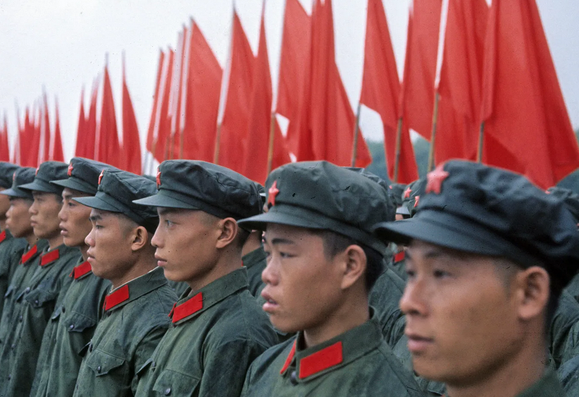
Historian Lü Xiuyuan describes the period between 1966 and 1968 as the most destructive years of the entire movement. Following Mao’s directive to destroy the “Four Olds” (ideas, cultures, customs, and habits), his paramilitary youth groups, the Red Guards, swept the country with violence. They identified, tortured, and killed so-called “counterrevolutionaries,” raided temples and schools, and destroyed priceless artifacts. In 1968, university campuses, middle schools, and other public spaces became the sites of bloody battles, not only between Red Guards and alleged counterrevolutionaries but also between revolutionary factions. The chaos of the “Red Terror” couldn’t continue indefinitely, so Mao determined that Chinese workers would help suppress the Red Guard, restore order, and continue the revolution in a more measured manner. In this endeavor, Mao was helped, improbably, by a box of yellow-fleshed fruit.

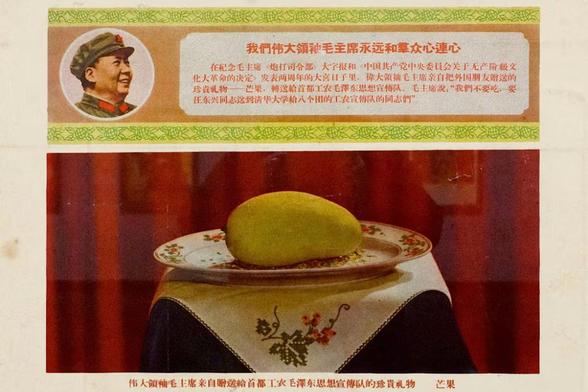
In August 1968, a visiting foreign minister from Pakistan, Mian Arshad Hussain, gave Mao a box of mangoes as a gift during a state visit. Presenting mangoes has a long tradition in Pakistan, but in China, the fruit was virtually unknown. Mao passed the box to workers occupying the Tsinghua campus in Beijing, who were attempting to control the Red Guards stationed there. The scholar of Chinese visual culture Alfreda Murck writes that the mangoes carried an implicit message: from now on, the workers, not the Red Guards, would be in charge of education and the transformation of China in Mao’s image.

According to Murck, even Mao could not have anticipated the consequences of his gift. Because the mangoes came from the supreme leader, they were transformed, in the eyes of the workers, from a simple fruit into an object endowed with attributes of the divine. William H. Hinton, the author of Fanshen, compiled eyewitness accounts of workers who reported staying up all night, touching the mangoes, and marveling at their new station as protégés of the Chairman. Using the momentum, the official party cadres concocted a propaganda campaign surrounding the mangoes, workers, and Mao, and in doing so, according to the political scientist Richard Baum, effectively signed “the death warrant of the Red Guards.”

Quickly, the Red Guards were disbanded, many of them sent for reeducation in the countryside where they labored and lived alongside rural peasants. By contrast, the workers who received Mao’s mangoes, a sign of his favor, were energized and became Cultural Revolution leaders. Yet, their promotion was an illusion. True power lay with the People’s Liberation Army. Despite, or because of that, the workers—and the mangoes—played a significant role in official propaganda in the months to come.

When the workers returned to their factories after putting down the Red Guards, Mao had a fresh mango delivered to them. Workers held welcoming ceremonies for the fruit, preserved it in wax, placed it on altars, and bowed to it when walking by. In one factory, the fruit was boiled down into sacred mango water; each devotee drank a spoonful. From there on, the cult of the mango escalated. Wax and even plastic mangoes were quickly produced in Chinese factories and appeared all over the country, often displayed in glass cases. Images of the mango adorned plates, wedding gifts, and cigarette packages. It was stitched onto blankets, and propaganda teams armed with wax replicas were sent into the remotest corners of the country to spread its lore. More than seventy different types of mango badges to stitch onto clothes were given away for free or sold at a low price to those who couldn’t afford more expensive mango-themed items. Alongside the mangoes were mentions of Mao’s selflessness and love for the people (though no reference to the fate of the Red Guards), and many badges bore the slogan “With each mango profound kindness.”…

… During the 1968 National Day parade in Beijing, the mango was front and center. At least three mango-themed floats participated in the parade, decorated with slogans that emphasized the significance of the working class, as well as a colossal white statue of Mao. The parade reinforced the importance of Mao as the supreme leader and the mango as a symbol of his power.

According to development studies scholar Xing Li, Mao viewed ideology as the primary means of mobilizing the masses and driving change, putting special emphasis on themes such as dedication, self-sacrifice, and hard work. The mango was a perfect vessel for Mao’s “love” for the workers. Unlike already established symbols such as the peony, peach, or pomegranate, the mango had no preexisting meaning in China and, importantly, no association with emperors or divinity. Quickly, rumors spread that mango trees only blossom every century—or every thousand years, according to others—and that eating the fruit would bring about a long life, similar to the peaches of immortality that feature prominently in Chinese legends. Mao’s refusal to keep the mangoes for himself was therefore seen as a great sacrifice on behalf of his people.

The veneration of the mango coincided with a high point in Mao’s personality cult. In the 1960s, one billion copies of the “Little Red Book,” a collection of Mao’s quotes, were printed. The book had to be waved and quoted at the beginning of each workday and whenever someone made a political statement. Mao was everywhere. And so were his mangoes. They became inextricably linked, and criticism of one meant criticism of the other. Murck tells of a dentist in Sichuan province, for example, who, after seeing a mango paraded through his town, said that the fruit resembled a sweet potato. He was arrested, tried as a counterrevolutionary, marched through the streets, and executed. His children were sent to the countryside for reeducation. Given the serious consequences of even the slightest criticism, it’s impossible to say how many people genuinely participated in the mango cult and how many complied out of fear.

Political movements need symbols to foster cohesion and emotional connection, but for these to thrive and remain, they must have at least some internal logic, cultural coherence, or tradition. The mango was an artificial symbol, created randomly, and the people’s devotion to the fruit must have been at least partially performative. By 1969, the mango cult had already begun to decline; it was no longer featured in official campaigns, although the sheer volume of mango-themed products ensured that it didn’t disappear entirely until the mid-1970s. After Mao’s death in 1976 and the 1980s reassessment of his personality cult, it became acceptable to discard mango ephemera that some Chinese still kept in their homes, or more prudently, to repurpose the wax mangoes as candles. Because the mango was so closely linked to Mao, it couldn’t remain a meaningful symbol without him.

Still, the mango as a political symbol never entirely faded. US-based Chinese author Ha Jin, who served in the Chinese army at the time of the Cultural Revolution and has been an outspoken critic of the Chinese government, wrote in his 2019 poem “A Sacred Mango:”

The mango was exhibited in the center of the hall.
We lined up to look at it
and to show our gratitude and respect.

But that night some curious child tasted the fruit
and was not caught.
Our mayor, frightened and outraged, said,
“Damn it, if I knew which son of a rabbit bit the mango
I would turn his whole family
into counter-revolutionaries!”

But what could we do?
We substituted a wooden mango for a real one.

For Ha Jin, as for others, the mango remains not a sign of Mao’s power, but a reminder of the Cultural Revolution’s absurdity and the arbitrary labeling of counterrevolutionaries. Despite being a short-lived propaganda tool, the mango’s symbolism endures as a testament to the irrationality of Mao’s extreme personality cult.

Commercial production of the mango in China began around that time, but only really accelerated in the 1980s. Although some people still recall the mango cult and spoke about it in their interviews with Murck, today the meaning of this particular fruit is largely forgotten, and the mango, far from symbolizing Mao’s eternal love and sacrifice for the working class, has transformed once again. This time, into a refreshing summer treat…

A fleeting cult built around a fruit exposes the logic, and illogic, of Mao’s personality cult: “When Mao’s Mango Mania Took Over China,” from @jstordaily.bsky.social.

* Eve Babitz

###

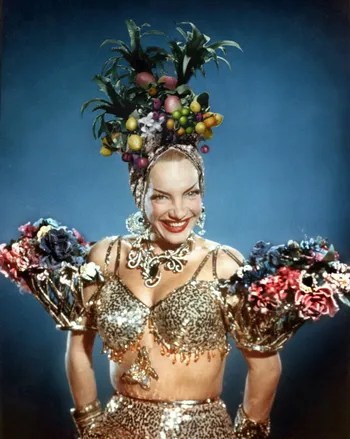
As we pare away the peel, we might send decorative birthday greetings to Maria do Carmo Miranda da Cunha; she was born on this date in 1909. Better known by her stage name, Carmen Miranda (and her nickname, “the Brazilian Bombshell”), she was a successful singer, dancer, and actress.

As a young woman, Miranda designed clothes and hats in a boutique before making her debut as a singer, recording with composer Josué de Barros in 1929. Miranda’s 1930 recording of “Taí (Pra Você Gostar de Mim),” written by Joubert de Carvalho, catapulted her to stardom in Brazil as the foremost interpreter of samba. In 1939 she was invited to Broadway by producer Lee Shubert, and quickly lured from there to Hollywood, where she made 14 films in as many years.

Miranda did much to popularize Brazilian music and raise American awareness of Latin culture, for which she has been honored (e.g., with a museum) in Brazil. Here, she is largely remebered for her style, in particular for her large “fruit hats.”

source

#Broadway #CarmenMiranda #cult #CulturalRevolution #culture #film #fruitHat #history #Hollywood #icon #mango #mangoes #Mao #MaoZedong #PeopleSLiberationArmy #personalityCult #RedGuard #RedGuards #samba

Life as a Red Guard in Revolutionary China – Interview with Red Guard Veteran Fred Engst [Part I]

China’s rise is reshaping the world. US hegemony is crumbling, and a “Chinese century” is no longer unthinkable. From socialist book clubs to US anti-communist think tanks, people rush to explain what China is and how it came to be.

Yet to understand China today, it is not enough to analyze GDP figures or geopolitics. You have to understand how the People’s Republic was forged, and above all, the upheaval that marked its most contested and transformative moment: the Cultural Revolution. To explore this history from the inside, [comra] sat down with Red Guard veteran Fred Engst in Beijing.

“[…] the Cultural Revolution was the most comprehensive, the longest-lasting, the most thoroughgoing, and the most in-depth experiment of the working class to explore how to be the real master of society,” Engst said.

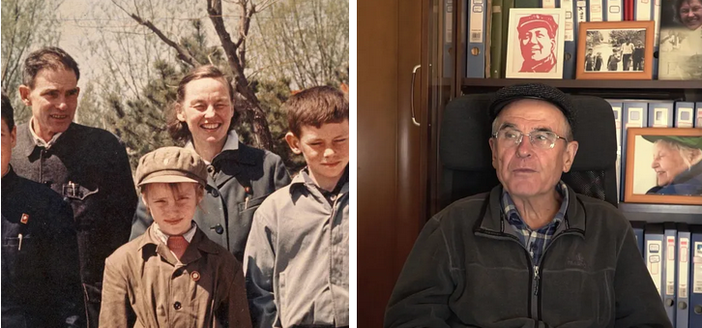
Known in China as Yang Heping, Engst was born in Beijing to American communist parents who joined the Chinese revolution in the 1940s. Raised on a state farm in the Chinese countryside, a Red Guard in his teens, a factory worker on both sides of the Pacific, and later an economist, Engst lived the Cultural Revolution before spending decades trying to understand it.

In the first part of this two-part interview, he reflects on his personal experiences, the lessons of that turbulent era, and why one of the most misunderstood periods of modern Chinese history still matters today.

Fred Engst with family in Beijing, 1960s & [comra] meeting Fred Engst in Beijing

[comra]: You grew up during revolutionary China’s most formative years. There are many misconceptions surrounding that era; what was it actually like to experience it firsthand?

Fred Engst: Well, it’s hard to ask fish to describe water, isn’t it? What I can say, of course, is in contrast to other experiences. What made China a revolutionary society was not that it kept on talking about the glorious past, but rather that it had to deal with the contemporary issues [it was facing]. And the Cultural Revolution was a case in point. That was really inspiring when I was in seventh grade […]

Young people generally tend to be rebellious, right? You know, middle school and high school kids are in their rebellious age. So they’ve been very easily drawn to this idea that we should not just learn through books. The reason we learn stuff in school is to become the rulers in society. Because the traditional Chinese idea is that rulers use their brains, and the people use their muscles. That’s the Confucian idea. We were rebelling against that kind of Confucian idea. Unfortunately, today, that’s the dominant idea.

What is socialism? How to achieve socialism? Is a peaceful transition from capitalism to socialism possible? And when you have socialism, how do you know you have socialism? These were the kind of debates that really excited the youth. And they wanted to make sure that China stayed on the socialist road rather than learning from capitalist society. That was the spirit of the students. And of course, that eventually led them to the workers and peasants. Once the working class overthrows capitalism, feudalism, and imperialism and sets up a new government, then the real issue becomes, how do you govern—how do you run the new society?

Factories have to be organized and coordinated, and agriculture has to be collectivized. But then, what is the relationship between the managers and the managed? What are their roles, and how does one become the manager? And how does one manage? Does one manage in the same way as the capitalists, or how is socialist management different from capitalism? These are very concrete day-to-day life experiences that people need to deal with.

Long story short, the Cultural Revolution was the most comprehensive, the longest-lasting, the most thoroughgoing, and the most in-depth experiment of the working class to explore how to be the real master of society. And that’s the significance of the Cultural Revolution. I witnessed that, and I saw all kinds of ups and downs.

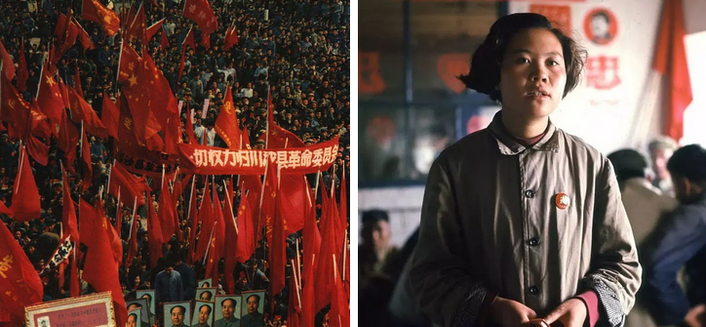
The “January Revolution” in Shanghai, 1967 & Chinese youth discussing political theory, 1968

[comra]: What makes the Cultural Revolution such an important topic in modern Chinese history?

Fred Engst: First, the New China brought education to the whole population. The writing of history was no longer a privilege only a few had. So we had a whole population that was able to write its own history. For today’s people to be able to study that history is an enormous amount of wealth of information. That is unprecedented.

This was the most complex struggle in human history—complex in the sense that every type of conceivable ideology in society today, any kind of ideology, had a chance to play. Then what kind of ideology really wins? And how do you reach consensus? The working class and peasantry were not born to know how to be the masters of society.

And how do you distinguish and correctly handle two very distinct types of contradictions? That between the working class and the old ruling class? That’s easy. You know who the old landlord was. You know who the old capitalist was. But what about the contradictions among the people?

There was a phrase during the Cultural Revolution called “capitalist roaders.” People in the leadership went down a capitalist road; people in the party—the authority—went down a capitalist road. But how do you know what a capitalist road is? It’s not like they had it written on their foreheads: “I’m a capitalist roader. Come on, shoot me.” Nothing like that. So how do you identify anybody in the leadership, whether they’re going down a capitalist road or a socialist road?

Of course, in hindsight today, we know what it is. But you have to go back in history and see what the actual struggle was—where was the fork in the road? And actually, on this road of building socialism, there are many, many forks. When people have different opinions—different ideas—does it make them capitalist? Or are they just people who have different opinions?

It is unimaginably complicated. Also, people born in the old society had all kinds of backward ideologies that they picked up as they were growing up. I mean, feudalism, imperialism, and capitalist ideology don’t just die away.

[A new society] has a lot of baggage from the old society—in ideology, in customs, in habits. Thus, the working class has to struggle and try to figure out what ideology—what kind of line and practice—is for the interest of the working class in the long term, and what is just for short-term benefits, or what is the leftover from the old society?

Basically, it comes down to the working class having to change itself in the process of changing society. These two things go hand in hand. And the big lesson—if I can say so now—is that the working class really needs to learn how to overcome factionalism within its own ranks. That’s what caused the demise of the Cultural Revolution, because once the working class rises up trying to be the master of society, they split into different factions and they ruthlessly fight each other. Some people resorted to violence, and in some places it was pretty brutal, pretty bloody.

Today, that’s all you hear about it. But you have to analyze it through the lens of that being the growing pain of the working class learning how to be the master of society. You cannot throw the baby out with the bathwater. There were a lot of mistakes made, but there was a lot of experience gained. It is a tremendous wealth of experience that needs to be summed up for any future working-class struggle, because we will make the same mistakes. History repeats itself. But once we learn this history, hopefully we can make fewer mistakes.

[comra]: What was the role of women in the Cultural Revolution?

Fred Engst: It’s not just about the Cultural Revolution alone, but the Chinese Revolution as a whole. You had the Chinese people who came from a long feudal society—the obedience to authority, the oppression of women, and the hierarchical way of society were very deeply ingrained.

And the Cultural Revolution provided a tremendous destruction of that kind of feudal weight and that oppression of women. The oppression of women was broken through land reform, through collectivization.

But also during the Cultural Revolution, you had so many women Red Guards and women rebels, and they were really just equally capable of challenging authority. And they were just totally free to do that. That has never before existed on such a mass scale.

[comra]: Looking back on your time as a Red Guard, what is one moment that sticks in your mind the most?

Fred Engst: In 1966, our family moved to Beijing, and after a while, I went with my cousin to a coal mining town, just like Red Guards would travel to a coal mining town. I stayed there for about three or four months. I was only 14. We went to the mines and worked with the miners.

So one day, another worker from a different mine came to our field and said, “God damn it, those conservative factions tore down and burned the national flag. They are counterrevolutionaries! We’ve got to go condemn them!”

So we all got excited. And then after work, we got off the mine, went to the bathhouse, cleaned up, changed our clothes, and marched to the coal mining headquarters. There were hundreds of workers, and they were all arguing and talking. I just went, “What happened? What happened? What happened?”

It turned out there were two factions of workers: one rebel and one conservative. And the conservative faction felt like the factory managers were revolutionaries, and that the others attacked them and were counterrevolutionary. The rebel faction said that the leadership were capitalist roaders and that they upheld the capitalist line, and that they were going to rebel against them.

The argument got heated up. So then the conservative faction got so angry with the rebel faction that they tore down the rebel flag and put it down on the floor. Turns out it wasn’t a national flag but the rebels’ flag. And the rebel said, “We are the revolutionaries. You tore down our flag and that defines you as reactionary.” It was just that logic.

Daily life during the Cultural Revolution, 1966-1976

So you can see, the working class needs to learn how to be the master of society, and there are these small issues. Because of the Cultural Revolution, people in China had a sense that they were the masters of society. So they dared to speak up, and they dared to criticize the leadership. They had what’s called big character posters.

But today, where’s the place for people to speak up other than on “election days”? You can support certain candidates, but have no arena, a space where people can discuss their schools, their factories, their farms, their institutions, a space where everything goes practically. I saw this in the factories, and I saw it in schools. You had your big character posters criticizing the leadership or some other faction—you had factional debates—and you put your poster up and the other guy says, “No, I don’t like that.” He writes something else and covers it up. It was so confusing. People had to sit through all these opinions and figure out what the real issue was.

That’s the relevance for China and the Chinese working class. They were determined to control their destiny. However, due to immaturity, they got stuck in factional infighting and let the capitalist roaders take over.

[comra]: Few modern historical narratives are as highly contested as the Cultural Revolution, but why?

These so-called capitalist roaders were also former revolutionaries. They made great contributions to the Chinese Revolution, the War Against Japanese Aggression, and the war against the Nationalists [Chinese Civil War]. So these were former revolutionaries, but later on, they treated the people as their subordinates. They saw themselves as the masters rather than the servants of the people. Class struggle in China built up to that extent—that sharp disagreement about which way to go forward for China.

China was a very backward agricultural society. Before 1949, roughly 80% of the population engaged in agriculture, and we had a very poverty-stricken society that went through a hundred years of warring warlords fighting each other and imperialists plundering China. So it was a country ravaged by imperialism and feudal warlords fighting each other. To then overthrow imperialism and capitalism was a big achievement. But thus, the people who joined the revolution before ‘49 had all kinds of reasons to join the revolution. They could be against feudalism, but not capitalism. They could be against imperialism, but not capitalism, and so on and so forth.

The revolutionary ranks were made up of people with all kinds of different ideologies, so that during the revolutionary war, it was not clear what their true motivation was, because everybody was fighting a common enemy. But once that common enemy was overthrown, the differences among the ranks within the so-called vanguard party—the differences in ideology—started manifesting themselves.

Then China started condemning the Cultural Revolution, and that made me realize, “Wait a minute. I understand why you condemn it. Because you were the target! You were the capitalist roaders. And that’s why you condemn it.”

You know, after the Cultural Revolution, there was something called “scarlet literature” and sobbing, crying about how [intellectuals] were mistreated by the Red Guards, by the Cultural Revolution, and the whole anti-intellectualism. I found that laughable and sad at the same time. Because part of all this so-called persecution against intellectuals was not done by the state. It was the infighting among the intellectuals themselves. I mean, imagine university professors fighting each other. Who do you blame?

[comra]: You jumped straight from the Cultural Revolution into the cold waters of the US. How can one imagine this drastic contrast?

Fred Engst: I found it really puzzling when I first went to the US. And in the US, they always praised themselves as champions of democracy and freedom. So I said, “Well, I experienced the Cultural Revolution. Why are you condemning the Cultural Revolution? Isn’t that democracy?” People responded, “No, it’s not.” And when I asked, “Oh, what is democracy then?” they just said, “Elections!”

Okay, if elections are democracy, then what about the factories? I mean, I experienced a real, lively, daily type of democracy. We argued, debated, and we talked about freedom. I mean, of course, there’s a limit to what you can freely say.

In the US, you can say anything you want, but you’re not free to criticize your boss. I mean, you could criticize your boss, but then you’d [be fired]. You’ve got to pay a price for it. So, I find it really puzzling when Western scholars, especially, are so into US democracy, freedom, and Western ideology, and condemn what was going on in the Cultural Revolution.

The portrayal of China as an authoritarian regime is so contrary to the daily lives of the people. And that’s what’s incredible. I was working in a factory during Mao’s period for five years, and then I went to the US, where I worked in a factory for more than a dozen years. And the contrast cannot be more startling. After my five years in that Beijing factory, I don’t have a single memory of the workers being afraid of the people in the leadership. When the factory managers and people in the top leadership came, the workers just said, “God, I haven’t seen you in a long time,” in a sarcastic tone, as in, “You are so divorced from the masses.”

To have an impact on what’s going on in the factory, you cannot just go by your own grievances. To have an impact, your grievances must be shared by a whole lot of people. So you have to have some kind of consensus among the workers, saying, “No, this is wrong.” Only then can you really make a change.

However, it was a revolution under the dictatorship of the proletariat. What does that mean? That means you could not challenge socialism. If you had said, “Down with the Communist Party, down with Mao,” you would have been condemned by the population. Before the cops would’ve come to arrest you, you would’ve been beaten [by the people]. People were really into defending the new society.

Mass rally in Beijing during the Cultural Revolution & Children in Yunnan Province studying the “Little Red Book”

[comra]: What do you think is the most dangerous or most common misconception about the Cultural Revolution era?

Fred Engst: Misconceptions? There are a lot of them. I’m not sure which one is the most dangerous. What does that mean? I think it depends. If you are on the side of capitalists, then of course you condemn the Cultural Revolution, that is the so-called “tyranny of the majority,” the lived experience of the “tyranny of the majority.” And if you’re afraid of the majority, it’s because you’re a capitalist; that I can understand. But if you are coming from a working-class perspective and condemn the Cultural Revolution, you are just totally misinformed.

I was really confused in the 80s and 90s because of what happened in China—all the denunciations of the Cultural Revolution, of Mao, made me wonder whether I was brainwashed, whether I was duped, whether I was just naive, whether I was just believing whatever I heard first and then sticking to it.

So I’ve been challenging and questioning my understanding [of the Cultural Revolution], but I cannot negate my experience. I cannot erase what I saw. Quite often, what we see is people calling it chaotic, crazy, almost like religious fervor. And all that means is that they don’t understand what happened.

They focus on Mao’s personality cult. But is that the main contradiction in Chinese society? It’s not, right? When we try to overthrow feudalism and feudal ideology, it doesn’t happen overnight. So the people who joined the revolution had all kinds of motives. And the workers who rebelled against the capitalist roaders might’ve quite often used feudal ideology as their weapon because that’s what they knew.

Okay, so you got to figure out what the main contradiction is. The working class and the movement can make all kinds of mistakes. You cannot hang on to that one mistake and denounce the whole movement. You have to step back and see, “Okay, overall, are they among the forces who pushed the working class towards greater emancipation, or are they hindering the working class towards its path to emancipation?

Source: Comra

https://abolitionmedia.noblogs.org/?p=26070 #asia #china #greatProleterianCulturalRevolution #history #maoism #redGuards
DOGE put a college student in charge of using AI to rewrite regulations - https://arstechnica.com/tech-policy/2025/05/doge-put-a-college-student-in-charge-of-using-ai-to-rewrite-regulations/ " The DOGE operative has been tasked with rewrites to the Department of Housing and Urban Development." #RedGuards 2.0
DOGE put a college student in charge of using AI to rewrite regulations

The DOGE operative has been tasked with rewrites to the Department of Housing and Urban Development.

Ars Technica
#BOTD: Yang Jiang 楊絳 (1911–2016), playwright and translator who produced the first complete #Chinese translation of #DonQuixote #唐吉訶德. Completed in the 1960s, it was confiscated by #RedGuards during the #CulturalRevolution #文化大革命 and only published in 1978. #ModernChina

"红卫兵 "是一个毛派邪教组织,其成员遍布美国各地。

该组织有许多与黑锤组织(Black Hammer)的相似之处,黑锤组织是最近另一个变成流行的毛派组织。

首先突出的一点是,这两个组织都痴迷于与其他左翼人士进行斗争。与“黑锤“相比,“红卫兵“的内讧更加有效,他们在打击Antifa运动失败后失去了大部分左翼的支持。

目前还没有系统性的调查,信息也不多。只能看到一些表面的特征,比如这类组织成员使用大量在线骚扰来针对其他不同意他们的活动家,以及一些自称为早期成员的证词关于内讧和特朗普主义等故事。

这里有一个项目页面,旨在收集相关资料和证词,有可能持续更新:

🧬 https://maoistcultexposed.wordpress.com/

#RedGuards #USA #Maoist

Ex- Red Guards and CR-CPUSA Hub

Sharing information and helping former members to heal.

Ex- Red Guards and CR-CPUSA Hub

Former members of Red Guards, a Maoist cult with groups across the US have written a post-mortem of the high control group.

There are many similarities here to Black Hammer, another recent Maoist cult that turned fash. The first thing that sticks out is both groups obsession with fighting other leftists. Infighting was more effective for Red Guards than Black Hammer, who lost most of their left-wing support after their failed campaign against antifa.

This is worth a read to learn red flags for high control groups. No one is immune from falling into a high control group like this.

https://maoistcultexposed.wordpress.com

#Cult #Maoism #Communism #RedGuards

Ex- Red Guards and CR-CPUSA Hub

Sharing information and helping former members to heal.

Ex- Red Guards and CR-CPUSA Hub

Looking for a video clip! Last seen on birdsite...

In 2020 Matt C Knight posted an entertaining video of somewhat excitable #CCP #RedGuards in full party mood having a blast in swinging late sixties London... at a typically chill British reporter. His account is now "protected" from public viewing.

Any twitter friends of Matt here? My youtube search for any such footage drew a blank, interestingly.

Text of the post: "Matt Knight on Twitter: "In Aug 1967 Red Guards stormed the British embassy in Beijing. This is what happened some days later when ITN reporter Bill Treharne Jones paid a visit to Xinhua News Agency’s London bureau."

https://twitter.com/MattCKnight/status/1249321033154338816

#culturalrevolution #xinhua #history #china

Tweet / Twitter

Twitter

Very interesting Reddit AMA threads from a former member of the violent Gonzaloite Maoist #cult that formed in Austin and a few other cities, formerly known as the "Red Guards," though they had MANY front groups. They apparently collapsed in March, which will be a relief to many who they victimized (including myself). https://www.reddit.com/r/AMA/comments/zawf3c/i_was_a_member_of_a_left_wing_political_cult_for/
https://www.reddit.com/r/cults/comments/zawgzw/i_was_a_member_of_a_left_wing_political_cult_for/

(this isn't leftist infighting or even me having a problem with communists, this was a legit destructive group that attacked people including myself for not following them. I really hope they are actually gone, as it will make organizing in Austin a million times easier)

#Activism #Austin #cults #RedGuards

I was a member of a left wing political cult for 6+ years, AMA

I am starting to get curious about what people want to know about my experience, what information may become useful for other people who have been...

reddit