Blaise Agüera y Arcas implemented a computational simulation of what amounts to the RNA world hypothesis using a modified form of brainfuck language to encode the evolvable information-carrying and self-replicating substrate as executable programs:

"Computational Life: How Well-formed, Self-replicating Programs Emerge from Simple Interaction" (2024)
https://arxiv.org/abs/2406.19108

Was quite the amusing talk that he gave - and even more amusing that someone noted his paper in brainfuck's wikipedia page.

#brainfuck #RNAworld #evolution

Computational Life: How Well-formed, Self-replicating Programs Emerge from Simple Interaction

The fields of Origin of Life and Artificial Life both question what life is and how it emerges from a distinct set of "pre-life" dynamics. One common feature of most substrates where life emerges is a marked shift in dynamics when self-replication appears. While there are some hypotheses regarding how self-replicators arose in nature, we know very little about the general dynamics, computational principles, and necessary conditions for self-replicators to emerge. This is especially true on "computational substrates" where interactions involve logical, mathematical, or programming rules. In this paper we take a step towards understanding how self-replicators arise by studying several computational substrates based on various simple programming languages and machine instruction sets. We show that when random, non self-replicating programs are placed in an environment lacking any explicit fitness landscape, self-replicators tend to arise. We demonstrate how this occurs due to random interactions and self-modification, and can happen with and without background random mutations. We also show how increasingly complex dynamics continue to emerge following the rise of self-replicators. Finally, we show a counterexample of a minimalistic programming language where self-replicators are possible, but so far have not been observed to arise.

arXiv.org
Scientists and Senators are Excited About the Sugars Found in the OSIRIS-REx Samples

It’s been over two years since the samples from Bennu gathered by OSIRIS-REx were returned to Earth. But there’s still plenty of novel science coming out of that 121.6 g of material. Three new papers were released recently that describe different aspects of that sample. One in particular, from Yoshihiro Furukawa of Tohoku University in Japan and their co-authors, has already attracted plenty of attention, including from US Senator (and former astronaut) Mark Kelly. It shows that all of the building blocks for early life were available on the asteroid - raising the chances that planets throughout the galaxy could be seeded with the abiotic precursors for life.

Universe Today

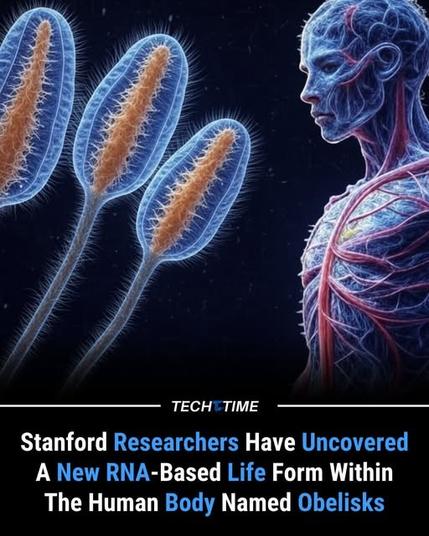
Scientists at Stanford have made a discovery that could change how we understand life itself. They have identified a previously unknown RNA-based life form residing in the human body. Researchers have given it a mysterious name: Obelisks.

This life form is unlike anything we have seen before. Unlike bacteria or viruses, Obelisks are RNA-based and do not fit into traditional categories of life. They seem to coexist within human cells without causing harm, and may even play a role in regulating cellular processes that we are only beginning to understand.

The discovery was made using highly advanced genomic and imaging techniques that allowed scientists to detect structures invisible to conventional microscopes. Early studies suggest that Obelisks may influence how our cells respond to stress and could even have a subtle effect on our immune system.

While the research is still in its early stages, scientists are fascinated by the potential implications. Understanding Obelisks could open entirely new fields of medicine and biology. Could they hold the key to combating certain diseases or unlocking hidden mechanisms of human physiology? The possibilities are intriguing.

Stanford researchers emphasize that much more work is needed to determine how these RNA-based entities interact with humans, and whether they are present in all individuals or only a subset of the population.

This breakthrough highlights how much we still have to learn about the microscopic world within us. Our bodies may be far more complex than we ever imagined, hosting life forms we are only now beginning to recognize. Obelisks could be the start of a revolution in understanding human biology and the invisible life that surrounds us.

Core discovery & science
#MedicalBreakthrough #LifeSciences #RNAResearch #FutureOfBiology #Microbiology

New life form & mystery
#Obelisks #HiddenLife #UnknownLifeForms #InvisibleBiology #RNAWorld

28-May-2025
Chemists recreate how #RNA might have reproduced for first time

https://www.eurekalert.org/news-releases/1085301 #science #astrobiology #RNAworld #OriginOfLife

Chemists recreate how RNA might have reproduced for first time

Chemists at UCL (University College London) and the MRC Laboratory of Molecular Biology have demonstrated how RNA (ribonucleic acid) might have replicated itself on early Earth – a key process in the origin of life.

EurekAlert!
Beautiful #RNA #macromolecular assembly complexes today in the #Science magazine, in a publication from #Sichuan University and other institutions, showing what may be relics of the #RNAworld. https://www.science.org/doi/10.1126/science.adv3451
RNAWorld

xkcd

The more you study #biology, the more you realize how complicated and weird the living world (and our living bodies) are.

Latest discovery is #RNA "obelisks": self-replicating strands of naked RNA that hijack RNA polymerase to make copies of themselves. Unlike RNA #viruses, they don't make a protein coat for themselves, but unlike plant #viroids, it looks like they might actually encode some proteins (likely to encourage RNApol to replicate their sequences).

These things are almost certainly a part of your personal biology, happily replicating themselves without you ever knowing. It's unclear what effects (if any) these things have on their hosts.

It's likely these are echoes of the origin of life, the primitive #RNAworld that predates #DNA and cellular life.

https://www.science.org/content/blog-post/what-s-obelisk-anyway

(Oh, and if you haven't discovered Derek Lowe yet -- welcome to his wonderful world! He's a treasure ... check out his "things I'll never work with" series for a good chuckle.)