 Lexmilian S. R. B. de Mello
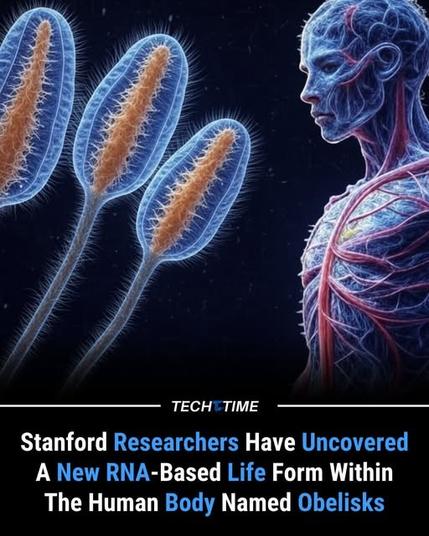
Scientists at Stanford have made a discovery that could change how we understand life itself. They have identified a previously unknown RNA-based life form residing in the human body. Researchers have given it a mysterious name: Obelisks.
This life form is unlike anything we have seen before. Unlike bacteria or viruses, Obelisks are RNA-based and do not fit into traditional categories of life. They seem to coexist within human cells without causing harm, and may even play a role in regulating cellular processes that we are only beginning to understand.
The discovery was made using highly advanced genomic and imaging techniques that allowed scientists to detect structures invisible to conventional microscopes. Early studies suggest that Obelisks may influence how our cells respond to stress and could even have a subtle effect on our immune system.
While the research is still in its early stages, scientists are fascinated by the potential implications. Understanding Obelisks could open entirely new fields of medicine and biology. Could they hold the key to combating certain diseases or unlocking hidden mechanisms of human physiology? The possibilities are intriguing.
Stanford researchers emphasize that much more work is needed to determine how these RNA-based entities interact with humans, and whether they are present in all individuals or only a subset of the population.
This breakthrough highlights how much we still have to learn about the microscopic world within us. Our bodies may be far more complex than we ever imagined, hosting life forms we are only now beginning to recognize. Obelisks could be the start of a revolution in understanding human biology and the invisible life that surrounds us.
Core discovery & science
#MedicalBreakthrough #LifeSciences #RNAResearch #FutureOfBiology #Microbiology
New life form & mystery
#Obelisks #HiddenLife #UnknownLifeForms #InvisibleBiology #RNAWorld