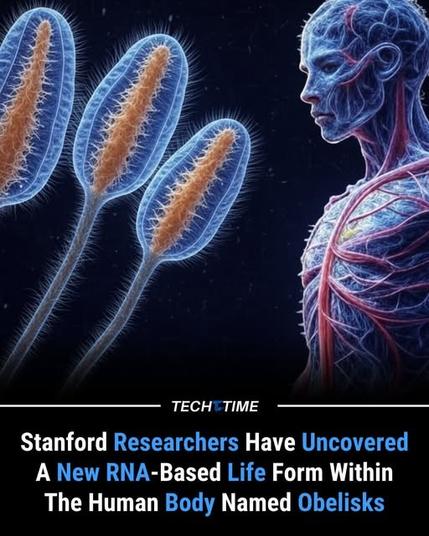
Scientists at Stanford have made a discovery that could change how we understand life itself. They have identified a previously unknown RNA-based life form residing in the human body. Researchers have given it a mysterious name: Obelisks.

This life form is unlike anything we have seen before. Unlike bacteria or viruses, Obelisks are RNA-based and do not fit into traditional categories of life. They seem to coexist within human cells without causing harm, and may even play a role in regulating cellular processes that we are only beginning to understand.

The discovery was made using highly advanced genomic and imaging techniques that allowed scientists to detect structures invisible to conventional microscopes. Early studies suggest that Obelisks may influence how our cells respond to stress and could even have a subtle effect on our immune system.

While the research is still in its early stages, scientists are fascinated by the potential implications. Understanding Obelisks could open entirely new fields of medicine and biology. Could they hold the key to combating certain diseases or unlocking hidden mechanisms of human physiology? The possibilities are intriguing.

Stanford researchers emphasize that much more work is needed to determine how these RNA-based entities interact with humans, and whether they are present in all individuals or only a subset of the population.

This breakthrough highlights how much we still have to learn about the microscopic world within us. Our bodies may be far more complex than we ever imagined, hosting life forms we are only now beginning to recognize. Obelisks could be the start of a revolution in understanding human biology and the invisible life that surrounds us.

Core discovery & science
#MedicalBreakthrough #LifeSciences #RNAResearch #FutureOfBiology #Microbiology

New life form & mystery
#Obelisks #HiddenLife #UnknownLifeForms #InvisibleBiology #RNAWorld
Obelisks, ancient Egyptian monuments, have transcended time and space to become recognizable landmarks worldwide. #ancientegypt #obelisks https://connectparanormal.net/2024/01/04/egyptian-obelisks-around-the-world-monuments-of-mystery-and-majesty/
Egyptian Obelisks Around the World: Monuments of Mystery and Majesty

Uncover the fascinating history and symbolism behind obelisks. Explore why these ancient monuments have become iconic landmarks worldwide.

Connect Paranormal Blog
Viroid-like “obelisk” agents are widespread in the ocean and exceed the abundance of RNA viruses in the prokaryotic fraction.
#Viroids #Obelisks #HammerheadRibozyme #Metatranscriptomics #UncorrectedManuscript
https://academic.oup.com/ismej/advance-article/doi/10.1093/ismejo/wraf033/8042533
New forms of life discovered inside human bodies
They resemble what scientists call #viroids, which are infectious loops of #RNA known for their effects on plants. #Obelisks share certain traits with these plant pathogens, yet they appear in human-associated bacteria. Their discovery came about when researchers began analyzing massive #genetic libraries, searching for patterns that did not match any known organisms.
https://www.earth.com/news/scientists-find-new-forms-of-life-inside-humans-rna-carriers-obelisks/
New forms of life discovered inside human bodies

Researchers find obelisks, mysterious RNA molecules in human bacteria that challenge our understanding of viruses and microscopic life.

Earth.com
Researchers just discovered an entirely new class of life living inside humans

Researchers say they have discovered an entirely new class of life inside the human body, and it is very similar to a virus.

BGR
Viroid-like colonists of human microbiomes

Here, we describe the “Obelisks,” a previously unrecognised class of viroid-like elements that we first identified in human gut metatranscriptomic data. “Obelisks” share several properties: (i) apparently circular RNA ∼1kb genome assemblies, (ii) predicted rod-like secondary structures encompassing the entire genome, and (iii) open reading frames coding for a novel protein superfamily, which we call the “Oblins”. We find that Obelisks form their own distinct phylogenetic group with no detectable sequence or structural similarity to known biological agents. Further, Obelisks are prevalent in tested human microbiome metatranscriptomes with representatives detected in ∼7% of analysed stool metatranscriptomes (29/440) and in ∼50% of analysed oral metatranscriptomes (17/32). Obelisk compositions appear to differ between the anatomic sites and are capable of persisting in individuals, with continued presence over >300 days observed in one case. Large scale searches identified 29,959 Obelisks (clustered at 90% nucleotide identity), with examples from all seven continents and in diverse ecological niches. From this search, a subset of Obelisks are identified to code for Obelisk-specific variants of the hammerhead type-III self-cleaving ribozyme. Lastly, we identified one case of a bacterial species ( Streptococcus sanguinis ) in which a subset of defined laboratory strains harboured a specific Obelisk RNA population. As such, Obelisks comprise a class of diverse RNAs that have colonised, and gone unnoticed in, human, and global microbiomes. ### Competing Interest Statement The authors have declared no competing interest.

bioRxiv

The last stop of our tour of Italy: Rome, 21 Oct 2024. We started at the Piazza del Popolo, the historic centre of Rome. It features the 'twin' churches, the Basilica di Santa Maria in Montesanto (Church of the Artists) [left] and the Church of Santa Maria dei Miracoli [right], the Museo Leonardo da Vinci with the Basilica of Santa Maria del Popolo behind it, and an Egyptian obelisk in the centre of the square.

#Photography #Rome #Italy #Churches #Museums #Obelisks

#RNA #Ambiviruses #Obelisks #Oblan

So there I was happily minding my own retired business and it was today o'clock that I read that a new form of proto-life has been discovered and published this year.

It will be very interesting to see the parsing of viroids, obelisks, prions, and other not-quite-viruses in the coming years. ...and how this relates to DNA plasmids.

Obelisk (biology) https://en.wikipedia.org/wiki/Obelisk_%28biology%29?wprov=sfla1

Obelisk (biology) - Wikipedia

Word Search Puzzle 960

Word List : #resiance #ustarana #cogwheel #obelisks #pres #artiad #remold #bugseeds #psalmist #glyoxal #wailaki #mammin #workably #weigela #coryl #keyaki #lilylike #tutorly

Kara Finance
A new virus-like entity has just been discovered – ‘obelisks’ explained

Your mouth and your gut is full of them. But we don’t know if they’re friend or foe.

The Conversation